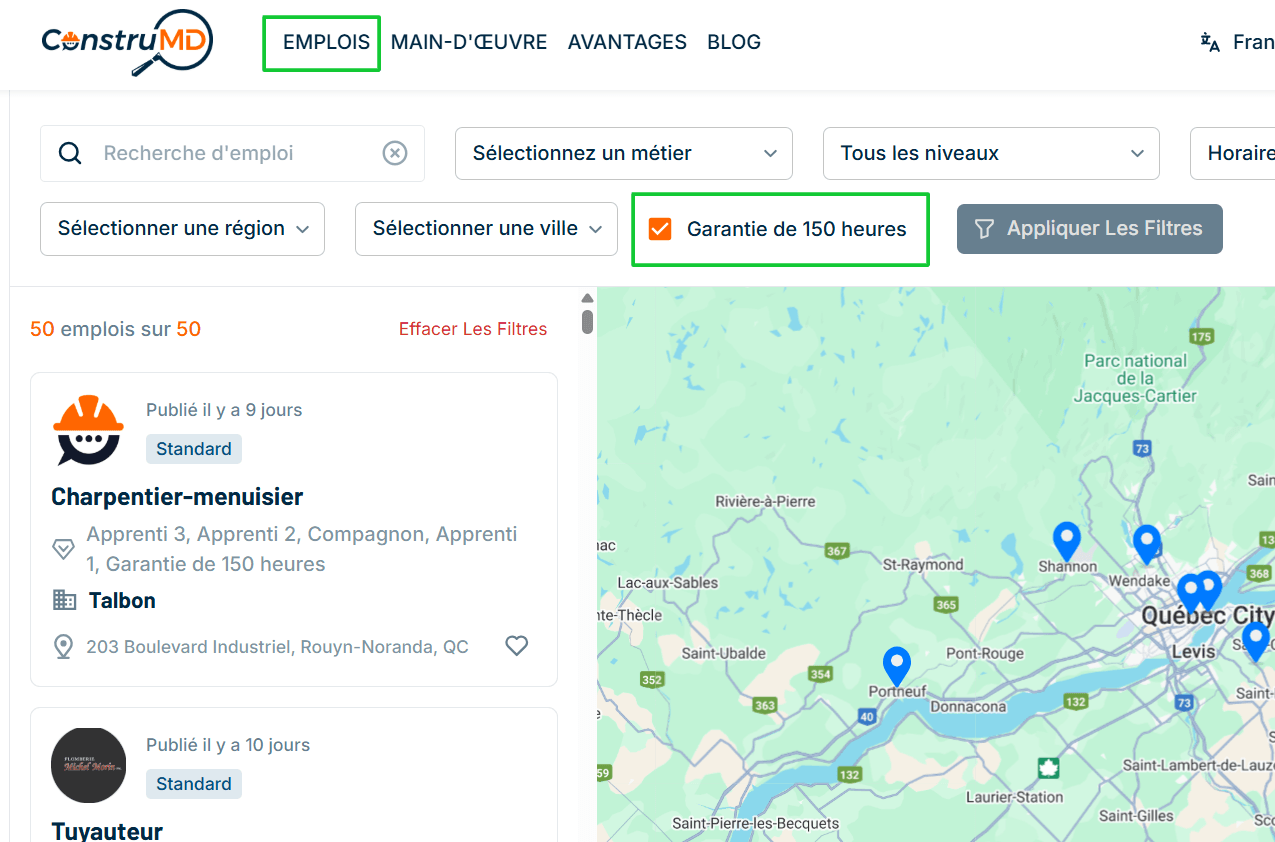
Easily find a 150h construction guarantee
ConstruMD
Nov 5, 2026
All Posts
SHARE THIS POST
Published : November 5, 2026
Working in construction without a diploma is possible and more accessible than you think.
You can get a job on a construction site by following a few simple steps, even without prior experience.
The labour shortage in this sector opens the door to many opportunities, provided you know the entry rules.
You will need to complete health and safety training to access the sites. Then, you must apply for your competency certificate according to the trade or occupation you are targeting.

Some positions are open year-round, but others depend on the opening of pools, which requires staying alert and ready to apply quickly.
Once hired, you will begin a mandatory apprenticeship program to develop your skills. This will not only help you keep your job but also allow you to progress to more qualified and better-paid roles over time.
You can work in the construction industry even without a diploma if you meet certain conditions.
The needs related to the labour shortage sometimes open doors, but access depends on specific rules and mandatory steps.
To start, you need to target a trade or occupation recognized by the Commission de la construction du Québec (CCQ).
Without a diploma, access is often through an apprentice or occupation competency certificate. This document authorizes you to work legally on construction sites.
You must also be ready to undergo mandatory training once hired. For example, an apprentice must complete at least 30 hours of relevant training each year to maintain their certificate.
Some occupations also require a general industry knowledge course, such as the CCGIC (60 hours in total).
In summary:

The construction industry manages hiring through labour pools.
These pools group candidates available for a trade or occupation.
You can only be hired if the pool for the desired position is open.
An opening occurs when there is a shortage of qualified workers or a labour shortage.
Openings are not announced long in advance. Therefore, you must regularly monitor updates from the CCQ or organizations like CSD Construction.
When a pool opens, you must act quickly: submit your application, present your documents, and obtain your certificate.
Tip: Prepare your file (identification documents, proof of residence, forms) before the opening.
The General Health and Safety on Construction Sites course is mandatory for anyone who wants to work on a construction site.
It usually lasts 30 hours and covers accident prevention rules, safe use of tools, and hazard identification.
Without this certificate, you cannot obtain your competency card or enter a construction site.
It is advisable to take this course even before the pools open. This allows you to apply immediately and avoid delays.
Many training centres and union organizations offer this course at a moderate cost or for free in some cases related to the labour shortage.
To work legally on a construction site in Quebec, you must hold a competency certificate issued by the Commission de la construction du Québec (CCQ). This document proves that you are authorized to practice a trade or occupation in the construction industry. The procedures vary depending on your situation and experience.
If you do not have a diploma or training, you can apply for an Occupation Competency Certificate (CCO). This certificate is intended for labourers and specialized labourers.
Access is often possible during a labour pool opening, when the CCQ identifies a shortage of workers. You must then meet certain criteria, such as being immediately available and residing in Quebec.
In some cases, your employer can request an exemption if no qualified worker is available. This request must be justified and approved by the CCQ before your hiring.
To apply, you must complete an official CCQ form and provide supporting documents. Common documents include:
The application can be submitted online or in person at a regional CCQ office. Administrative fees apply and must be paid at the time of application.
Ensure all documents are up to date and legible, as an incomplete file may delay the issuance of the certificate.
Once hired with a competency certificate, you must adhere to the rules of the construction industry. This includes complying with health and safety standards, collective agreements, and established schedules.
You must also keep your card valid. This may involve renewing certain training or paying periodic fees to the CCQ.
In case of a change of employer or trade, you may need to update your certificate. Failure to comply with these obligations may result in the suspension or withdrawal of your right to work on construction sites.
Some roles in construction do not require a diploma or extensive training. They mainly rely on your ability to learn quickly, follow safety instructions, and work physically on-site.
These positions can be a gateway to more specialized trades if you choose to pursue training later on.
As a labourer, you perform various tasks to support specialized teams. You may transport materials, clean work areas, and prepare tools.
This role requires physical endurance and a good understanding of safety rules. You must wear personal protective equipment (PPE) such as a helmet, boots, and gloves.
Schedules can vary depending on the sites. You often work outdoors in changing weather conditions.
A labourer can progress to more qualified positions, such as carpenter or mason, by following training recognized by the Commission de la construction du Québec (CCQ).
The plumber's helper assists the plumber in installing and repairing plumbing systems. You transport and prepare materials, hold tools, and help lay pipes.
You learn on the job by observing and replicating technical gestures. This position requires precision and strict adherence to safety and hygiene standards.
Other helper roles exist, such as electrician's helper or carpenter's helper. In all cases, you work under the supervision of a qualified professional.
These roles can lead to a competency certificate if you accumulate the required hours and complete mandatory training.
The site labourer prepares and organizes the construction site. You may mix concrete, move equipment, set up scaffolding, or help install temporary structures.
You must pay attention to foremen's instructions and be able to handle heavy loads safely. Coordination with other trades is essential.
This role is often one of the first you can take on in a construction job without prior training. With experience, it can pave the way to more technical trades.
Once hired in the construction industry, you must complete certain training to maintain your competency certificate. These trainings vary depending on whether you are an apprentice or hold an occupation position.
They are governed by specific rules and must be completed within set deadlines.
If you hold an apprentice competency certificate, you must complete a minimum of 30 hours of training each year.
Only training related to your trade's study program is recognized by the Commission de la construction du Québec (CCQ).
This requirement applies until you obtain the journeyman competency certificate.
Tracking these hours is essential, as a delay or lack can result in the suspension of your certificate.
Here are some key points:
You can take these courses through accredited organizations or via programs offered on-site, depending on availability.

If you hold an occupation competency certificate, you must take the General Industry Knowledge Course (CCGIC).
This course includes two parts:
The CCGIC provides an overview of the rules, rights, and responsibilities in the sector.
It also helps you better understand the working conditions and obligations related to your job.
Meeting these requirements is necessary to maintain your right to work on construction sites.
In addition to mandatory training, you have access to over 500 free training courses listed in the Proud and Competent program.
These courses may cover:
They can be conducted online, in a classroom, or directly on-site.
Even if they are not required for your certificate, they can enhance your skills and job prospects.
Some training is funded or offered during working hours, reducing the impact on your schedule.
The labour shortage in the construction sector is changing how employers recruit and train. It creates openings for candidates without complete training, but it also concentrates demand in certain regions and specific trades.
When companies lack qualified workers, they often broaden their recruitment criteria.
This can allow you to access a construction job even without a diploma or direct experience in the trade.
Some employers now offer internal training or retraining programs.
These programs can last from a few weeks to several months and allow you to acquire basic skills while working.
You can also find positions where tasks are adapted for beginners, such as:
| Job Type | Required Training Level | Training Offered by Employer |
|---|---|---|
| Labourer | None | Yes |
| Carpenter's Helper | Low | Yes |
| Construction Logistics Officer | Variable | Sometimes |
However, this openness is more frequent in sectors where recruitment pressure is highest, such as residential construction or infrastructure work.
Demand is not uniform across the territory.
Some regions, particularly those with high population growth or large public projects, offer more jobs accessible without prior training.
For example, metropolitan areas and zones near major road or industrial projects are recruiting heavily.
Employers there are more inclined to hire candidates to train on-site.
The trades most affected by the labour shortage include:
In these positions, initial training can be short and done directly on the field, reducing the entry barrier for you.
To enter a construction job without training, you need to prepare your documents in advance, stay alert to official announcements, and connect with potential employers. These actions increase your chances of quickly securing a position when opportunities arise.
A well-prepared file allows you to react quickly when labour pools open.
It should contain your identification documents, your contact information, and, if possible, a 150-hour employment guarantee over three months provided by an employer.
Include your ASP card if you have already taken the health and safety course on construction sites.
If not, plan to take this 30-hour training as soon as possible.
Organize your documents in a clear format, both paper and digital, to be able to send them quickly.
A complete and ready-to-use file puts you in a favourable position when demand is high.
The labour pools of the Commission de la Construction du Québec (CCQ) can open at any time, sometimes for just one day.
Regularly check the CCQ website to know the status of pools by trade and region.
Understand the three status levels:
By closely following this data, you can act as soon as an opening arises.
A quick response is often the key to obtaining a competency certificate.
Finding an employer willing to guarantee 150 hours is essential to access a construction job without a diploma.
Start by targeting active companies in your area and contact them directly.
Use platforms like ConstruMD or specialized agency websites to spot offers.
Also, participate in job fairs and building-related events to expand your contacts.
Maintain your professional relationships by staying in touch with recruiters you meet.
A strong network increases your chances of being recommended or informed of a position before it is published.
In the construction industry, you can progress to more qualified positions even if you start without a diploma. Basic jobs often serve as a stepping stone to specialized trades that are better paid and more stable. The key is to combine practical experience, mandatory training, and recognized certifications.
As a labourer, you perform simple tasks under supervision. This role allows you to understand work methods and safety rules on a site.
To become a journeyman, you must obtain an apprentice competency certificate. This involves completing recognized training and accumulating a defined number of practical work hours for your trade.
For example, a future plumber must complete a structured apprenticeship program. You work alongside experienced journeymen, allowing you to learn directly on the field.
Once the required hours and training are validated, you take the qualification exam. Passing it grants you journeyperson status, with more responsibilities and a higher salary.
Specialized trades like plumber, electrician, or carpenter offer better salary prospects and a constant demand in most regions.
To access them, you often need to:
Some trades also require particular physical or technical skills. For example, a plumber must know how to read plans, install piping systems, and comply with current plumbing codes.
The advantage is that these trades are less affected by automation and offer long-term job opportunities in the construction industry.
The construction site is your main learning environment. You develop practical skills there that classroom training cannot always offer.
Programs like Proud and Competent offer more than 500 free training sessions. This allows you to improve your techniques and stay updated on new methods and tools.
As an apprentice or occupation, you must meet continuing education requirements. For example, an apprentice must complete at least 30 hours of training per year to maintain their certificate.
These training sessions, combined with daily experience, enhance your autonomy and increase your chances of advancing to more qualified positions.
Some construction professions remain accessible even without a diploma or prior experience, provided you meet legal requirements and follow certain basic training.
The rules vary depending on the trade, region, and labour needs in 2025.
You can access various positions such as labourer, carpenter's helper, or specialized labourer.
These jobs often only require the Health and Safety on Construction Sites course (ASP).
The labour shortage in 2025 opens more doors for women in several trades.
In most cases in Quebec, you need a competency certificate issued by the CCQ.
However, when pools open for a trade in shortage, you can obtain this card without a prior diploma.
You must then submit your application quickly.
If the position does not fall under the CCQ's jurisdiction, you can be hired directly by the employer.
This is the case for certain maintenance work, minor renovations, or off-site manufacturing.
These jobs do not grant access to CCQ-regulated sites.
Yes, several short training programs are offered by Emploi-Québec, vocational training centres, and some unions.
They can last from a few days to a few weeks and are often free or subsidized.
They allow you to quickly obtain the mandatory certifications to work on a construction site.
Trades like labourer, tool operator, carpenter's helper, or road labourer are accessible without a diploma.
Wages can exceed $25 per hour after a few months, depending on collective agreements.
The experience gained can also lead to better-paying positions.
You cannot work as a qualified electrician without following the official apprenticeship program.
However, you can start as an electrician's helper if a pool is open and you obtain your apprentice certificate.
You will then need to complete the required training and practice hours.
You might like
ConstruMD
Nov 5, 2026

ConstruMD
Nov 5, 2026
ConstruMD
Nov 5, 2026