The Most In-Demand Construction Jobs in Quebec (2025)
In 2025, the construction sector in Quebec is facing an unprecedented labour shortage. The Commission de la construction du Québec (CCQ) estimates that an average of 13,500 new workers will need to be recruited each year until 2026 to support the industry (source).
In total, approximately 310,000 new workers will be required between 2020 and 2029 to meet the needs, largely due to numerous retirements (source).
This employment market tension is expected to continue in the medium term: according to the CMHC, 860,000 homes will need to be built by 2030 to meet demand in Quebec. In this context, several construction trades are particularly in demand.
Here is a ranking of the most in-demand trades in 2025 in Quebec, with each trade's sector, outlook, required training, key skills, and average salary.
1. Carpenter-Joiner
The trades hiring in construction vary by region; active job postings provide a more concrete picture of the market.
The trade of carpenter-joiner tops the list of the most sought-after construction trades in Quebec. It was at the top of the list of professions with a labour shortage in the province (source).
Carpenters-joiners work on both residential sites (house frames, roof structures, drywall) and commercial and industrial sites (concrete formwork, wood or metal structures).
The strong demand for new housing particularly fuels the need for carpentry in the residential sector. With the ambitious goal of building hundreds of thousands of new homes by 2030, the demand for this trade will remain high in the long term.
In-demand sectors:residential construction (houses, apartment buildings) and institutional/commercial (structures, formwork).
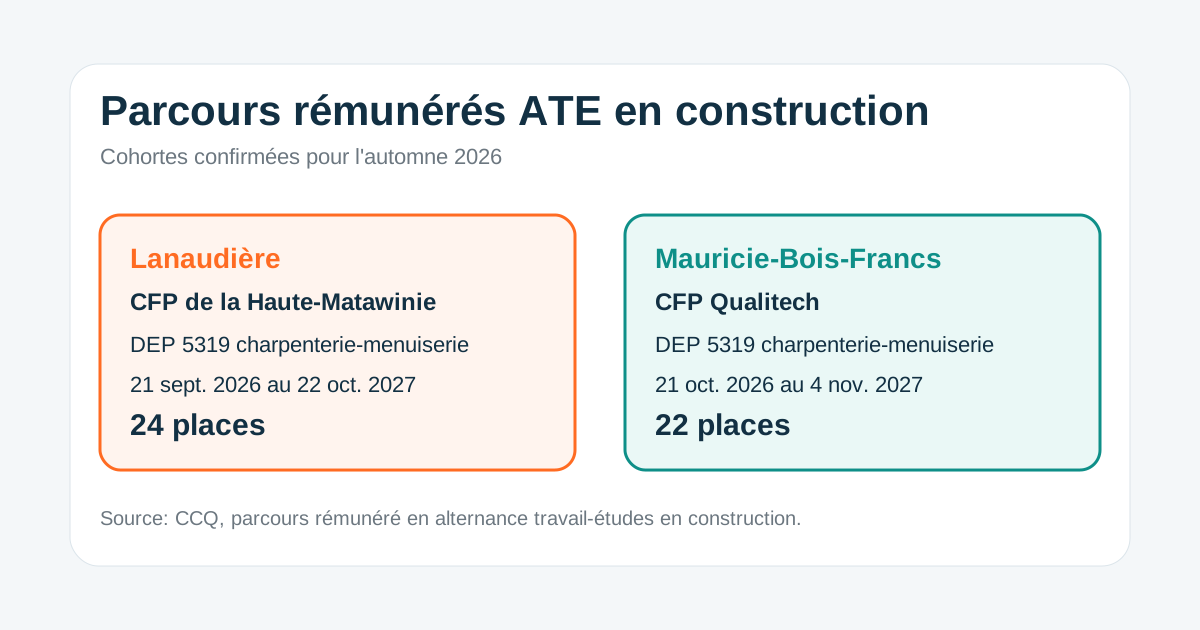
Required training: DEP in carpentry-joinery (approximately 1,350 hours of training) and obtaining the CCQ competency certificate. A candidate can also enter the market through the opening of pools with a guarantee of 150 hours of work.
Key skills: excellent manual dexterity, blueprint reading, teamwork aptitude, attention to detail, and good physical condition.
Average salary: approximately $33 per hour (median) in Quebec, with a maximum reaching $40 to $42/hour for experienced journeymen (source). A journeyman carpenter-joiner in the commercial sector can earn around $42 per hour according to the collective agreement.
2. Plumber
Plumbers are among the most in-demand trades in Quebec construction.
Whether for new construction or renovation, their skills are essential in both residential (houses, apartments) and commercial/industrial (commercial buildings, factories) settings for the installation and repair of plumbing, heating, and gas systems.
The shortage of qualified plumbers is such that this trade is likely to experience a labour shortage until 2032, due to insufficient new recruits (source).
The needs are heightened by the growth of real estate projects and the replacement of retiring plumbers.
In-demand sectors:residential (residential plumbing, domestic heating) and commercial/industrial (plumbing and heating systems for buildings, factories, and public infrastructure).
Required training: DEP in plumbing and heating (approximately 1,680 hours, ~17 months of training) followed by on-site apprenticeship. The plumber must hold a CCQ competency certificate once graduated.
Key skills: good physical condition, ability to read plans and diagrams, knowledge of mathematics (measurements, volumes, pressures), dexterity and precision, adherence to safety standards.
Average salary: the median hourly wage for a plumber in Quebec is about $38. Generally, plumbers earn between $20 and $43 per hour depending on their experience and region (source). Experienced journeymen often approach the higher range ($40/hour), which corresponds to an annual salary of around $80,000.
3. Electrician (construction)
Construction electricians are also highly sought after. The Quebec government's labour market balance report indicated as early as 2022 that the trade of electrician (excluding industrial and network electricians) was in labour shortage in 13 out of 17 regions in Quebec, with a critical lack of professionals until 2025 (source).
In construction, electricians work on installing electrical networks in residential, commercial, and industrial buildings, as well as on infrastructure sites. The energy transition and the growing popularity of electrical systems (charging stations, smart buildings) also increase the demand.
The trend is expected to continue beyond 2025 with workforce renewal: this trade is among those with the highest apprenticeship enrolments to meet future needs.
Sectors in Demand:residential (electrical networks for new homes, renovations), commercial and industrial (building electrical installations, public lighting systems, infrastructure).
Required Training: DEP in electricity (approximately 1,800 hours, ~18 months of training) followed by apprenticeship regulated by the CCQ. The electrician must hold a competency certificate (apprentice then journeyman) issued by the CCQ.
Key Skills: excellent logical and mathematical sense, ability to read electrical plans and diagrams, rigor in applying safety standards, dexterity and good colour vision (for wires), ability to work at heights or in confined spaces.
Average Salary: generally between $24 and $44 per hour for a construction electrician in Quebec (source). A journeyman electrician often earns around $80,000 per year working full-time (about $40-45/h). Apprentices start around $24-25/h and see their hourly rate increase with each apprenticeship period.
4. Cement Finisher
Concrete specialists, cement finishers are among the most in-demand trades, just after carpenters according to recent data.
They play a crucial role in the construction of concrete structures: preparing and pouring floor slabs, foundations, concrete walls, finishing sidewalks, outdoor slabs, etc.
They also apply coatings and waterproofing products. Cement finishers are mostly found on large commercial, institutional, and civil engineering (roadwork) sites, as these projects require the most concrete work.
The seasonality of the trade (reduced activity in winter) does not prevent strong demand, supported by numerous ongoing infrastructure and public building projects.
The outlook until 2030 remains very favourable, as new concrete structures (bridges, roads, buildings) will need to be maintained and built to meet the population's needs.
Sectors in Demand: mainly institutional and commercial (buildings, schools, hospitals, shopping centres) and civil/industrial engineering (roads, bridges, factories) – less commonly light residential.
Required Training: DEP in concrete preparation and finishing (900 hours of training, ~7 to 8 months) or apprenticeship path via CCQ pools. The cement finisher competency certificate (apprentice then journeyman) is mandatory to work on sites.
Key Skills: good physical endurance, technical knowledge of concrete properties (setting time, mixes), ability to handle vibrating and smoothing tools, plan reading, meticulousness for quality finishing, adherence to health and safety rules (postures, chemicals).
Average Salary: the median salary of a cement finisher is about $34 per hour in Quebec. In the commercial sector, a journeyman earns around $41/h (according to agreements), while a starting apprentice in residential begins at $26-27/h. Over a year, a busy journeyman cement finisher can earn over $55,000.
5. Bricklayer-Mason
Bricklayer-masons are in high demand to meet the needs of building construction and renovation.
They lay bricks, masonry blocks, stones, and other cladding materials on walls and facades. This trade is in high demand in Quebec, driven by the construction of buildings with multiple brick or masonry facades, as well as the restoration of built heritage (renovation of brick buildings, restoration of old masonry).
Both the residential sector (apartment buildings, condos, townhouses) and the commercial/institutional sector (schools, public buildings, shopping centres) heavily rely on bricklayer-masons.
With the expected construction boom by 2030, new entrants are encouraged in this trade to fill the many available positions.
Sectors in Demand:residential (house masonry, condos, multifamily) and commercial/institutional (building exterior walls, commercial buildings, firewalls, etc.). Renovation and architectural restoration also call for qualified masons.
Required Training: DEP in bricklaying-masonry (approximately 900 hours of training). After the DEP, the new apprentice must obtain their CCQ competency certificate and complete an apprenticeship of 3 periods (about 6,000 hours of work) before becoming a journeyman.
Key Skills: sense of alignment and precision, good spatial perception, manual dexterity to handle bricks and mortar, physical endurance (working on scaffolding, heavy loads), aesthetic concern for uniform finishes.
Average Salary: the median hourly wage is around $36. Generally, a bricklayer-mason earns from $23 to $42 per hour depending on experience and status. Experienced journeymen approach the higher range ($40+/h), which corresponds to over $75,000 per year when they accumulate enough hours.
6. Sheet Metal Worker (Tinsmith)
The trade of sheet metal worker – also known as tinsmith – is also experiencing a labour shortage. Sheet metal workers are among the most in-demand construction trades currently in Quebec.
These specialists work with sheet metal to manufacture and install various elements: ventilation ducts, air conditioning and heating systems, chimneys and exhausts, metal exterior cladding, gutters, and sheet metal roofs, etc.
With the growth of commercial and institutional constructions requiring significant ventilation and air conditioning systems, sheet metal workers are in high demand.
The residential sector also needs them for the installation of ducts (e.g., air exchangers in new homes) or the installation of increasingly popular metal roofs.
Job prospects are excellent according to the CCQ, which recently ranked this trade among those offering the best career opportunities in construction (source).
Sectors in demand: mainly the commercial and institutional sector (installation of ventilation/air conditioning systems in commercial buildings, office towers, hospitals, schools) and industrial (factory ventilation). In residential, sheet metal workers are called upon for ventilation/heating ducts and metal roofing.
Required training: A DEP in sheet metal work (approximately 1,605 hours of training, or ~12 to 14 months) is mandatory to practice. It is also possible to enter the trade through the opening of pools (150 guaranteed hours) followed by obtaining the CCQ competency certificate.
Key skills: ability to read mechanical plans (HVAC systems), know how to measure and cut metal precisely, basic welding skills to assemble parts, manual agility, frequent work at heights (roofs, ceilings), and good physical fitness.
Average salary: as a journeyman sheet metal worker, the average annual salary was about $66,465 in 2022 (source), which corresponds to an hourly rate of around $32 to $35 (depending on the number of hours worked). Hourly rates generally range from $25 to $45 for sheet metal workers in Quebec, depending on experience and sector. The most experienced can reach nearly $47/h in some regions.
7. Refrigeration Mechanic
With the development of modern air conditioning and refrigeration systems, the refrigeration mechanic is another trade in high demand.
It appears in the top 10 construction trades hiring, according to Indeed and other sources (source).
Refrigeration mechanics install, maintain, and repair refrigeration and air conditioning systems in commercial buildings (office buildings, data centres, grocery stores, arenas), industrial (cold storage warehouses), and sometimes high-end residential.
The trend towards air conditioning in new constructions, combined with the need to replace old systems with more energy-efficient equipment, boosts employment in this field.
By 2030, demand is expected to remain strong as almost all new commercial and multi-residential buildings incorporate sophisticated HVAC (heating, ventilation, air conditioning) systems requiring qualified refrigeration mechanics.
Sectors in demand: mainly the commercial sector (shopping centres, offices, businesses with cold rooms) and industrial (food processing plants, refrigerated warehouses). Some refrigeration mechanics also specialize in residential systems for heat pumps and central air conditioning.
Required training: A DEP in refrigeration (approximately 1,800 hours of training, ~20 months). After the DEP, the new refrigeration mechanic must complete practical training under the supervision of journeymen and obtain their CCQ competency certificate to work on construction sites.
Key skills: solid understanding of thermal principles (refrigeration cycles, refrigerant gases), ability to safely handle pressurized compounds, electrical skills (refrigeration systems have electrical components), troubleshooting, work at heights or in cramped mechanical rooms, and environmental certifications (handling refrigerant gases).
Average salary: refrigeration mechanics typically earn between $21 and $45 per hour in Quebec (source). The average annual salary for a refrigeration mechanic is around $55,000 to $60,000 (or ~$28/h) for an intermediate level of experience (source). In major urban centres, an experienced journeyman refrigeration mechanic can easily exceed $35 to $40/h, especially if they hold several specialized certifications.
8. Building Painter
Building painters are essential during the finishing phase of construction sites and are among the sought-after trades in 2025.
Every new construction or major renovation requires painters for walls, ceilings, woodwork, and other surfaces.
In Quebec, demand is strong in both residential (numerous condo projects, new homes or home renovations) and commercial (office, retail space) and institutional (painting schools, hospitals, etc.).
The labour shortage also affects this manual trade, as it attracts fewer young people and requires good expertise to achieve a professional result.
Nevertheless, the prospects remain good: sustained construction activity until 2030 ensures a constant flow of sites to paint, and many senior painters will retire by then, creating positions to fill.
Sectors in demand:residential (new and interior/exterior renovations of houses and apartments), commercial and institutional (interior painting of public buildings, commercial premises, metal structures, etc.).
Required training: A DEP in building painting (900 hours of training, ~8 months) is recommended. Although the trade is accessible without a diploma through direct on-the-job training, formal education accelerates access to journeyman status. The painter must also obtain their CCQ competency certificate to work on regulated construction sites.
Key skills: attention to detail and impeccable finishing, knowledge of different types of paints and coatings (acrylic, epoxy, stain, wallpaper), surface preparation (plaster, sanding, primer), dexterity and speed of execution, absence of vertigo (working on ladders/scaffolding), and a good sense of aesthetics for colour coordination.
Average salary: Building painters generally earn between $22 and $41 per hour in Quebec. The average salary is around $25 to $30/hour, which is approximately $50,000 to $60,000 per year for an experienced painter. Apprentices start near the minimum (~$22-25/hour) and the hourly rate increases with experience and skills.
9. Construction Site Manager / Project Director
With the increase in construction sites, the role of construction site manager (also known as site director, site foreman, or foreman depending on the level) has become crucial and highly in demand.
Construction companies struggle to recruit enough experienced supervisory staff to oversee work, coordinate teams, and ensure deadlines are met.
This profile is among the sought-after trades in 2025 in the industry. A competent construction site manager ensures projects are delivered on time and within budget, an essential asset in the face of the construction boom.
The institutional and commercial sectors particularly generate opportunities, as large-scale projects (hospitals, office towers, large residential complexes) require several site managers.
The demand will remain strong until 2030, especially as many baby boomer site managers retire, necessitating the rise of the next generation.
Sectors in demand:institutional and commercial (large sites requiring complex management), industrial (specialized sites, factories), and also residential multi-housing (condo projects, residential towers).
Training/experience: There is no single path, but most site directors are former journeymen in a trade (carpentry, civil engineering, etc.) promoted after several years, or graduates in construction project management (DEC, BAC). Additional training in health and safety on construction sites and team management is a plus. The position generally requires a health and safety certification (CCSST card) and, for roadwork, ASP training.
Key skills: solid technical experience on construction sites, leadership and communication skills to manage teams, organizational skills to plan project stages, knowledge of building codes and standards, stress management, and real-time problem-solving. Proficiency in project management software is also increasingly in demand.
Average salary: An experienced site foreman or project director earns a high salary. On average, it's about $110,000 per year for a project director in Canada (source), which is around $50 to $60/hour. In Quebec, a beginner in a foreman role can start between $75,000 and $90,000 annually, while an experienced manager on large projects can exceed $130,000 per year. These positions often include benefits (vehicle, bonuses) that enhance compensation.
10. Crane Operator
Finally, crane operators – construction crane operators – are among the most prominent and sought-after trades for 2025.
Every major building or civil engineering site needs crane operators to move heavy materials at height or over long distances.
The modernization of infrastructure and the construction of condo or office towers create a demand for this specialized trade.
In Quebec, a shortage of experienced crane operators is even anticipated: forecasts indicate a shortage of new journeyman crane operators by 2032 if the next generation is insufficient (source). This demanding trade includes mobile crane operators, tower crane operators, or concrete pump operators, with active sites across the entire industrial, commercial, institutional, and civil spectrum.
Safety is a crucial aspect of their work. The medium-term prospects are excellent, as major projects (bridges, highway interchanges, skyscrapers) planned by 2030 will all require certified crane operators.
Sectors in demand:civil engineering and major works (construction of bridges, dams, roads – mobile cranes), commercial and institutional building (high-rise buildings – tower cranes), industrial (mining sites, factories – mobile and fixed cranes). The small-scale residential sector uses few crane operators, except for certain large buildings.
Required training: professional training in a company or specialized center to become a crane operator. In Quebec, one generally needs to follow an apprenticeship program under the aegis of the CCQ after obtaining a job as an apprentice crane operator (there is no specific DEP for crane operators, training is done on the job with specialized courses, notably the CCQ training program). The candidate must pass a qualification exam to obtain their journeyman crane operator competency certificate. A specialized driver's license (class 1 or 3 driver's license) is often necessary to operate mobile cranes.
Key skills: excellent hand-eye coordination and reflexes, understanding of communication signals on the site, heightened vigilance regarding safety (heavy loads, crane stability, weather conditions), ability to concentrate for long periods at height, and stress tolerance. Good physical condition is required to climb up and down from the cabin, as well as satisfactory visual and auditory acuity.
Average salary: the crane operator profession is well-paid due to its technical nature. In Canada, the average salary is estimated at around $79,500 per year (approximately $40/hour). In Quebec, crane operators usually earn between $25 and $50 per hour depending on the type of crane and experience. In Montreal, a journeyman crane operator can earn nearly $44 per hour according to listed offers. Over a year, this corresponds to a salary approaching or exceeding $75,000, not counting possible bonuses for working at height or under special conditions.
In conclusion
The construction sector offers tremendous job opportunities in 2025 in Quebec, particularly in specialized manual trades.
Carpenters, plumbers, electricians, cement finishers, masons, tinsmiths, refrigeration technicians, painters, site managers, and crane operators (to name a few) are actively recruited to participate in the numerous ongoing and upcoming projects.
Medium-term projections confirm that this demand will continue, or even increase, until 2030 and beyond, given the massive needs for housing and infrastructure.
For those seeking a future-oriented career in Quebec, construction trades thus represent a true goldmine that is both exciting, well-paid, and sustainable.
Ready to Start?
Connect with construction professionals in Quebec.