
Easily find a 150h construction guarantee
ConstruMD
Nov 5, 2026
All Posts
SHARE THIS POST
Published : November 5, 2026
Training in construction often poses the same problem: many workers want to obtain a diploma but cannot afford to stop working for months without pay. On the other hand, employers would like to train and retain good candidates but hesitate to bear the cost of classroom absence alone.
This is exactly the gap that paid work-study programs in construction aim to fill. The idea is simple: allow a person associated with a company to pursue a DEP in a prioritized trade, be paid during their courses, and then do paid internships on-site in compliance with collective agreements.
The CCQ has confirmed two new cohorts for fall 2026 in carpentry-joinery. For workers, it's a path to watch if the goal is to obtain a DEP without completely leaving the job market. For employers, it's a recruitment and retention tool that can help develop a skilled workforce.
According to the official CCQ page on the paid work-study program, two cohorts are confirmed with ongoing registrations.
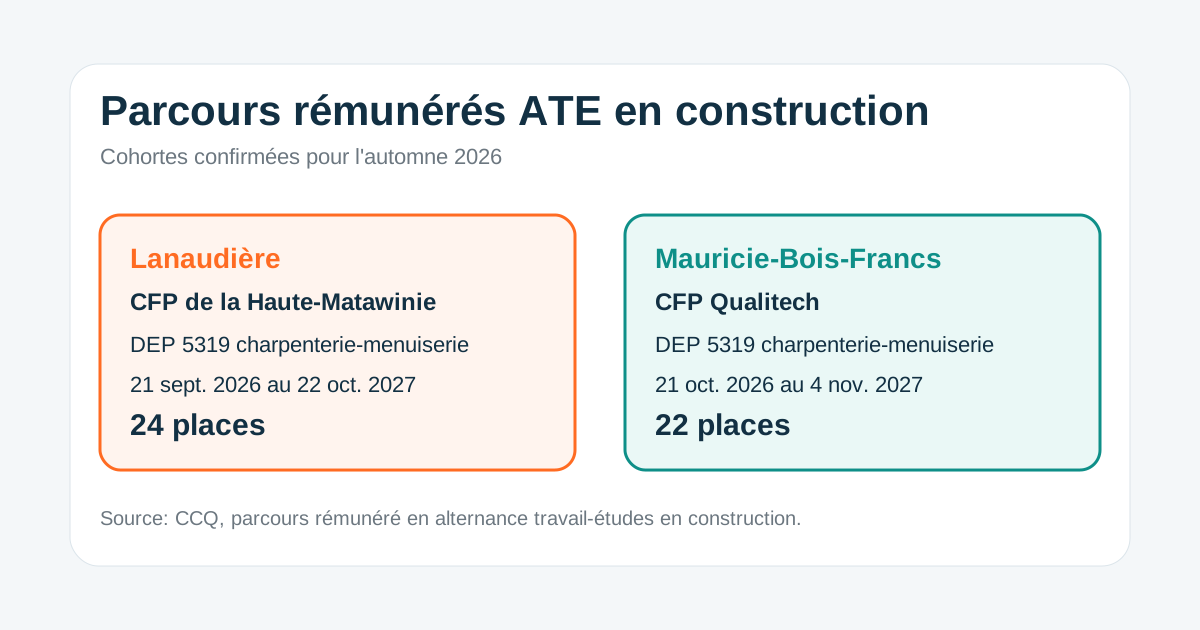
The first cohort targets the DEP 5319 in carpentry-joinery at the Centre de formation professionnelle de la Haute-Matawinie, in Lanaudière. The announced training period is from September 21, 2026, to October 22, 2027. The cohort has 24 places, some of which are prioritized for members of the Atikamekw community.
The second cohort also targets the DEP 5319 in carpentry-joinery, this time at the Centre de formation professionnelle Qualitech, in the Mauricie-Bois-Francs region. The announced period is from October 21, 2026, to November 4, 2027. The cohort has 22 places.
These numbers are modest. We're not talking about a reform that opens thousands of places overnight. But for workers and companies in the targeted regions, these are very concrete places, with a salary and subsidy mechanism that can influence the decision to participate or not.
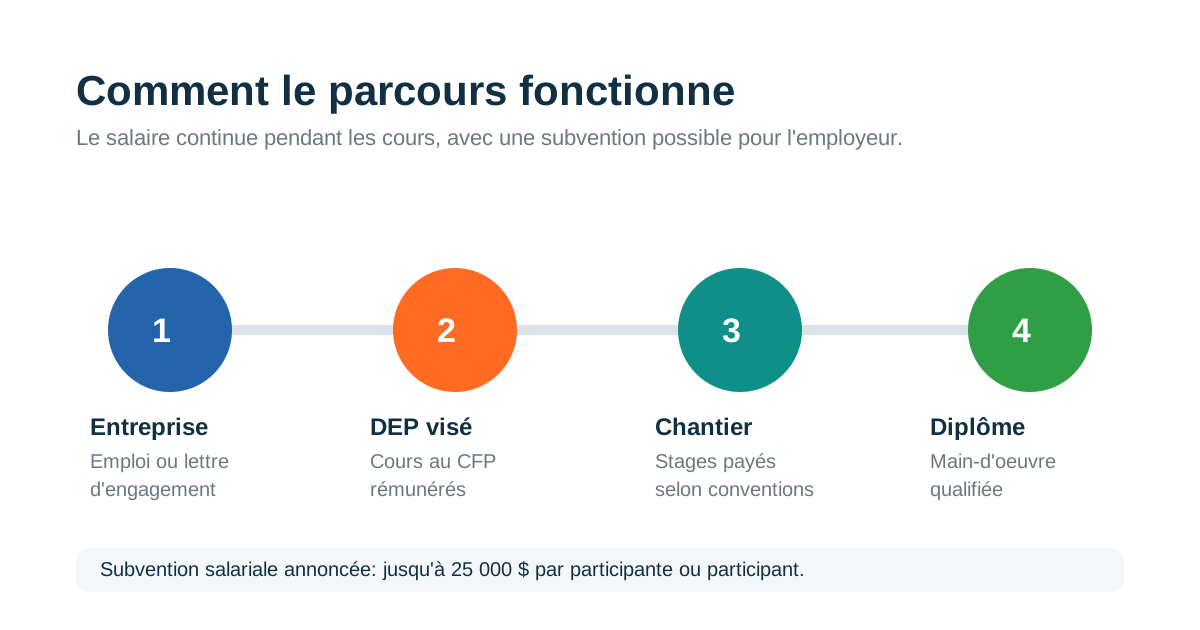
A paid work-study program allows a worker from a construction company to enroll in a study program leading to a DEP in a targeted trade. The significant difference is that the person can be paid when attending the required courses at the vocational training centre.
The initiative provides for a wage subsidy of up to $25,000 per participant to support companies during this period. So, it's not just aid for the worker. It's also a mechanism to reduce the financial burden on the employer who agrees to train or maintain a person in their program.
The program also includes one or more paid internships on construction sites. The CCQ specifies that these internships must comply with collective agreements. In short, the training is not meant to bypass industry rules. It is meant to organize a structured path between the VTC, the company, the participant, and construction obligations.
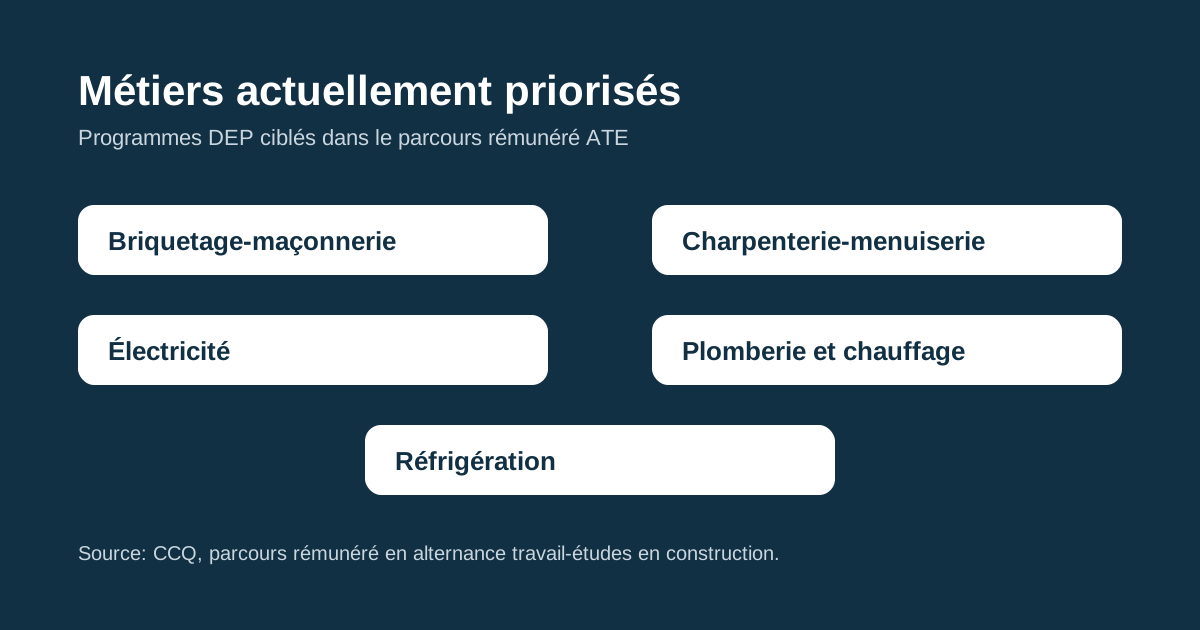
The trades currently prioritized by the program are bricklayer-mason, carpenter-joiner, electrician, refrigeration mechanic, and pipefitter. On the detailed program page, the CCQ associates these trades with the following DEPs: bricklaying-masonry, carpentry-joinery, electricity, plumbing and heating, and refrigeration.
These trades directly address the need for specialized labour on sites. They also require a structured progression: training, work rights, apprenticeship, hours, experience, and compliance. A worker who wants to better understand the concrete role of each trade can consult the ConstruMD guide on construction trades and occupations in Quebec before committing to a specific path.
In the case of the two cohorts confirmed for fall 2026, the targeted trade is carpenter-joiner. It's a logical choice because this trade is present in various types of sites and often serves as a structured entry point into the industry. The ConstruMD guide on the carpenter-joiner trade in Quebec can help situate the tasks, the DEP, and the prospects before considering a cohort.
The program is not intended for just anyone who simply wants to pursue a DEP. The CCQ indicates that the initiative targets individuals who hold a valid competency certificate, apprentice or journeyman in another trade, or an exemption issued by the CCQ. It also targets newly hired individuals who hold an apprentice competency certificate as a student.
For a candidate, the conditions mentioned by the CCQ include being 16 years or older, having Canadian citizenship or valid permanent resident status, meeting the educational prerequisites of the targeted program, and having a connection with an eligible construction company, either because the person already works for them or has obtained a letter of commitment.
The person must also meet the CCQ requirements, including holding a valid work permit throughout their participation. This point is crucial. A paid program does not replace the rules for site access. It organizes them within a specific framework.
Do not confuse an interest form with official registration. The CCQ specifies that interested individuals can fill out an interest form, but this does not automatically constitute registration. The vocational training centre remains responsible for evaluating admission to the study program.
The Vocational Training Centre may also require admission or placement tests, including a French test, regardless of the level of education achieved. In practice, this means that a motivated person must still validate the educational prerequisites and the specific process of the training centre.
For workers who are still in the process of choosing a path, the ConstruMD guide on essential training to start in construction helps distinguish between the DEP, cards, certifications, and other steps that are often part of the process.
For a company, this program can be attractive because it turns part of the training into a workforce strategy. Instead of waiting for a graduate worker to become available on the market, the company can support someone who is already working or whom they wish to hire, and then help them progress towards a DEP.
However, the CCQ specifies that the employer must meet the various CCQ compliance requirements. They must also employ the person or have provided a letter of commitment to a future worker. The person must meet the conditions of the program, including educational prerequisites and a valid work permit.
Financial support takes the form of wage subsidies while workers take the required courses at the Vocational Training Centre. The announced subsidy can go up to $25,000 per participant, but eligibility and actual implementation depend on cohorts, Vocational Training Centres, trades, regions, and applicable conditions.
This program is not an automatic guarantee of permanent employment. It does not replace a collective agreement, a competency certificate, an exemption, or CCQ rules. It also does not turn an interest form into confirmed registration.
It is also not the same as the 150-hour guarantee used in some industry access processes. The 150-hour guarantee concerns another mechanism, often related to workforce pools. Candidates seeking this type of entry may instead monitor construction jobs with a 150-hour guarantee, but it is important to avoid mixing the two issues.
The logic of the paid program is different: it aims for structured vocational training, with salary during courses, paid internships, and collaboration between employer, Vocational Training Centre, and CCQ.
The program addresses a known issue: the industry needs more graduates, but training requires time, organization, and income. The CCQ also published in 2026 professional outlooks that estimate workforce needs at 17,000 salaried people on average per year for the period 2026-2030. In this context, training more people already connected to the industry becomes a concrete lever.
The CCQ explains that the pilot project is made possible through funding from the Short-Term Training Program of the Commission des partenaires du marché du travail. The programs are administered by the CCQ in collaboration with the Ministry of Employment and Social Solidarity, the CPMT, and participating Vocational Training Centres.
In simple terms, the program attempts to align three needs: the worker's need to maintain an income, the employer's need not to entirely lose their workforce during training, and the industry's need to increase the number of graduates.
A worker should first verify if the desired trade truly matches their project. A DEP in carpentry-joinery does not have the same daily routine as a DEP in electricity, refrigeration, or plumbing and heating. The right choice must consider tasks, worksite pace, prerequisites, regional prospects, and CCQ progression.
Next, confirm the admission conditions with the Vocational Training Centre, CCQ requirements, and work status. Those who do not yet have a card or do not fully understand their status can review the ConstruMD guide on how to obtain a CCQ competency card, as the right to work remains a central point.
An employer, on the other hand, should verify if they can truly pay the person throughout their program, coordinate absences for training, integrate internships, and comply with collective agreements. The program can help, but it requires real operational planning.
Paid work-study programs in construction are not just a training announcement. They represent a more structured way to train a qualified workforce while reducing the financial shock for both the individual and the company.
For fall 2026, confirmed cohorts are limited, specific, and regional: carpentry-joinery in Lanaudière and Mauricie-Bois-Francs. Therefore, spots should be quickly monitored by workers, employers, and the concerned Vocational Training Centres.
The best way to approach this journey is to see it as a structured commitment: a targeted trade, a DEP, an employer, a CFP, a salary during training, paid internships, and a valid work permit to maintain. When used well, it is a serious tool for entering, progressing, or retaining talent in the construction industry in Quebec.
You might like
ConstruMD
Nov 5, 2026

ConstruMD
Nov 5, 2026
ConstruMD
Nov 5, 2026