
MÉDIC Construction 2027: changes in reimbursements
ConstruMD
Nov 18, 2026
All Posts
SHARE THIS POST
Published : November 5, 2026
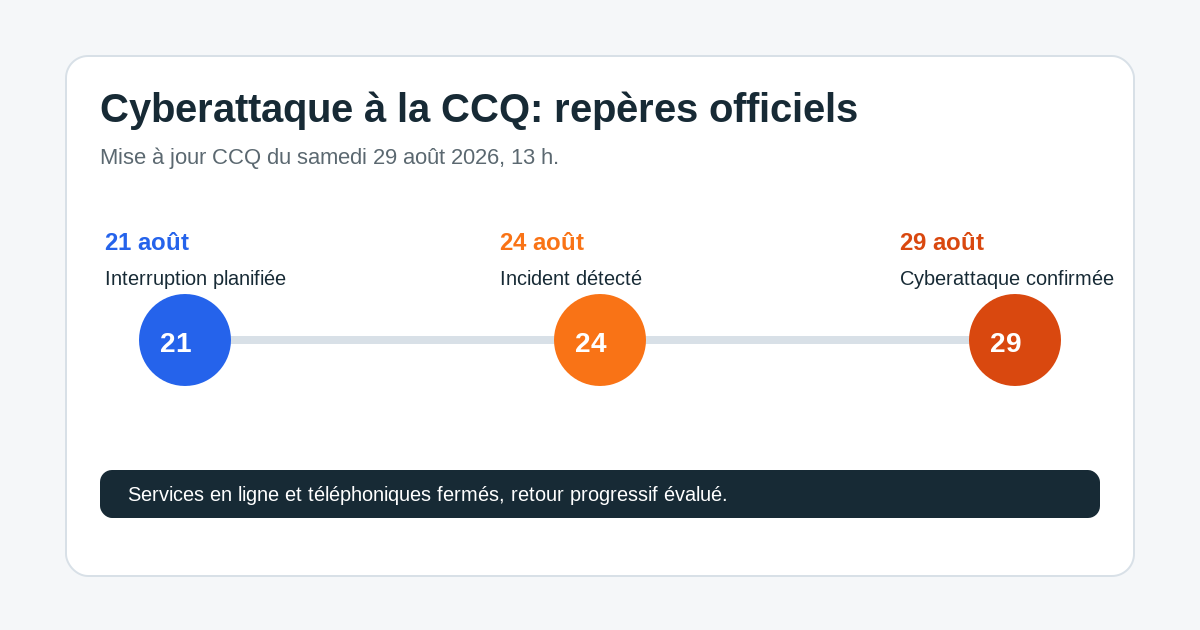
The Commission de la construction du Québec confirmed in an update published on Saturday, August 29, 2026, at 1 PM, that the interruption of its services is linked to a cyberattack. The IT security incident was detected on Monday, August 24, early in the morning, and the CCQ shut down its systems to limit the impacts and allow for a secure recovery.
For workers, employers, and those awaiting a work permit, the situation raises very concrete questions: are the online services working? Are expired certificates still valid? What happens to the labour pools? Are MÉDIC claims still being processed? Should one register with Equifax now? Will employers be penalized for workforce movements or monthly reports?
Here is a simple and structured explanation of what is known, what continues, what is suspended, and the reflexes to adopt. The information below should be reviewed alongside the official CCQ page, as the situation is rapidly evolving.
The CCQ indicates that the progress of the investigation confirms it is a cyberattack. It specifies that its online and telephone services remain closed for the moment, while its teams work on the secure restoration of the systems.
The CCQ also states that it is working on a plan for the gradual return of services. This means that one should not necessarily expect a complete return all at once. Some services might return before others, depending on ongoing security checks.
The official temporary service interruption page of the CCQ remains the source to follow. It contains the list of emergency services, the FAQ, and the most important operational information for workers and employers.
A confirmed cyberattack does not automatically mean that all personal information has been stolen. The CCQ indicates that the investigation into the nature of the affected data is still ongoing. If it determines that sensitive personal information of an individual has been taken, it must communicate directly with that person.
The nuance is important. The situation should be taken seriously, but one should avoid turning uncertainty into certainty. At this stage, the confirmed fact is the cybersecurity incident and the shutdown of the systems. The exact extent of the data breach remains under analysis according to the CCQ.
The CCQ also states that, to date, there is no indication that the incident is related to the Chantier numériccq. It also specifies that the 2023 incident involved an external supplier of the CCQ for the administration of certain MÉDIC Construction insurance claims, and not the CCQ's systems.
The CCQ is not just an administrative portal. Its services affect access to the industry, work permits, workforce movements, monthly reports, status letters, insurance, claims, exams, pools, and several employer obligations.
When these services slow down or become unavailable, the effect quickly reaches the construction sites. An employer may need to hire, declare a layoff, confirm a status letter, or regularize a file. A worker may be waiting for a certificate, checking their MÉDIC coverage, filing a claim, or monitoring their personal information.
This is why the crisis should be viewed in two aspects: the operational aspect, which concerns services and procedures, and the personal information protection aspect, which concerns identity, fraud, and credit risk.
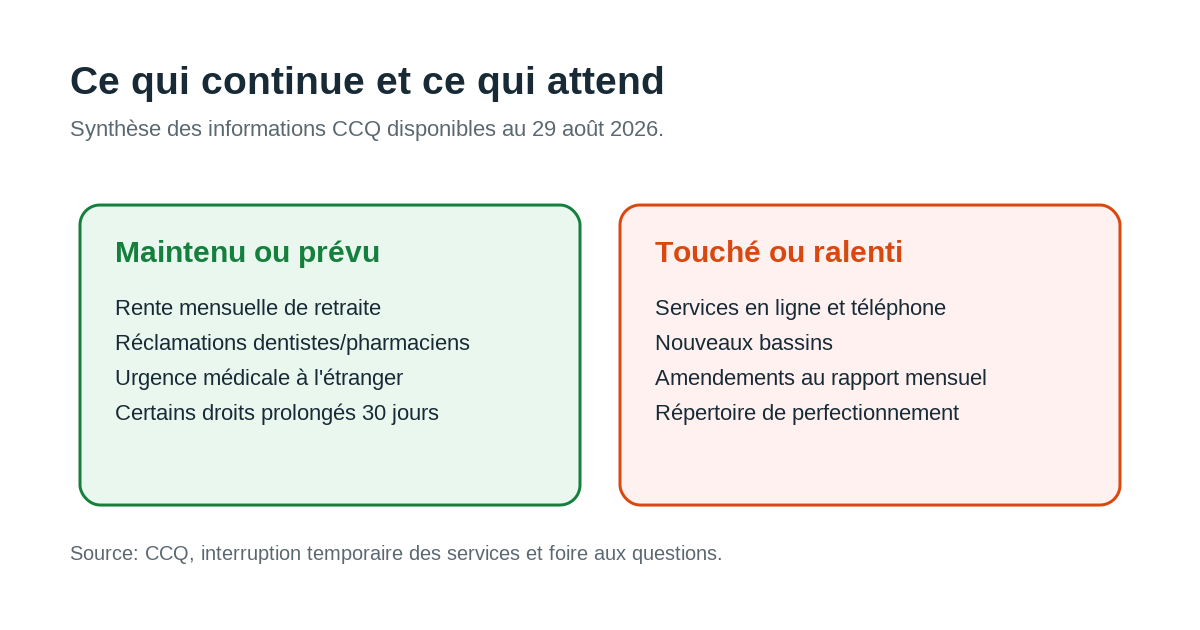
An important point concerns the competency certificates, with or without a job guarantee, as well as exemptions from the requirement to hold a competency certificate that expire on August 31 and September 1, 2026. The CCQ indicates that their validity is extended for an additional 30 days.
The explanation is simple: if your work permit expires precisely on August 31 or September 1, 2026, the CCQ indicates that you are authorized to continue working for 30 days. No immediate action is required on your part. However, when services are restored, you will need to contact the CCQ to regularize the situation.
This point is particularly important for workers and employers managing site entries. It does not replace the usual industry access rules, but it creates a temporary measure to prevent a system outage from unnecessarily blocking people already affected by these deadlines. On issues of access without a card or with status to clarify, the ConstruMD guide on checks before hiring without a CCQ card remains useful for understanding why compliance must always be validated.
The CCQ indicates that for pools that were open before Monday, August 24, work permit applications made before this date will be processed in the coming days. For pools that were open when services were shut down, the CCQ says it will ensure to resume all the days that were planned.
On the other hand, since online services are unavailable, the CCQ indicates that it is not possible to open new pools at the moment. The organization plans to communicate new information when conditions allow for resumption.
For candidates and employers who follow pool openings, this clarification is central. It distinguishes requests already made before August 24 from new pools that cannot be opened as long as services are unavailable. The ConstruMD article on CCQ pools, openings, and the 150-hour guarantee can help place these temporary measures within the normal functioning of the pools.
The CCQ indicates that the obligation to declare workforce movements, such as hires, layoffs, and other movements, is suspended until services resume, without administrative consequences.
For employers, this does not mean that internal records should stop being kept. On the contrary, it becomes even more important to keep track of dates, names, actual movements, communications, and evidence. When services return, it will be necessary to update the information correctly.
For monthly reports, the CCQ indicates that services allowing modification or amendment of a monthly report are currently unavailable. No action is required at the moment, and modalities will be communicated when services are restored. It adds that it will take necessary measures to avoid any prejudice to its clientele during this exceptional period.
This distinction matters. The suspension of an administrative obligation during an interruption does not remove the responsibility to keep a clear record of what is happening in the company. For employers, payroll, hours, and movement data must remain clean even if official transmission waits. The ConstruMD article on CCQ payroll and deductions reminds why salary and hour-related information must be understood accurately.
The CCQ indicates that the MÉDIC application and the MÉDIC online site are not accessible at the moment. However, claims submitted by dentists and pharmacists continue to be received and processed.
If a claim cannot be submitted during the interruption, the CCQ recommends keeping receipts and supporting documents to submit them when services are accessible again. It also specifies that the emergency medical service abroad and the Construire en santé program remain accessible during this period.
For workers who need to understand their coverage and reimbursements, the ConstruMD article on MÉDIC Construction dental insurance remains relevant, especially if receipts need to be kept before a later submission.
The CCQ indicates that the payment of the monthly retirement pension is maintained. Retired individuals already receiving a pension should continue to receive it, including new pension payments scheduled for September 1.
The CCQ also indicates that retirement statements will be sent by mail. For qualification exams, the FAQ specifies that the exams on August 31 are maintained unless otherwise communicated directly to the concerned individuals. Exams scheduled for September 1 are not maintained, and the concerned individuals would have been notified.
As this information may evolve, individuals affected by an exam should monitor direct communications from the CCQ. Do not rely solely on a screenshot or information transmitted by a colleague.
The CCQ will offer, as a preventive measure, a credit monitoring and identity theft protection service from Equifax to all its clients, customers, and employees, even without proof that personal information has been taken.
The FAQ specifies that this protection will be offered free of charge for a period of 24 months from registration. It targets individuals whose personal information may be held by the CCQ, including workers, employers, business individuals, as well as current and former CCQ employees.
Important practical point: the CCQ asks to wait for the communication that will be sent by email or mail before contacting Equifax. Without this information, the file cannot be processed correctly according to the CCQ. If a person already benefits from an Equifax service, the coverage offered by the CCQ will be added to the one already in place.
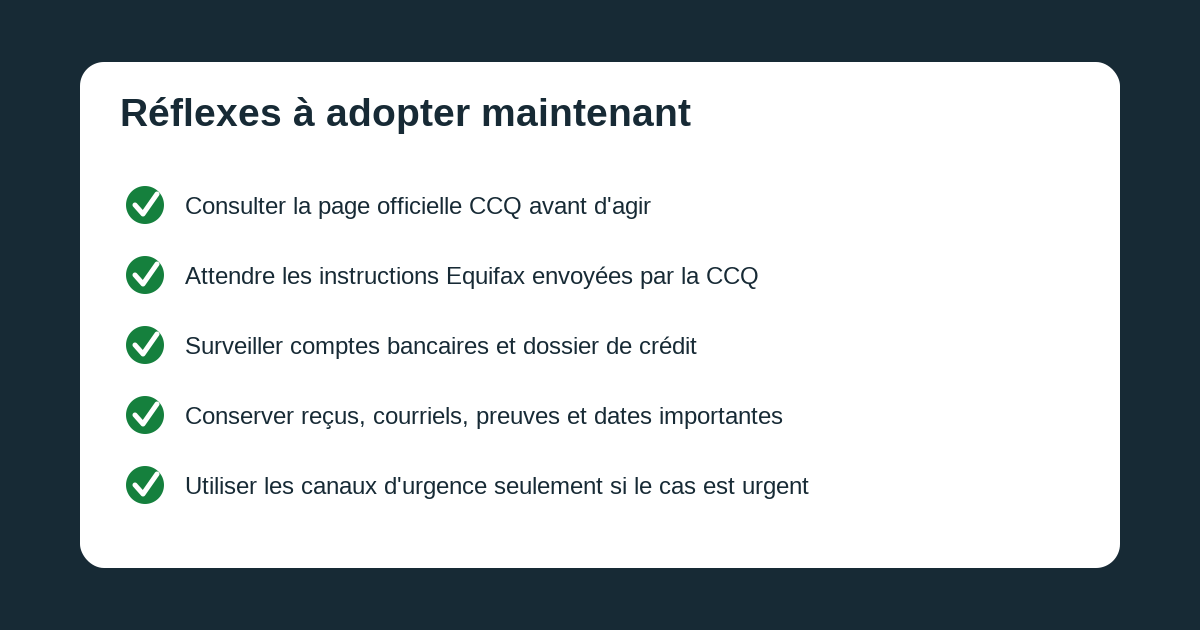
The first thing to do is to follow the official updates from the CCQ. The second is to keep evidence: MÉDIC receipts, work documents, notices received, emails, screenshots of official communications, and important dates.
The third is to monitor bank accounts, credit cards, and online records. The CCQ recommends monitoring accounts and reporting any unauthorized transactions to your financial institution. It also recommends regularly changing passwords, avoiding reusing the same password on multiple platforms, and enabling two-factor authentication when available.
The Commission d'accès à l'information du Québec also provides useful tips in case of personal information leaks or identity theft, including documenting evidence, being wary of suspicious calls or messages, and considering freezing your credit file with Equifax and TransUnion when the situation warrants it.
The employer should first separate real emergencies from ordinary follow-ups. The CCQ indicates that only urgent requests will be answered and treated as a priority. Requests that can wait should be kept and prepared for when services resume.
Next, it's important to maintain a clean internal record: hires, layoffs, workforce movements, hours, payrolls, reports to be modified, pending requests, proof of sending, communication dates, and impacts on construction sites. The goal is to be able to quickly regularize files when systems return.
Finally, inform teams without fueling confusion. Workers need to know where to find official information, what to keep, and what not to do. Clear internal communication prevents rumors about payrolls, work rights, pools, or personal data.
The CCQ cyberattack creates an exceptional situation, but several temporary measures are already specified. Online and telephone services remain closed for the time being. There is no specific date for a return to normal, but the CCQ is evaluating a gradual return of certain services.
Work rights expiring on August 31 and September 1, 2026, are extended by 30 days. Requests related to pools already open before August 24 are processed according to CCQ instructions, but no new pools can be opened as long as online services are unavailable. Employers' workforce movements are suspended until services resume, without administrative consequences.
For personal information, the right stance is vigilance without panic. The investigation is ongoing, but the CCQ will offer free Equifax protection for 24 months to affected clients. Workers and employers should wait for official instructions, monitor their accounts, keep their evidence, and avoid improvised actions.
You might like
ConstruMD
Nov 18, 2026

ConstruMD
Nov 15, 2026

ConstruMD
Nov 11, 2026