
150-Hour CCQ Guarantee: What the Employer Really Promises
ConstruMD
Nov 5, 2026
All Posts
SHARE THIS POST
Published : November 5, 2026
In the construction industry in Quebec, the question often arises: can you employ someone who doesn't yet have their card, is waiting for their certificate, has just graduated from a vocational program, or has experience outside the CCQ-regulated sites?
The short answer is simple but sometimes misunderstood: on a regulated site, it's not just a person's actual skills that matter. You also need to verify if they have the right status to perform the specified work, in the right trade or occupation, at the right time.
For employers, the issue is concrete. A mistake can create a compliance problem, payroll issues, monthly report discrepancies, insurance complications, liability concerns, or team relationship issues. For workers, the issue is equally important: starting without understanding their status can slow down the accumulation of hours or create false expectations.
Before discussing the card, you need to know if the work is subject to the construction framework in Quebec. Some work clearly falls under the industry governed by Law R-20. Others may be outside the decree, non-targeted residential, or linked to specific situations.
This point is essential because obligations are not determined solely by the worker's title. They also depend on the nature of the site, the type of work, the sector, and the contractual context.
In borderline cases, the employer should validate before sending someone to the site. A quick interpretation based on habit or what is done elsewhere can be costly if the site is ultimately regulated.
The CCQ explains competency certificates as the official access allowing work in the regulated industry. The certificate is not just an administrative badge. It links a person to a recognized status in a trade or occupation.
The most well-known certificates are the journeyman competency certificate, the apprentice competency certificate, and the occupation competency certificate. Each corresponds to a different reality on the site.
A journeyman has demonstrated their qualifications in a trade. An apprentice is learning in a given trade. A person with an occupation certificate can perform a recognized occupation. These distinctions are important because they influence the permitted tasks, supervision, salary, progression, and recognized hours.
When the position requires stricter verification, comparing available CCQ workers can reduce the hiring risk.
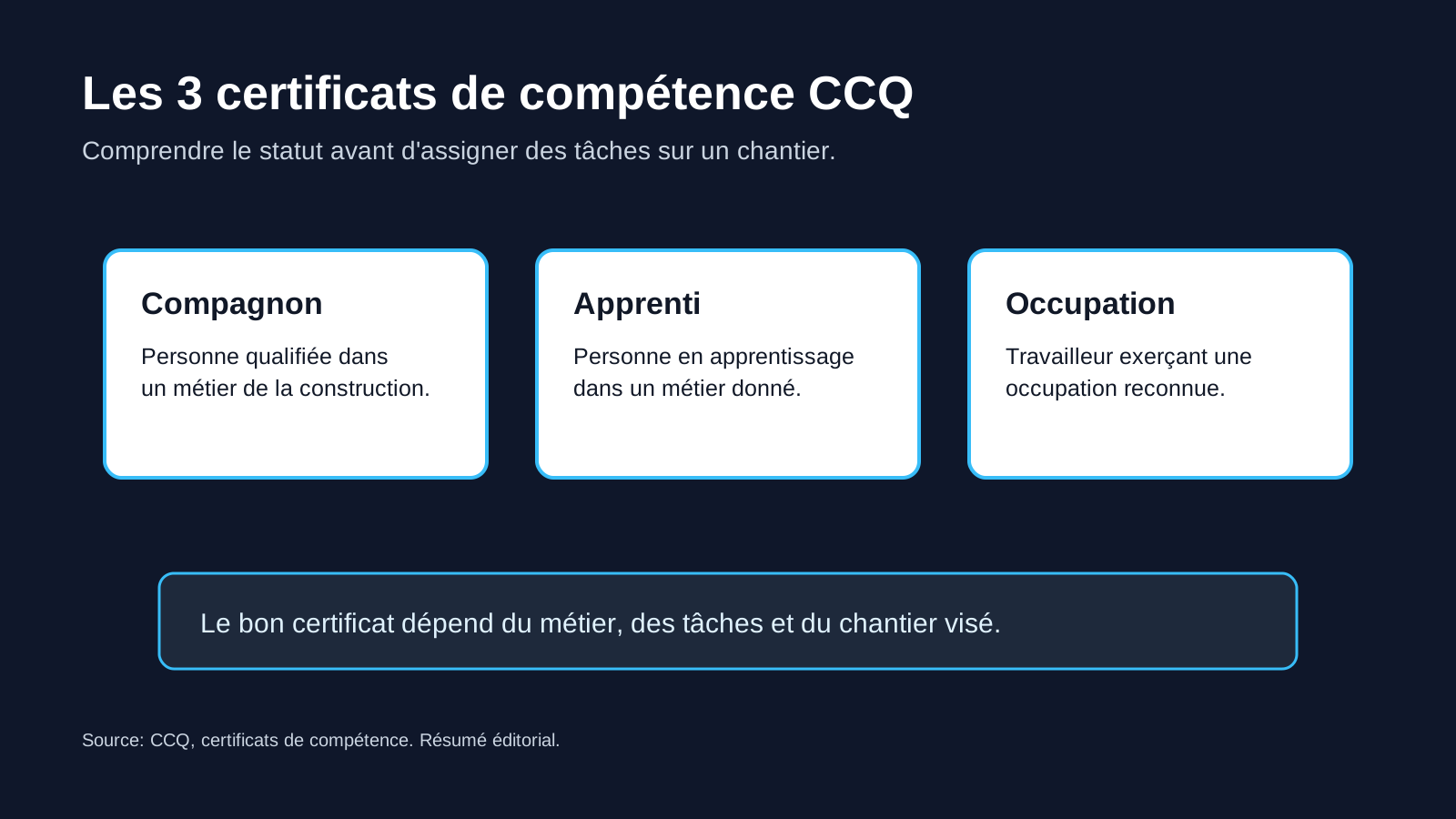
A worker may have real experience, be skilled, autonomous, and efficient, yet not be authorized to perform all tasks on a regulated site. This is often where misunderstandings begin.
Experience gained outside the CCQ, in another province, another country, in non-regulated renovations, or in a private context can be valuable. But it doesn't automatically replace the required certificate. In some cases, a recognition process or an apprenticeship path is necessary.
The CCQ also provides a page on recognition of training and work experience. For an employer, this nuance is important: recognizing that a person is competent in practice does not mean they are already compliant for all tasks.
An apprentice can work in the industry, but their status remains linked to an apprenticeship path. The ConstruMD article on how to hire an apprentice in construction in Quebec reminds us that good supervision avoids many misunderstandings.
The employer must verify the trade, the apprenticeship period, the tasks assigned, and the actual level of autonomy. An apprentice should not be treated as a journeyman simply because the site is short-staffed.
This distinction protects the employer, but also the worker. It allows for clearer progression, accumulation of the right hours, and avoids unrealistic expectations from the start of employment.
The main risk is not just a potential fine. The problem can affect several dimensions of the site: compliance, payroll, health and safety, liability in case of an incident, relationships with other workers, and credibility with clients.
A person misclassified or assigned to the wrong tasks can also create internal tensions. Site teams often know the basic rules very well. When an employer appears to bypass the system, the work environment can quickly deteriorate.
For employers recruiting in a tight market, it can be tempting to move quickly. But moving quickly without verifying status can lead to a hire that seemed to solve a problem but creates three others.
For the worker, the risk is believing that a job offer solves everything. A person may think they are accumulating the right hours, are in the right trade, or are progressing towards the right status, while their record does not exactly reflect reality.
This is particularly important for people entering the industry, changing trades, or returning after a period away from the site. The ConstruMD guide on trades and occupations in construction in Quebec can help distinguish paths, but official validation remains necessary for a specific case.
The worker should always ask about their status, how their hours will be reported, what trade or occupation they are working in, and what the next steps are if they want to progress.
Before sending someone to a job site, the employer should confirm if the site is subject to regulations, check the certificate held, associate tasks with the correct trade or occupation, document the hours, and validate edge cases with the appropriate sources.
The ConstruMD page on available CCQ workforce can also help employers visualize certain pools of workers. It does not replace regulatory verification, but it helps better organize the search for candidates.
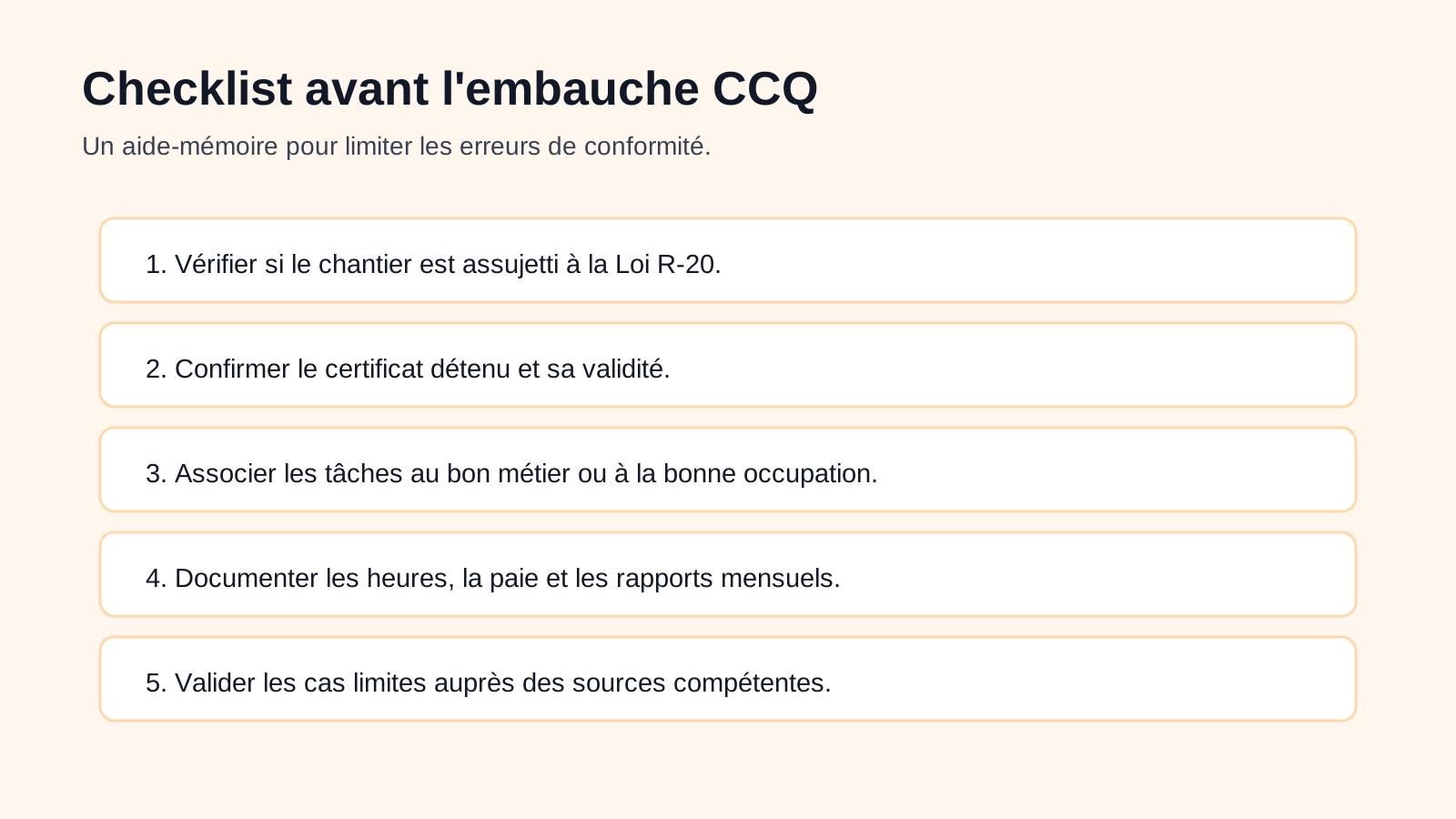
Hiring a motivated person is not enough. In regulated construction in Quebec, you must check the site, the certificate, the trade, the tasks, and how the hours will be reported.
The right approach is not to close the door to new workers. On the contrary, the industry needs new blood. But this new blood must enter through the right path, with the right status and clear expectations.
For both the employer and the worker, clarity from the start prevents more significant problems once the job site work begins.
You might like
ConstruMD
Nov 5, 2026


ConstruMD
Nov 5, 2026