
MÉDIC Construction 2027: changes in reimbursements
ConstruMD
Nov 18, 2026
All Posts
SHARE THIS POST
Published : November 5, 2026
A MÉDIC Construction card with the AJ designation offers good protection, but it doesn't mean that 90% of the total dentist bill will automatically be reimbursed. This is precisely what creates frustration when a treatment is expensive: the worker sees a high percentage on their statement, then receives a reimbursement that represents a much smaller fraction of the amount paid.
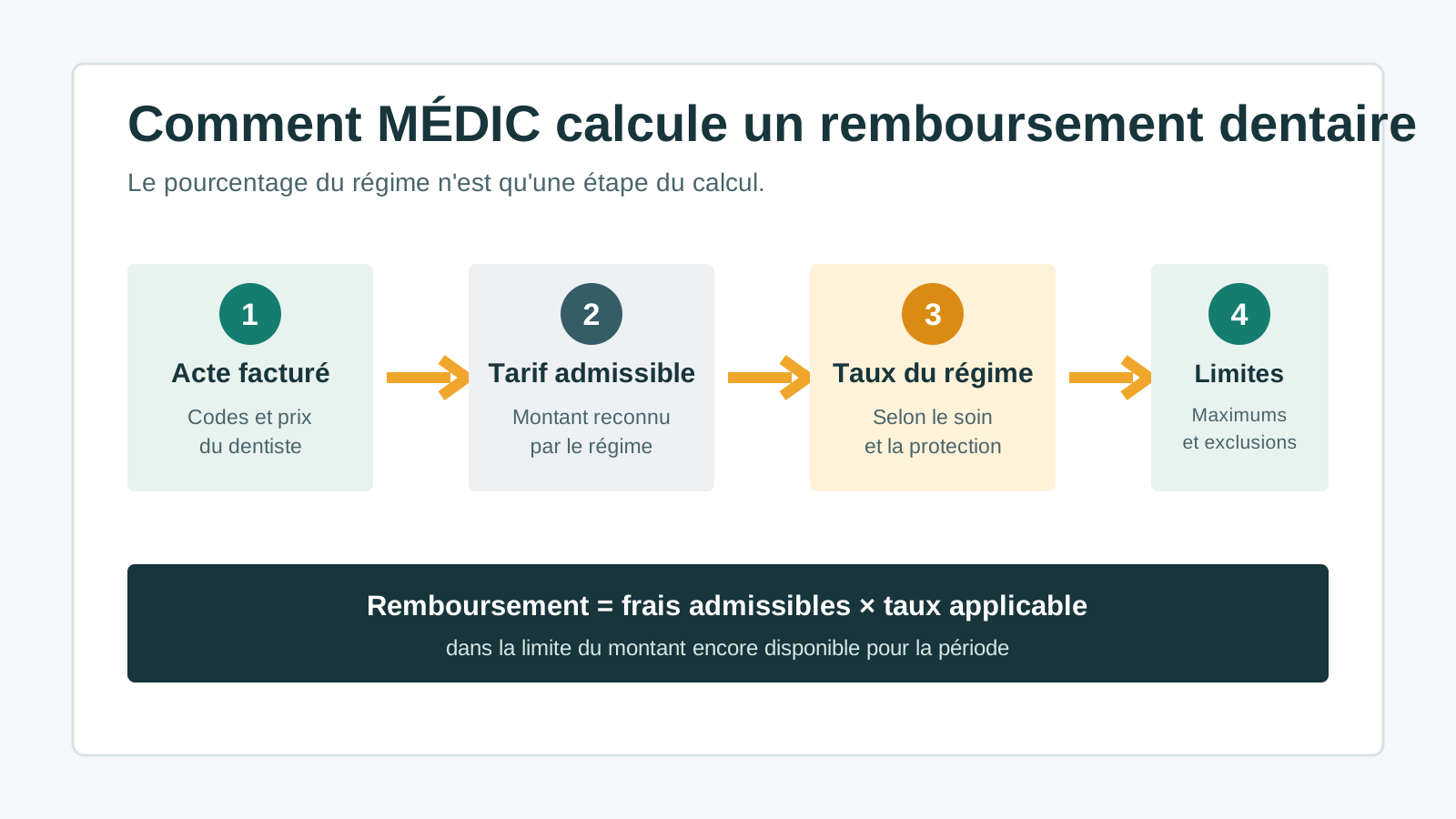
The reason is that MÉDIC Construction does not always calculate the reimbursement based on the actual billed amount. The calculation considers the eligible rate, the category of care, the percentage provided by the plan, the maximums per period, treatments already claimed, and applicable exclusions.

To understand a reimbursement, you need to separate four amounts:
The billed amount is the price requested by the dentist. The eligible amount is the sum that MÉDIC recognizes for the care according to the fee guides used. The reimbursement percentage depends on the plan and the type of care. The maximum then limits what can be paid during a given period.
In simple terms, the calculation looks like this: eligible rate multiplied by the plan percentage, subject to the deductible, available maximum, frequency limits, and exclusions. If the dentist charges more than the recognized rate, the difference remains the worker's responsibility.
The letters on the card identify the coverage held during a specific insurance period. The first letter corresponds to the basic plan A, B, C, or D. A second letter can identify an additional plan related to a trade. For carpenters, the letter J designates this additional coverage.
The AJ plan is therefore the A plan accompanied by the additional coverage for carpenters. It is not a promise of full reimbursement, and the word "maximum" does not mean "without a ceiling."
The coverage is established for a six-month period. The official AJ, BJ, CJ, and DJ bulletin for July 2026 covers the period from July 1 to December 31, 2026. The plan held at the time the care is received is the one to consult, not necessarily the one displayed on a previous or future card.
The hours worked and contributions determine the coverage obtained. They also explain why two workers in the same trade may not have exactly the same plan. Contributions related to benefits appear in the details of a CCQ pay, but the level of coverage must always be confirmed on the valid card and in MÉDIC online.
For the period from July 1 to December 31, 2026, the carpenters' bulletin indicates that the AJ plan reimburses 90% of eligible expenses for diagnosis, prevention, and minor treatments. This category notably includes fillings and extractions.
A maximum of $600 per person per insurance period applies to this category. The AJ plan does not impose a family deductible for these services during this period.
For periodontics and endodontics, the AJ plan provides a reimbursement of 80% of eligible expenses. For major restorations, such as certain crowns, dentures, or restorations, the indicated percentage is 75% of eligible expenses. Other maximums and limits may apply to these categories.
The bulletin also specifies that dental laboratory fees are limited to 50% of the eligible fees of the dentist or denturist. Several treatments are subject to a maximum frequency. For example, the recall exam is normally limited to once per nine-month period, while some periodontal treatments are limited per tooth over a five-year period.
A simple or complex extraction is part of the covered dental treatments. However, a procedure may involve several distinct acts: examination, X-rays, extraction, surgery, sedation or anesthesia, medications, and other professional services. Each act may be treated according to its own rule.
The official page on dental insurance notably indicates that general anesthesia used for dental surgery is reimbursable up to a maximum of $300 per session. This does not mean that all other forms of sedation or all fees billed around the procedure are automatically covered at the same level.
It is therefore impossible to determine the accuracy of a reimbursement by simply dividing the amount received by the total bill. You must look at the procedure codes, eligible amounts, and limits applied to each line.
MÉDIC Construction uses the 2026 rates from the guides published by professional dental associations and, where applicable, the guide for dental hygienist services. These rates serve as the basis for the calculation even if the treatment is performed by a specialist who charges more or if the care is received at a higher rate.
The difference between the bill and the eligible rate is not multiplied by 90%. It normally remains the insured's responsibility.
For minor treatments under the AJ plan, the maximum of $600 applies per person and per insurance period. Cleanings, exams, fillings, extractions, and other care in this category received during the same period can progressively use this maximum.
A worker who has already submitted claims since the beginning of the period may have less coverage available for a new extraction, even if the care is eligible.
A comprehensive invoice may contain procedures reimbursed at different percentages, capped procedures, and non-covered fees. The announced percentage for an extraction cannot be indiscriminately applied to all lines of the invoice.
A treatment may be generally recognized but denied in a specific case because it was received too soon after the previous treatment, because it is considered cosmetic, or because a condition of the plan is not met.
Among the exclusions indicated by the CCQ are certain cosmetic treatments, fees for a missed appointment, charges for filling out a form, and dental care for dependents starting from their 21st birthday.
The correct reasoning is not "my invoice is X dollars and my plan reimburses 90%, so I will receive 90% of X." Instead, you should ask what portion of each procedure is recognized by MÉDIC, what percentage applies to this category, and how much remains before reaching the period's maximum.
Two people receiving similar treatment may therefore receive different reimbursements if they do not have the same plan, if their dentist does not charge the same amounts, if they have already used part of their maximum, or if their invoices contain different procedures.
The CCQ recommends submitting a treatment plan accompanied by a cost estimate when the expected cost exceeds $500. MÉDIC Construction can then indicate the amount that would be reimbursable before the worker accepts the treatment.
For major dental care paid directly with the MÉDIC card, prior authorization is required. The dentist submits the plan and relevant X-rays, then MÉDIC communicates its decision. The fact that a dentist accepts the card does not, by itself, guarantee that all proposed care will be covered.
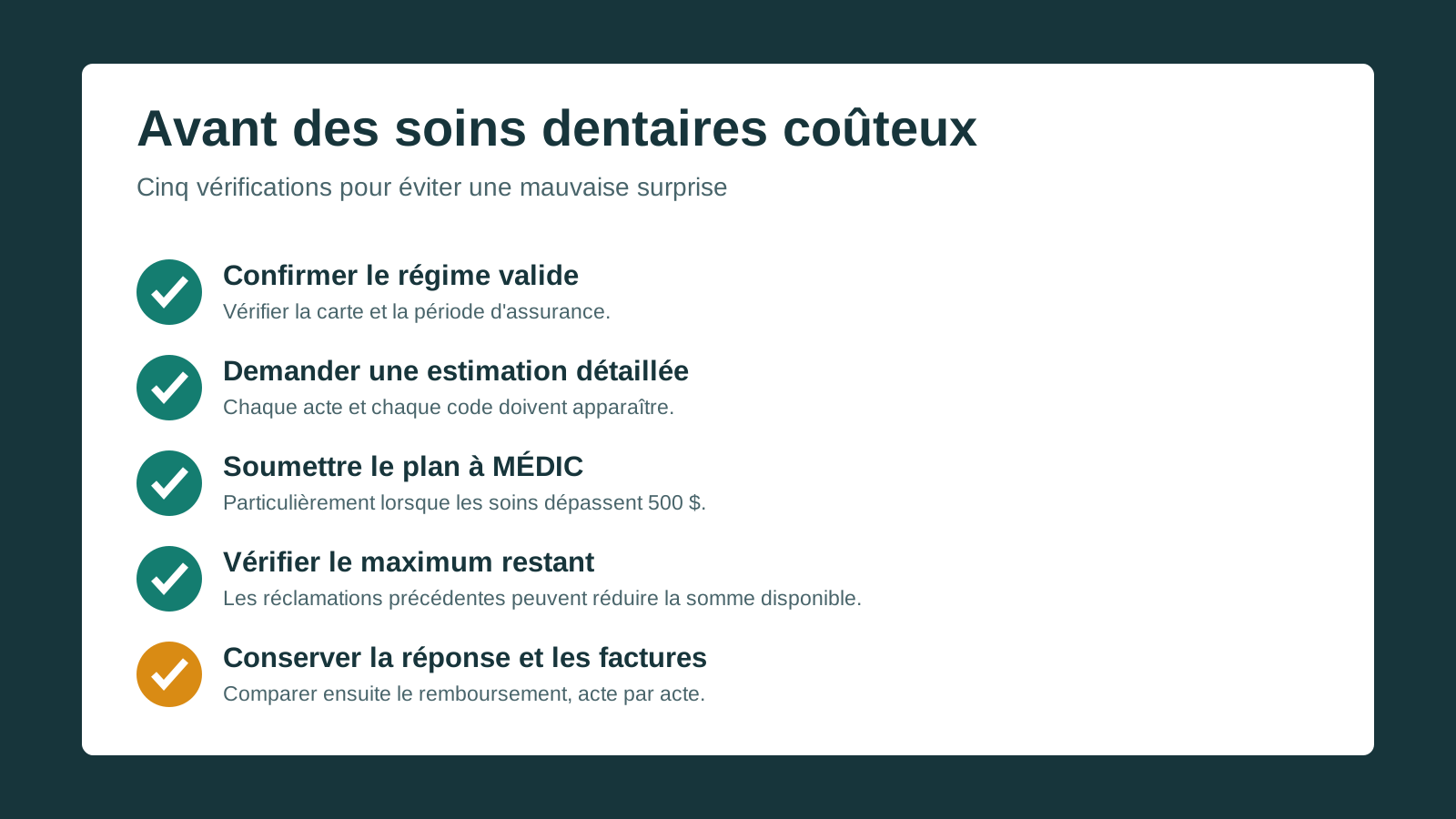
Start by confirming the plan that was valid on the date of care. Then ask the dental office for a detailed invoice showing each procedure code and each amount. Compare these lines with the reimbursement statement available in MÉDIC online.
For each procedure, look for five elements: the billed amount, the amount recognized as eligible, the percentage applied, the portion of the maximum already used, and the reason associated with any reduction or denial.
If the statement does not allow you to understand the calculation, contact MÉDIC Construction with the detailed invoice, procedure codes, date of care, and applicable plan at hand. The right question is not just "why did I receive so little?" but "what eligible amount, what percentage, what cap, and what exclusion were applied to each procedure?"
A reimbursement request must be submitted no later than one year after the event that entitles it. Waiting can therefore result in losing the reimbursement even when the care would otherwise have been eligible.
MÉDIC Construction includes several protections that do not all follow the same rules: medications, dental care, paramedical care, life insurance, and, depending on the plan, wage insurance. The latter follows a different logic, particularly for active directors and associates, as explained in our guide on MÉDIC Construction and wage insurance.
The common point is that you must always verify the specific protection rather than relying solely on the plan name or the presence of a card.
False. The 90% rate applies to eligible expenses in certain categories of care. Other care has a different rate, a distinct maximum, or is not covered.
False. The card facilitates direct payment of the reimbursable portion. It does not transform an excluded care into eligible care and does not remove caps.
False. The AJ plan offers advantageous percentages but also has maximums per period, frequency limits, and rules specific to each category.
False in the majority of planned cases. A prior estimate allows for a much more precise response, especially when care exceeds $500.
A MÉDIC Construction dental protection is not read as a simple percentage applied at the bottom of an invoice. The reimbursement depends on the eligible rate, the category of care, the valid plan on the treatment date, the remaining available maximums, and the stipulated conditions.
For the AJ plan, from July 1 to December 31, 2026, diagnostics, preventive care, and minor treatments, including extractions, are reimbursed at 90% of eligible expenses, with a maximum of $600 per person for the period. This maximum and the difference between the billed rate and the recognized rate explain much of the discrepancies that surprise workers.
Before undergoing significant treatment, the best action is concrete: obtain a detailed estimated invoice and submit it to MÉDIC Construction. After the treatment, request a line-by-line calculation. This is the only way to know precisely where each dollar goes and if the reimbursement truly respects your coverage.
You might like
ConstruMD
Nov 18, 2026
ConstruMD
Nov 15, 2026

ConstruMD
Nov 11, 2026