CCQ Retirement: When Can You Transfer Your Fund to a LIRA?
ConstruMD
Nov 5, 2026
All Posts
SHARE THIS POST
Published : November 5, 2026
A worker completes their week, looks at their gross salary, and then sees a much lower amount deposited into their account. The reaction is understandable: where did the rest go?
The answer is not “the CCQ takes it all.” A construction pay in Quebec combines several different systems: taxes, public plans, group insurance, retirement, union, and CCQ deductions. Meanwhile, the employer also pays several contributions out of pocket that are not deducted from the worker's salary.
This guide explains each category with the official rules and rates for 2026. It does not present a false example of an “average pay,” as the exact result truly varies depending on the trade, occupation, apprentice or journeyman status, sector, union, number of hours, bonuses, and personal tax situation.
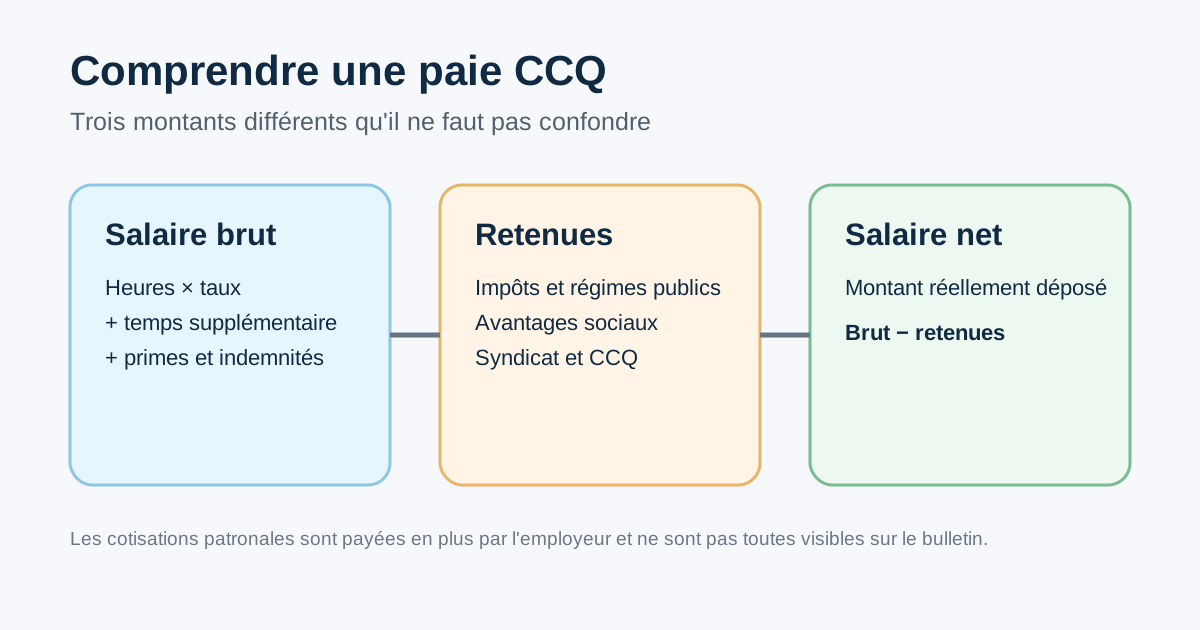
Gross salary is the compensation earned before deductions. It normally includes hours worked at the applicable rate, overtime, bonuses, and certain allowances.
The applicable rate depends on the trade or occupation, apprenticeship period, sector, and sometimes the salary schedule. The CCQ salary grids 2026 allow verification of the base rate, but the pay slip must show the hours worked at each rate.
The income used to calculate tax may differ from the amount of money earned. Some benefits paid by the employer, including part of the MÉDIC Construction insurance, constitute taxable benefits.
A taxable benefit is not an amount the employer deposits into the bank account. It is the tax value of a benefit received. This value is added to the income used to calculate certain tax deductions.
Net salary is the amount actually paid after payroll deductions. It is the deposit the worker sees in their account.
The employer's cost is higher than the gross salary. It includes the salary, employer contributions to public plans, social benefits, retirement plan, vacation fund, CCQ deduction, and other applicable charges.
This total cost is generally not fully presented on the worker's pay slip. It is a significant source of confusion: what is deducted from the employee and what the employer pays in addition are two different things.
These deductions are not specific to the CCQ. They also exist on the pays of many other Quebec employees.
There is no single tax percentage for all CCQ pays. Deductions depend notably on the pay period income, pay frequency, credits listed on tax forms, recognized deductions, and taxable benefits.
Taxes are progressive. This means that income is not entirely taxed at the highest bracket rate reached. Only the portion of income within each bracket receives the corresponding rate.
The amounts deducted from each pay are source deductions, thus advance payments of the annual tax. The tax return then makes the final calculation. A worker may receive a refund or have a balance to pay depending on their overall situation.
The QPP finances retirement pensions as well as certain disability and survivor benefits.
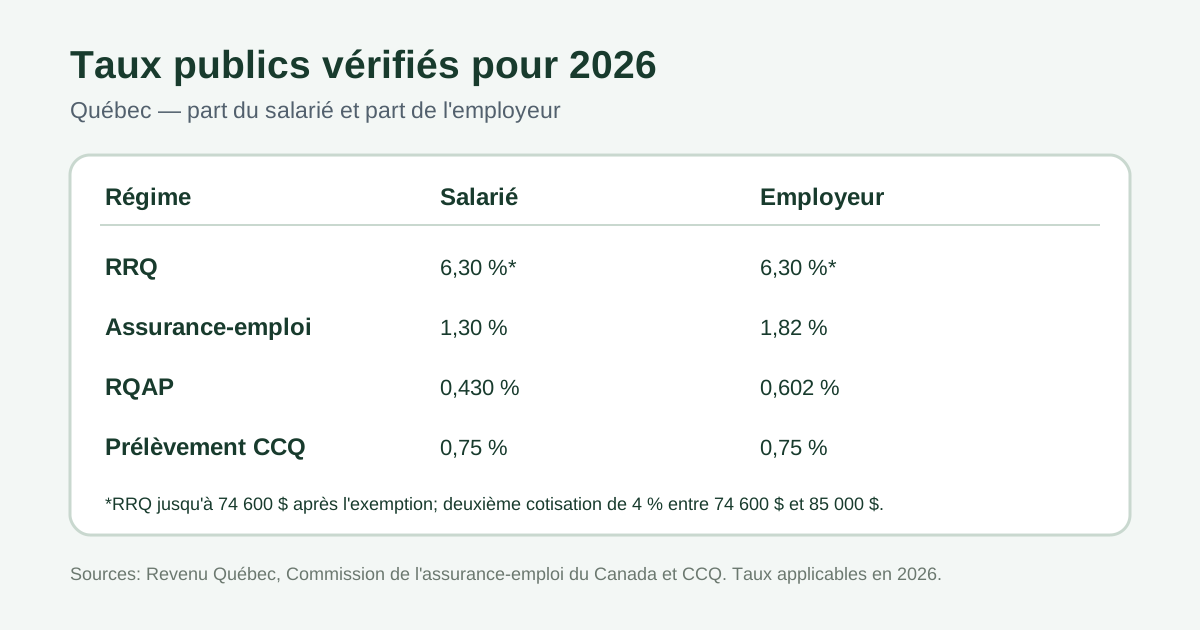
In 2026, the rate combining the base contribution and the first additional contribution is 6.30% for the employee, after the general exemption of $3,500, up to the maximum pensionable earnings of $74,600. The corresponding maximum contribution is $4,479.30.
A second additional contribution of 4% then applies to the portion of salary between $74,600 and $85,000, up to an additional maximum of $416. The employer pays an equivalent contribution.
On a Quebec pay, employment insurance and QPIP are two different plans. Both deductions are therefore normal and do not pay for exactly the same protections.
Employment insurance is a federal program. It finances regular benefits when a person loses their job in an eligible situation. It also finances certain federal benefits, such as sickness, compassionate care, and family caregiver benefits.
In Quebec, the employee rate is reduced because maternity, paternity, parental, and adoption benefits are covered by the Quebec plan rather than federal employment insurance.
In 2026, the Quebec employee contributes 1.30% of their insurable earnings to employment insurance, up to the annual insurable maximum of $68,900. The maximum employee deduction is $895.70.
The employer separately contributes 1.82%, up to an annual maximum of $1,253.98 per employee. This employer contribution is not deducted from the worker's pay.
The Quebec Parental Insurance Plan is a Quebec program. It pays maternity, paternity, parental, and adoption benefits to eligible individuals.
In 2026, the employee contributes 0.430% on a maximum insurable income of $103,000, up to an annual maximum contribution of $442.90.
The employer separately contributes 0.602%, up to an annual maximum of $620.06. This portion is also paid in addition to the salary.
In summary: employment insurance mainly protects against job loss and certain other events, while QPIP covers leaves related to the birth or adoption of a child. Quebec therefore collects both contributions but reduces the employment insurance rate to account for the existence of QPIP.
An employee contribution is used to finance the industry's insurance plan, and the applicable provincial tax is also deducted. The plan can offer, depending on eligibility and coverage level, protections related to medication, health, life, salary, and other care.
For the basic insurance plan, the CCQ has confirmed the maintenance, until April 24, 2027, of an employee contribution of $0.68 per hour and an employer contribution of $2.93 per hour. Additional plans or funds may be added for certain trades or occupations.
The employer's contribution provides a benefit to the worker. According to tax rules, part of this contribution becomes a taxable benefit. The worker therefore pays tax on the value of the coverage, but does not receive this amount in cash.
The detailed operation of MÉDIC Construction helps to understand why this line appears both as a contribution and as a taxable benefit.
The employee contribution to the retirement plan is deducted from the pay. Its amount varies depending on the trade or occupation, apprentice or journeyman status, sector, and salary schedule. There is therefore no single salary rate applicable to all.
This contribution is not a tax. It is paid into the retirement plan and employee contributions accumulate in the participant's supplementary account. They are also deductible from their taxable income according to applicable rules.
The employer also contributes for each hour worked. Since April 26, 2026, the general employer contribution to the retirement plan is $5.21 per hour for a journeyman or occupation and $4.29 for an apprentice. These amounts are generally not indicated on the pay slip.
The employer withholds union dues according to the method set by the worker's association. It can be calculated weekly, hourly, as a fraction of the hourly rate, or according to a combination of methods.
The amount is not determined by the CCQ. The CCQ collects it with the monthly report and then redistributes it to the concerned union association.
A sectoral contribution may also be deducted to finance labour relations training. In the residential sector, this sectoral contribution is paid by the employer.
The deduction finances the activities of the CCQ, including the enforcement of the law and collective agreements. The employee's share is 0.75% of their remuneration and is deducted weekly.
The employer pays an equal share of 0.75%. The total contribution is therefore not solely borne by the worker.
No. This is one of the most important myths to correct.
The CCQ confirms that the allowances representing 13% of the gross salary are paid by the employer to the CCQ. They are not deducted from the worker's salary.
This 13% is composed of 6% for mandatory annual leave, 5.5% for statutory holidays, and 1.5% for sick leave.
The CCQ places the amounts in a fund and remits them to workers before the summer and winter vacations. The interest produced by the fund is also remitted once a year before the summer vacation.
In other words, if the gross salary for a week is $2,000, the employer does not deduct $260 from this salary to create the vacation pay. The employer must instead pay the CCQ an allowance equivalent to 13% in addition to the earned salary. This example only illustrates the calculation of the official 13%; it does not represent a complete net pay.
The employer's share may include the 13% vacation fund, the employer contribution to MÉDIC, the employer contribution to the retirement plan, the employer's share of the CCQ deduction, the employer's share of the QPP, employment insurance, and QPIP, as well as other charges like applicable health and safety contributions.
These amounts are not taken from the worker's net salary. They add to the labour cost for the employer.
The pay slip mainly shows the employee's deductions. It therefore does not always provide a complete view of what the employer has paid for that week of work.
There is no universal CCQ deduction of 50%. If the gap between gross and net approaches this level on a pay, all lines should be added and verified rather than attributing the gap to a single organization.
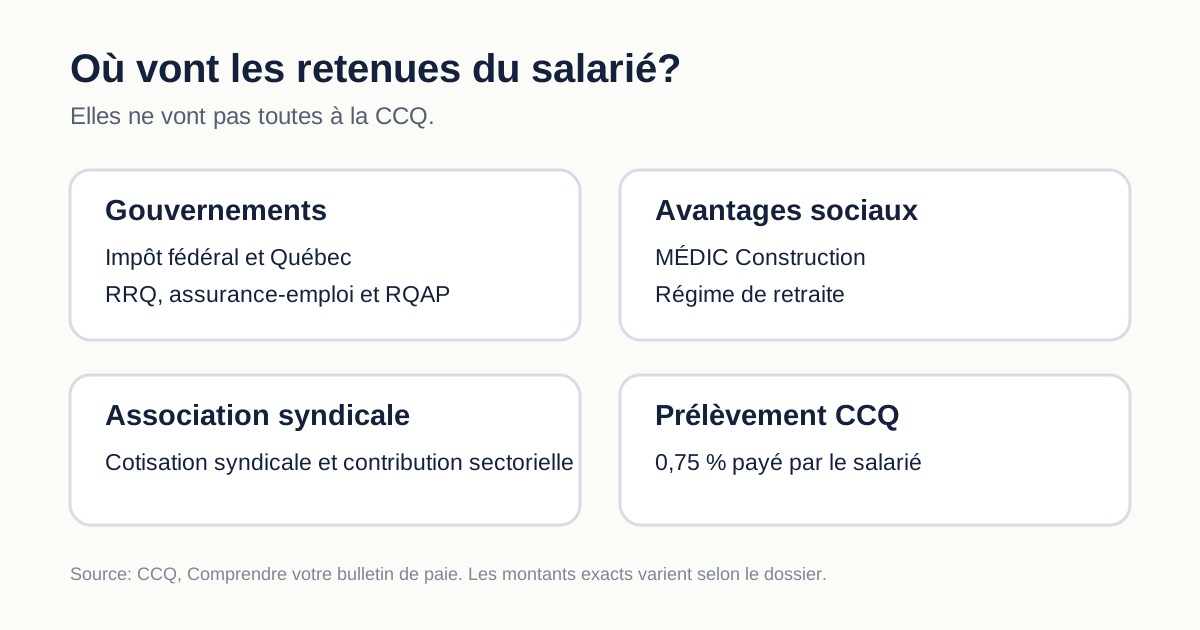
Federal and provincial taxes often form the largest category. Then add the QPP, employment insurance, QPIP, insurance, retirement, union dues, sectoral contribution, and CCQ deduction.
A high pay, overtime, or an irregular payment can also temporarily increase tax deductions. Payroll systems calculate deductions based on the period's remuneration. However, the final tax amount is determined with the annual return.
Finally, a taxable benefit can increase the income used to calculate tax without increasing the bank deposit. This line easily gives the impression that an amount has been deducted twice, whereas it represents the tax value of a protection partly paid by the employer.
False. Taxes, QPP, EI, and QPIP go to governments and public plans. Union dues are redistributed to the union. Insurance and retirement contributions finance the corresponding plans. Only the CCQ deduction directly funds the CCQ.
False. The 13% is paid by the employer in addition to the salary and later remitted to the worker by the CCQ.
False. The employer contributes notably to MÉDIC and the retirement plan. They also pay their share of public plans and the CCQ deduction.
False. Overtime increases gross income and period deductions, but tax is progressive. Not all annual income is taxed at the highest marginal rate. The tax return then establishes the final tax.
False. Retirement, certain insurances, union dues, and several conditions vary depending on the trade, sector, status, salary schedule, and union association.
False. It is the tax value of a benefit, such as insurance coverage paid by the employer. This value may be taxable even if it was not paid in cash.
Start by confirming the work period, trade or occupation, sector, apprentice or journeyman status, and the correct apprenticeship period.
Then check regular hours, overtime hours, the rate used, bonuses, travel or equipment allowances, and other amounts provided by the collective agreement.
Then separate deductions into four groups: governments, social benefits, union, and CCQ deduction. Do not mix a taxable benefit with an actually deducted amount.
Finally, compare the hours on the slip with the hours recorded in your online CCQ file. The file also allows you to consult the accumulation of vacation pay and the summary of contributions.
First, ask the payroll service or employer for the exact name of the deduction, its rate, its calculation base, and the period covered. An answer like “it's the CCQ” is not precise enough.
Then compare the slip with the official rates, the collective agreement, and your CCQ file. If an error appears in the hours or amounts declared, the employer can submit a correction.
If the disagreement persists, the worker can contact the CCQ or use the appropriate complaint and reporting process.
Gross salary is not the total cost paid by the employer, and net salary is not reduced solely by the CCQ.
Part of the deductions finances taxes and public plans. Another part finances insurance and retirement. Another is remitted to the union. The CCQ deduction represents 0.75% for the employee, with an equal share paid by the employer.
The 13% vacation is not deducted from the pay: it is paid in addition by the employer. Employer contributions to insurance, retirement, and public plans are also paid in addition.
When a worker compares a pay or a construction job offer with a 150-hour guarantee, they must therefore look beyond the hourly rate: the sector, status, bonuses, social benefits, retirement, and applicable deductions together determine the real value of the job.
You might like
ConstruMD
Nov 5, 2026

ConstruMD
Nov 5, 2026

ConstruMD
Nov 5, 2026