
Easily find a 150h construction guarantee
ConstruMD
Nov 5, 2026
All Posts
SHARE THIS POST
Published : November 5, 2026
The CCQ labour pools are among the topics that create the most confusion for workers wanting to enter the construction industry and for employers who are short on labour. A pool may be closed today, go under review tomorrow, and then open only for a limited period. For someone ready to work, this difference can determine when they can actually start their process.
The issue becomes even more tangible after the construction holidays, when many sites resume work, employers look to replace or add workers, and candidates monitor openings by region and trade. The CCQ also indicates that its labour pool status consultation tool provides daily information by region, trade, or occupation, but it may sometimes be intermittently inaccessible. In other words, understanding the system before an opening occurs is crucial.
This guide simply explains what a worker needs to know: what a pool is, when it is open, who can reserve a spot, what the 150-hour guarantee means, why a reservation is not always enough to start on a site, and what to prepare to avoid wasting time.
A pool is used to assess whether the workforce already holding a certificate is sufficient in a given region for a trade or occupation. The logic is regional and specific: it is not about a general shortage in the entire construction industry, but a lack for a trade or occupation, in a region, at a given date.
The CCQ explains labour pools as a mechanism related to industry access. When availability is too low, an employer can reserve a spot so that a new person can begin the process leading to a work right. For workers, it is often one of the entry points when they do not yet have a competency certificate.
Understanding the regulatory basis is important. On a site subject to Law R-20, a person cannot simply show up because an employer wants to hire them. The CCQ reminds that anyone performing construction work as defined by the law must hold a valid work right, such as a competency certificate, an exemption, a process confirmation number, or a temporary right. It is the employer's responsibility to verify this validity before allowing the person to start.
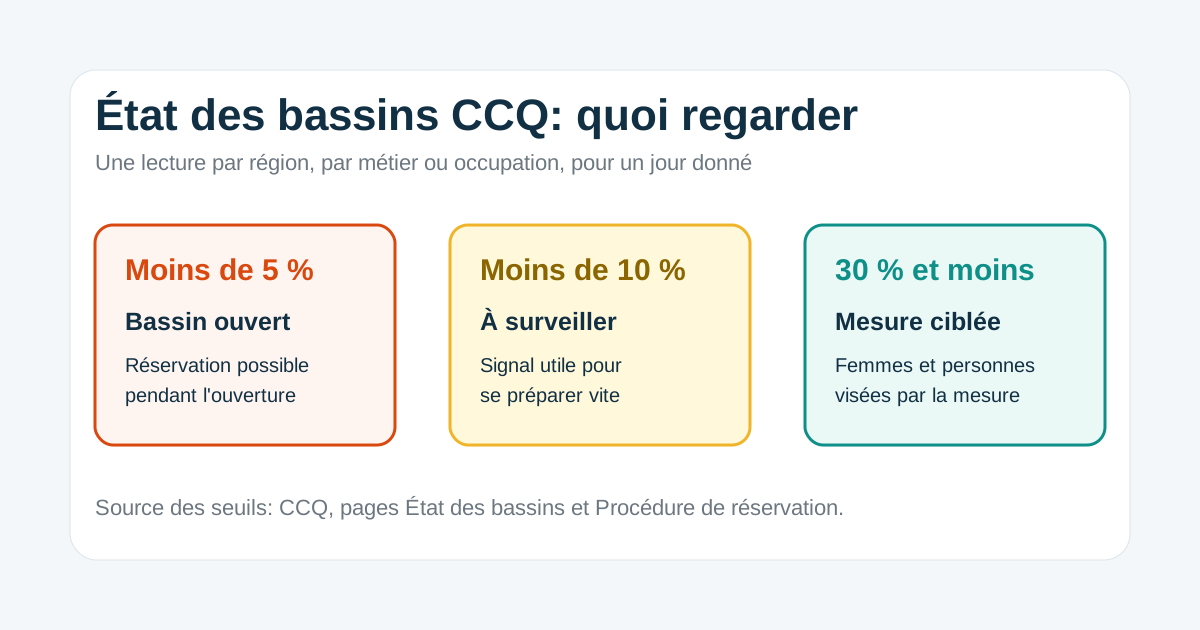
When monitoring the pools, three thresholds often come up: open pool, less than 10%, and 30% or less. They do not mean the same thing.
An open pool means that availability is low enough for the situation to be considered a shortage for the trade or occupation in the targeted region. According to CCQ procedure, an opening corresponds to less than 5% of apprentice or occupation competency certificate holders being available.
This is when an employer can reserve a spot for a person, guaranteeing them 150 hours of work over three consecutive months. The nuance is essential: the worker does not reserve their own spot. The process goes through the employer or, in some cases, through an employer or union association.
A pool at less than 10% indicates that availability is low and needs to be closely monitored. It is not automatically an opening. For a worker, it is time to prepare their file, confirm their trade, region, documents, health and safety course, and potential employer. For an employer, it is time to clarify the real need, as an opening may be short.
The CCQ also offers a Shortage Alert service to receive notifications when a pool opens or reaches certain thresholds. This service does not replace preparation, but it reduces the risk of missing a window.
The 30% or less threshold specifically concerns women, First Nations and Inuit people, or individuals representing the diversity of Quebec society, according to the specified conditions. It is not a general opening for everyone. It is a targeted access measure that can allow a reservation even when the pool is not open in the sense of the less than 5% threshold.
The modernization of the industry has also added or adjusted several measures related to access, mobility, and inclusion. The official page on the modernization of the construction industry presents the changes already in effect and those to come. In simple terms: the system is not only aimed at quickly filling positions but also at regulating who can enter, in what context, and with what obligations after entry.
The 150-hour guarantee is a promise of employment made by an employer. It means that the employer commits to providing 150 hours of work over a period of three consecutive months. It serves to demonstrate that the demand is not theoretical: there is a real need and an employer ready to integrate the person.
But this guarantee is not a CCQ card. It does not, by itself, grant the right to work on a regulated site. It is part of a process. The reservation must then be accepted, and the worker must obtain the applicable work right.
This is where many misunderstandings arise. A worker may believe that a verbal promise is sufficient. An employer may believe that a reservation settles everything. In reality, the CCQ specifies that reserving a spot does not automatically grant immediate access to construction sites. The candidate must first hold a valid work right related to the targeted pool.
The practical rule is simple: the candidate does not reserve their own spot. The reservation process goes through an employer or an authorized association. The employer must have a need, target the right region and the right trade or occupation, and then submit the required information.
To reserve a spot, the employer must provide their employer number to the CCQ, information about the person responsible for the company, the region of the pool, the trade or occupation, as well as the exact details of the worker. The name, first name, and date of birth must be accurate, particularly to validate the General Health and Safety course on construction sites.
For candidates looking for an employer willing to support their entry, a page of construction jobs with a 150-hour guarantee can help identify opportunities aligned with this approach. The link does not replace official validation with the CCQ, but it can make the search more concrete.
Not necessarily. This is probably the most important point of the entire process. An accepted reservation opens the door to a process, but the worker must obtain a valid work right before accessing the site.
The CCQ notably describes the confirmation number of the process according to the state of the pools. This number can allow the employee to work in the trade or occupation and the concerned region while they submit the required documents to complete their application. The CCQ page on hiring rules specifies that this number is temporary and valid up to 14 working days following the reservation.
If this number is not obtained, the worker must wait to receive their competency certificate or exemption before going to the site. For the employer, allowing someone to start too early can create a compliance issue. For the worker, starting without the correct status can also harm the clarity of their record, hours, and progression.
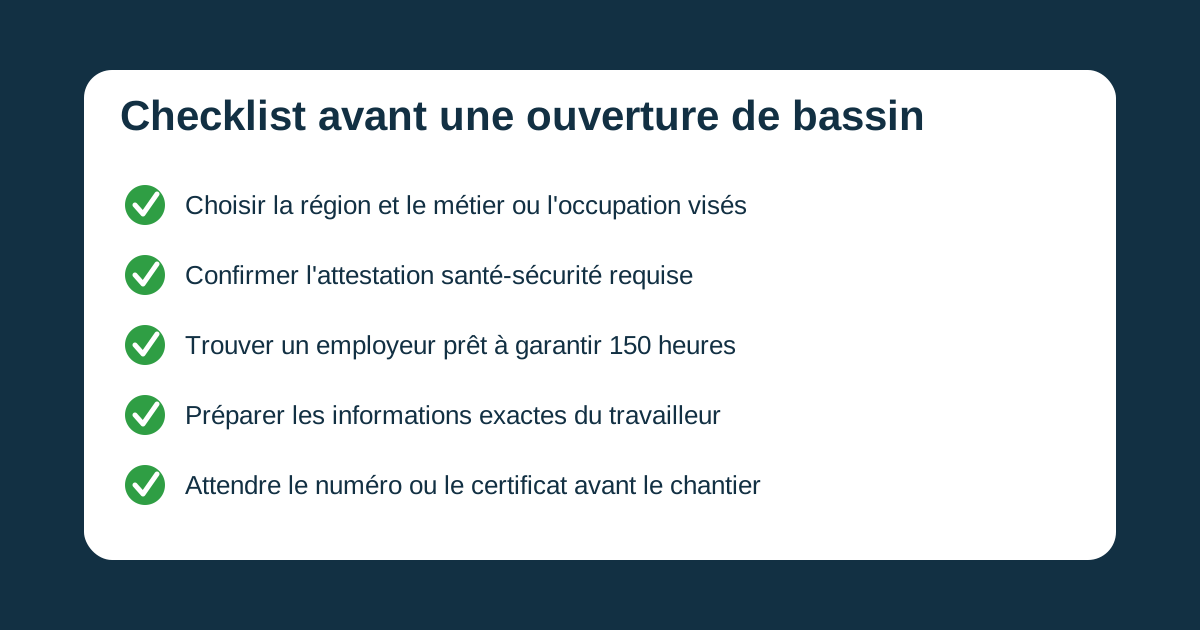
The best strategy is not to wait for a pool to open to start organizing. An opening can be quick. Services can be busy. The daily tool can be consulted by many people at the same time. An incomplete file can cause the window to be missed.
The worker should first know exactly which trade or occupation they are targeting. An entry into a pool is not a vague entry into "construction." It is linked to a region and a trade or occupation. This precision influences tasks, salary, learning, recognized hours, and the subsequent path.
They should then confirm their health and safety course, prepare their exact personal information, and clearly discuss with the employer the 150-hour guarantee. Those who are still unsure about the path can reread the ConstruMD guide on trades and occupations in construction in Quebec to better distinguish roles before targeting a pool.
On the employer's side, preparation is just as important. It is necessary to verify that the need corresponds to the right trade or occupation, that the region is correct, that the candidate's information is accurate, and that the 150-hour guarantee is realistic.
The employer must also verify the work right before access to the site. The ConstruMD guide on what to check before hiring without a CCQ card complements this reading well, as it explains why experience or goodwill do not replace a compliant status.
Another common mistake is to promise too quickly. If the employer is not sure they can offer the 150 hours in the planned period, the process can create false expectations. A guarantee must be taken seriously, especially for a worker organizing their entry into the industry around this promise.
The state of a pool depends on available workers, regional needs, trades, occupations, and actual movements in the industry. A pool can therefore change without the entire market having changed. It only takes a specific trade to be lacking in a specific region.
This is also why discussions sometimes become confusing. One person may see an open pool for a region and a trade, while another person sees a closed pool for another trade in the same region. Both can be right. The reading must always combine three elements: region, trade or occupation, and date.
The first mistake is to believe that a pool at less than 10% is already open. It is a monitoring signal, not an automatic authorization.
The second is to believe that the worker can reserve their own spot. The process must go through an employer or an authorized association.
The third is to confuse the 150-hour guarantee with the work right. The guarantee supports the application, but a valid work right is still necessary before working on a regulated site.
The fourth is to aim for an approximate trade. If the request does not match the correct trade, occupation, or region, the application may not lead to the expected result.
The CCQ pools are a mechanism for accessing the industry, but they do not function like a simple waiting list. They require a precise understanding of the pool's status, a reservation made by the right actor, a guarantee of 150 hours when required, and above all, a valid work permit before arriving on the job site.
For a worker, the right reflex is to prepare before the opening: choose the right trade, confirm their region, have their documents ready, find a serious employer, and check the next steps with official sources. For an employer, the right reflex is to document the process and not let a person start before their status is clear.
The pool can open quickly. The application, however, must be ready beforehand.
You might like
ConstruMD
Nov 5, 2026

ConstruMD
Nov 5, 2026
ConstruMD
Nov 5, 2026