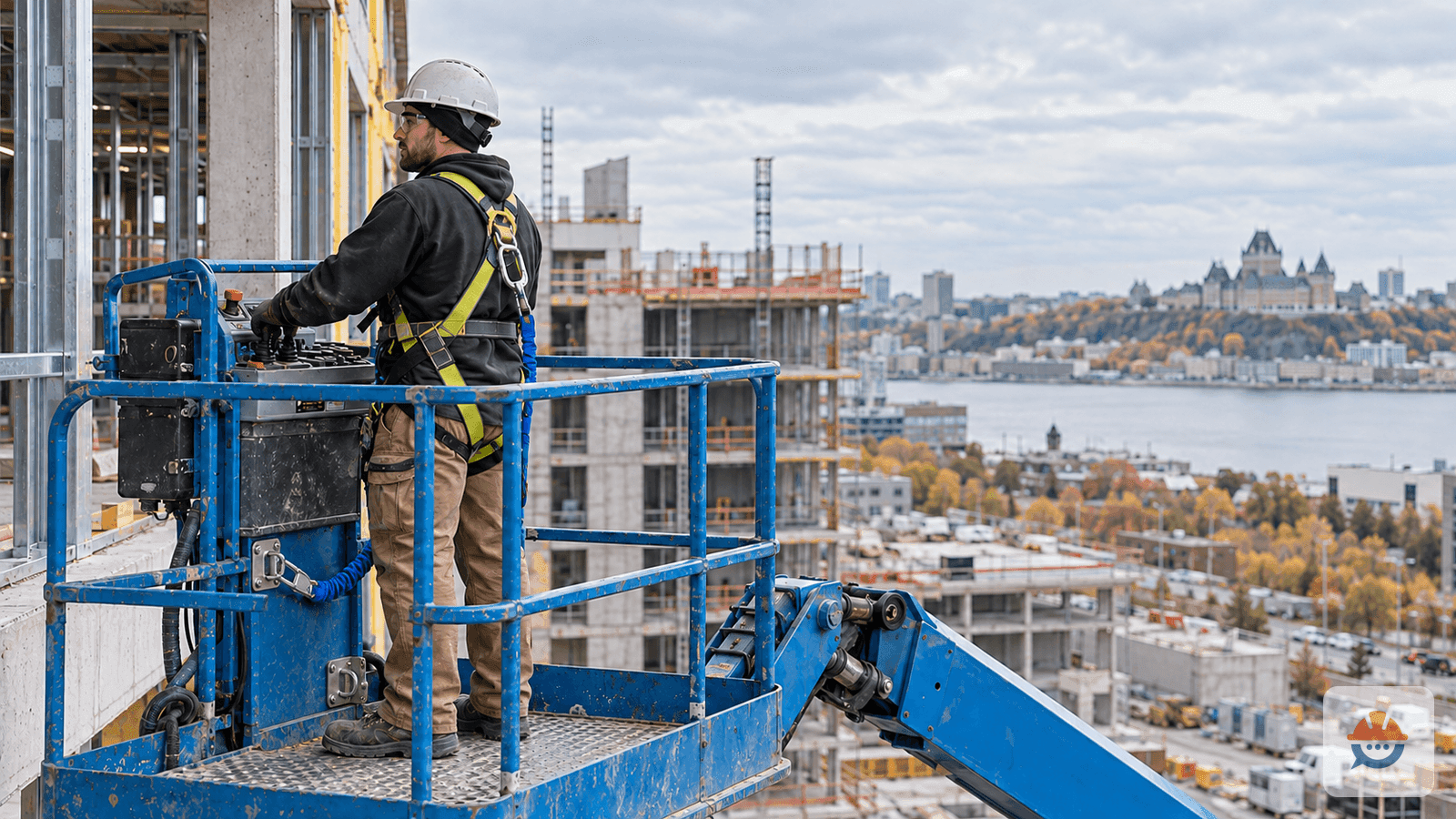
Harness and Aerial Platform: The Rule in Quebec
ConstruMD
Nov 5, 2026
All Posts
SHARE THIS POST
Published : November 5, 2026
Starting in construction at 18, 19, or 20 years old can give a very mixed impression. On one hand, the job offers a regulated salary, clear progression, benefits, a pension plan, and a high demand for labour. On the other hand, the days start early, the body takes a toll, commuting is burdensome, payroll deductions are surprising, and the net salary can seem much less impressive than the advertised hourly rate.
The discomfort is real. It shouldn't be dismissed with a phrase like "toughen up." But neither should a bad week, a bad employer, or a first difficult-to-understand paycheck be taken as proof that the entire industry isn't worth it.
The right question isn't just "should I stay or should I leave?" The right question is rather: what exactly is making me doubt, and is the problem with the job, the employer, the sector, my budget, my health, or my expectations?
Construction has a very strong performance culture. Endurance, punctuality, physical effort, the ability to keep up, and quick autonomy are valued. For a young worker, this culture can be motivating, but it can also become burdensome if the support is weak.
At 20, many are discovering full-time work, taxes, contributions, commuting, tool purchases, accumulated fatigue, variable schedules, and job site expectations all at once. Even with a good gross salary, daily life can give the impression that the effort isn't paying off quickly enough.
This is exactly why a superficial article isn't enough. Saying "construction pays well" is incomplete. Saying "everything is too hard" is also incomplete. We need to look at the facts and separate what is normal in the industry from what should be corrected.
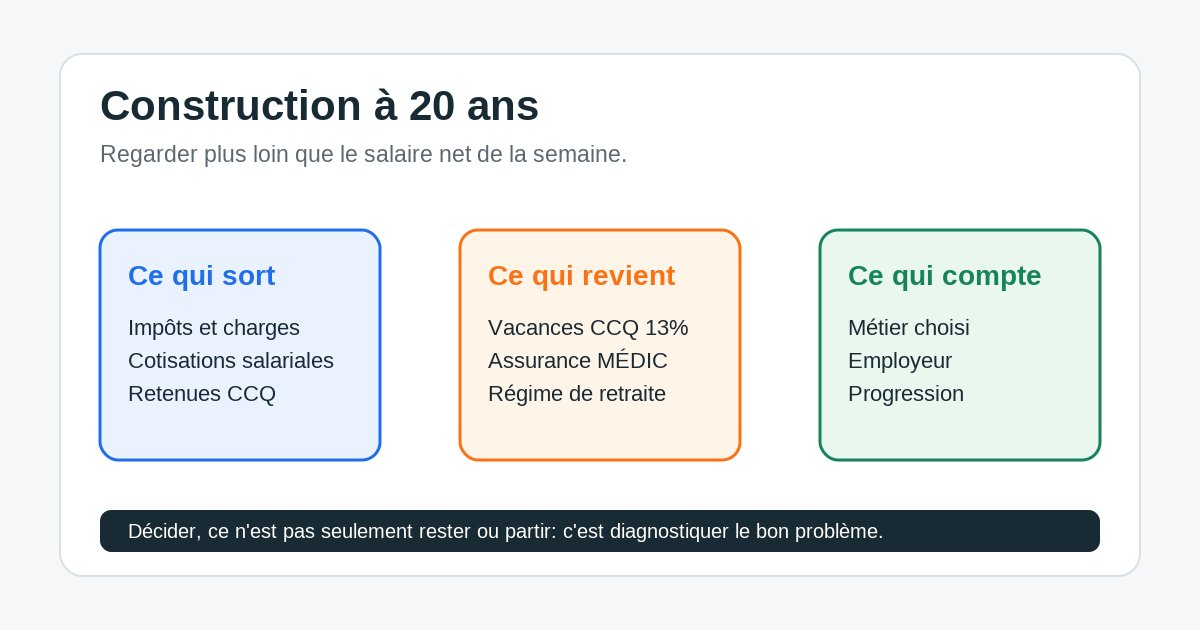
The first shock often comes with the paycheck. A worker sees their gross, looks at their net deposit, and then feels like a huge part of the money has disappeared. Part of it comes from mandatory deductions common to many workers in Quebec: federal tax, provincial tax, employment insurance, Quebec Pension Plan, and Quebec Parental Insurance Plan. The CCQ also explains that for work subject to the R-20 Law, the employer must deduct other amounts and remit them to the CCQ.
These deductions are not all "taxes" in the popular sense. Some are used to fund plans or protections. On the CCQ pay stub, you can notably find employee contributions for benefits, the MÉDIC Construction insurance plan, the pension plan, union dues, and the CCQ levy.
The important point is this: the week's net doesn't show everything that is part of the total compensation. The CCQ specifies, for example, that the employer also pays a contribution for insurance and an employer contribution to the pension plan. This employer portion is paid in addition to the salary. It is not simply taken out of the worker's pocket.
You also need to understand vacation pay. Annual leave, statutory holidays, and sick leave allowances represent 13% of the gross salary. According to the CCQ, these amounts are not deducted from the worker's pay; they are paid by the employer to the CCQ, placed in a fund, and then paid out before the summer and winter vacations. To untangle the deductions line by line, the ConstruMD article on CCQ pay and payroll deductions complements this explanation.
A construction hourly rate can seem very high when compared to other entry-level jobs. But the worker doesn't live on their hourly rate. They live on their deposit, their actual schedule, their weeks worked, their expenses, their physical recovery, and the stability of their job.
A young worker can therefore be well paid on paper and still feel squeezed. Boots, clothing, commuting, lunch, vehicle, gas, phone, tools, and quieter periods change the perception of the salary. It's not a contradiction. It's the difference between a good rate and real quality of life.
The solution is not to deny the frustration. It's to calculate correctly. A worker should look at their net income over several weeks, include vacation pay, understand their protections, and compare their possible progression over 12, 24, and 36 months. Construction can be lucrative, but it especially rewards those who manage to last, progress, and choose the right environment.
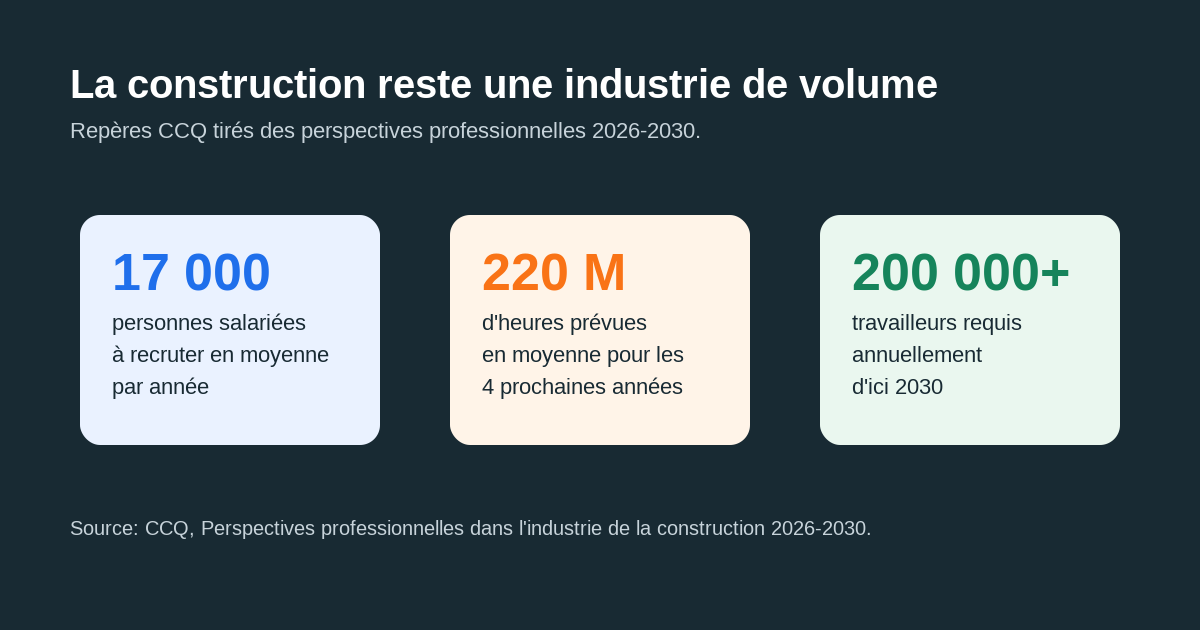
Despite its difficulties, Quebec construction remains a very large industry. The CCQ indicates that in 2025, the industry represented nearly 90 billion dollars in investment spending, 216.7 million hours worked, and 203,032 active employees. It's not a marginal market. It's an economic pillar where many trades remain necessary.
Recent prospects go in the same direction. In its 2026-2030 professional outlook, the CCQ estimates the labour needs at 17,000 salaried people on average per year. It also forecasts 220 million hours worked on average for the next four years and more than 200,000 workers needed annually by 2030.
For a young person, this context changes the analysis. The industry is not easy, but it still offers real demand, possible mobility, and progression guided by collective agreements. Wage rates and several compensation elements are published by the CCQ in its wages and rates tool, with an important note: in case of disparity, official collective agreements take precedence.
ConstruMD has also summarized the CCQ outlook 2026-2030 from a recruitment perspective. For a worker, these figures mean one concrete thing: if the industry needs new blood, a reliable, trained, and consistent young person can have significant value in the market.
Construction is not only paid in payroll deductions. It is also paid in fatigue, travel, early morning hours, difficult weather, production pressure, and job site instability. The CCQ describes the industry as a sector marked by workforce mobility, limited-duration projects, and cyclical and seasonal instability.
This point is essential. If a young worker feels drained after a few months, the problem is not automatically a lack of will. They may be facing a real characteristic of the sector: job sites change, teams change, there are busy and slow periods, and employment does not always have the stability of a fixed position in a factory or office.
Therefore, an honest comparison is necessary. A less well-paid job, but stable, close to home, and less physically demanding can provide a better quality of life in the short term. A job in construction can offer better progression in the medium term, but only if the worker manages to keep up without burning out.
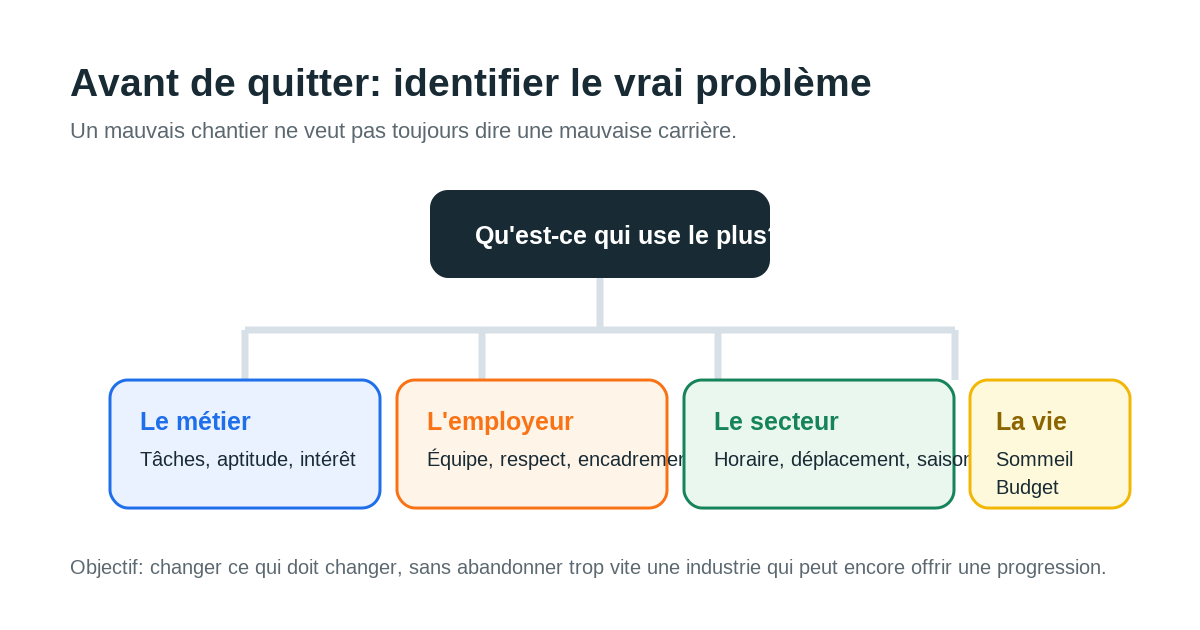
Before leaving construction, the real problem must be identified. Many workers say "I don't like construction," when they are mainly experiencing a bad combination: bad employer, bad foreman, bad sector, too much travel, lack of support, or a trade that does not match their strengths.
Some trades require more precision, others more physical strength, others more tolerance to heights, dust, noise, cold, or repetitive work. A young person may be in the right sector but not in the right trade. Before leaving the industry, it may be worthwhile to explore the trades and occupations in construction in Quebec to see if another path better matches their profile.
A bad employer can make the entire industry seem worse than it is. A poorly trained, disrespected worker, sent too quickly into tasks they do not master, or constantly treated as replaceable is likely to drop out. Conversely, an employer who explains the pay, supports the apprentice, respects safety, and provides clear progression can completely change the experience.
Changing employers is not a failure. In a mobile industry, it is sometimes the most rational decision. Construction jobs with a 150-hour guarantee can be a starting point to find offers where entry and minimal stability are better framed.
Residential, institutional and commercial, industrial, civil engineering, and roadwork are not all experienced in the same way. Schedules, distances, teams, pressure, tools, standards, and the type of job site change. A worker may hate their current daily routine and still love construction in another sector.
It must be stated directly: if work destroys sleep, mood, physical health, or personal life, the salary does not compensate for everything. Construction can be a good career, but it should not become a permanent test of endurance at the expense of health. In this case, the schedule, employer, sector, or trade choice must be adjusted before fatigue leads to complete dropout.
Staying can be logical if the worker sees real progression. For example: they are learning, becoming more autonomous, their employer respects the rules, their hours are accumulating, their trade suits them, their body recovers properly, and their net income becomes more predictable over time.
Staying can also be logical if the frustration mainly comes from a lack of understanding of the pay. When a worker understands what is deducted, what returns in vacations, what finances their protections, and what the employer pays extra, they can assess their situation more accurately. This does not make every deduction pleasant, but it avoids wrongly concluding that all is lost.
Finally, staying can be logical if the worker begins to build rare value: punctuality, reliability, up-to-date certifications, good safety habits, ability to work in a team, and willingness to progress. In an industry where workforce needs remain high, these qualities can carry significant weight.
Changing employers or environments becomes necessary if the problem is repeated and documentable: incomprehensible or non-compliant pay, poorly managed overtime, neglected safety, lack of support, toxic climate, lack of respect, or promises that never materialize.
The CCQ indicates that the worker can consult the rates and that there are recourses available when they believe they are not being paid according to the collective agreements, particularly for overtime or travel expenses. This is not a minor detail. A young worker should not resolve a questionable pay situation solely with hallway advice.
Changing trades may also become necessary if the tasks do not match the skills. A worker who likes the industry but not their current trade sometimes has more to gain by reorienting within construction than by leaving it entirely. The ConstruMD article on changing trades in construction targets a different age, but the logic is useful: one must distinguish between fatigue from a position and the end of a career.
Retaining young workers is not solved solely with better talk about good wages. A young person who does not understand their pay, does not see their progression, feels replaceable, and ends each day exhausted will eventually have doubts, even in a high-demand industry.
Employers have an interest in clearly explaining the total compensation: gross salary, net salary, CCQ vacations, insurance, retirement, contributions, expected hours, travel, equipment, and possible progression. This transparency reduces frustration because it replaces the feeling of having money taken away with a more complete understanding of the system.
They must also support the early years. A 20-year-old worker does not just need an hourly rate. They need to know what they are learning, what they need to improve, how they can advance, what to do when they are exhausted, and who to talk to when something is not working. In a market looking for new talent, leaving young workers to fend for themselves is costly.
Before saying that construction is not worth it, a young worker should honestly answer a few questions. Do I understand my pay, or am I only judging the net deposit? Does my trade really suit me? Does my employer help me progress? Is my main problem fatigue, the commute, the team, money, or uncertainty? Have I tried another sector or another employer before leaving the industry?
These questions are not meant to convince everyone to stay. They are meant to avoid a bad decision. Leaving may be the right option for some. But leaving without a diagnosis can also mean losing a career that could have been better with another trade, another team, or a better understanding of the system.
Construction at 20 can still be worthwhile, but not at any cost. It is worthwhile if the worker understands their pay, sees progression, finds a serious environment, protects their health, and chooses a trade compatible with their strengths.
It becomes less appealing if the net salary hides permanent fatigue, poor support, difficult-to-manage instability, or a lack of perspective. The right reflex is not to glorify the industry nor to condemn it. It is to sort through the facts, normal irritants, real warning signs, and possibilities for change.
For a young worker, the best decision is rarely made after just one bad week. It is made by understanding where the money goes, what the industry can offer, what it demands in return, and what realistic place they can build within it.
You might like
ConstruMD
Nov 5, 2026
ConstruMD
Nov 5, 2026
ConstruMD
Nov 5, 2026