150-Hour CCQ Guarantee: What the Employer Really Promises
ConstruMD
Nov 5, 2026
All Posts
SHARE THIS POST
Published : November 5, 2026
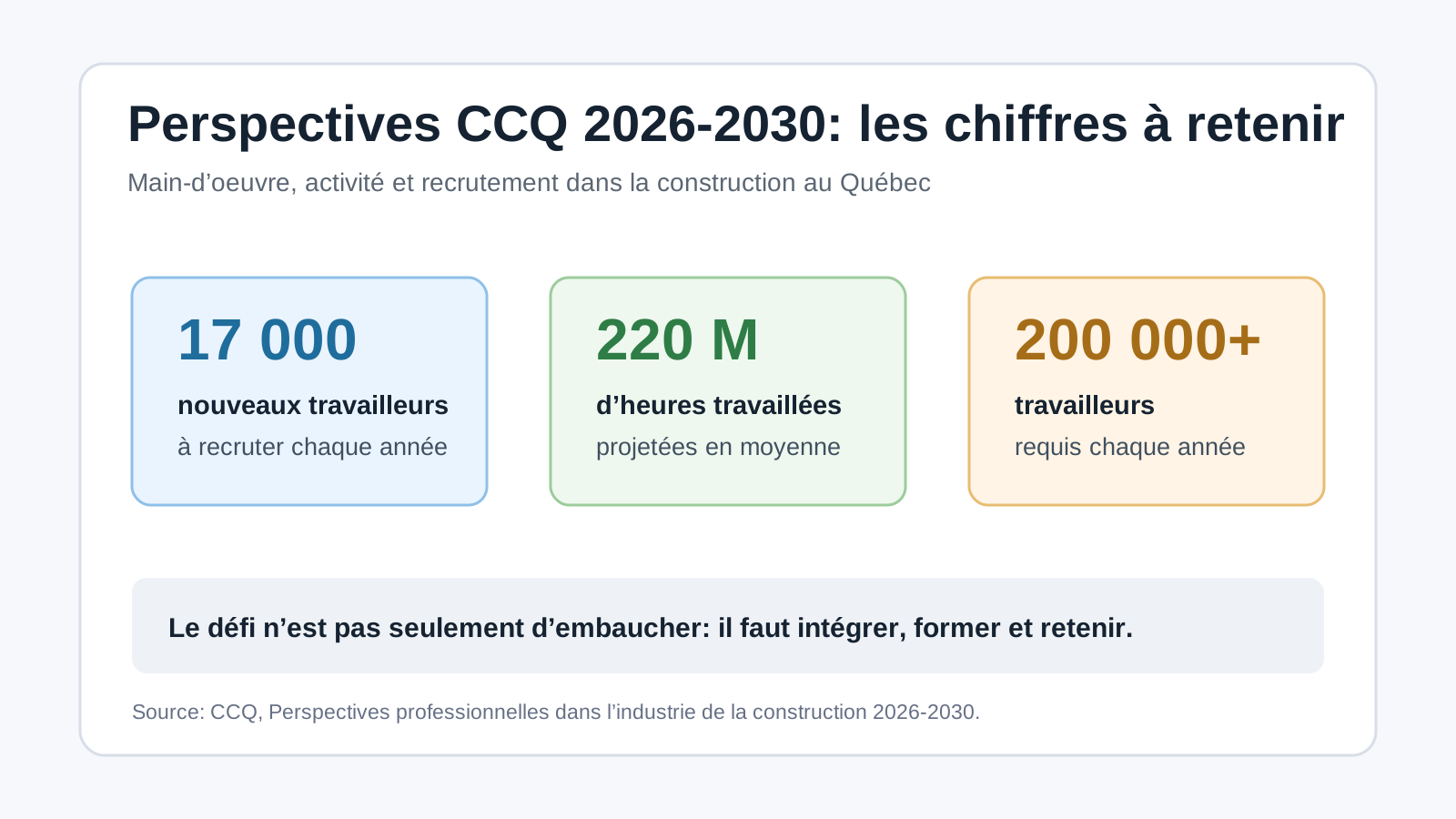
The new CCQ outlook for 2026-2030 confirms a reality that many employers are already experiencing on the ground: Quebec's construction industry will need about 17,000 new workers per year to meet demand, replace departures, and support the expected volume of activity.
This figure should not be read as a mere statistic of shortage. It indicates a deeper change: companies can no longer treat recruitment as a last-minute reaction. The workforce is becoming a planning issue as important as materials, schedules, subcontractors, and financing.
Long-term outlooks are useful, but the construction jobs in Quebec posted today show where demand is already active.

According to the CCQ, the 2026-2030 professional outlook forecasts an annual average of about 220 million hours worked in the industry. To support this activity, more than 200,000 workers will be required each year, and the industry will need to welcome about 17,000 new workers annually.
These needs do not stem from a single cause. They combine project demand, retirements, turnover, sector changes, apprentice progression, and companies' ability to retain workers.
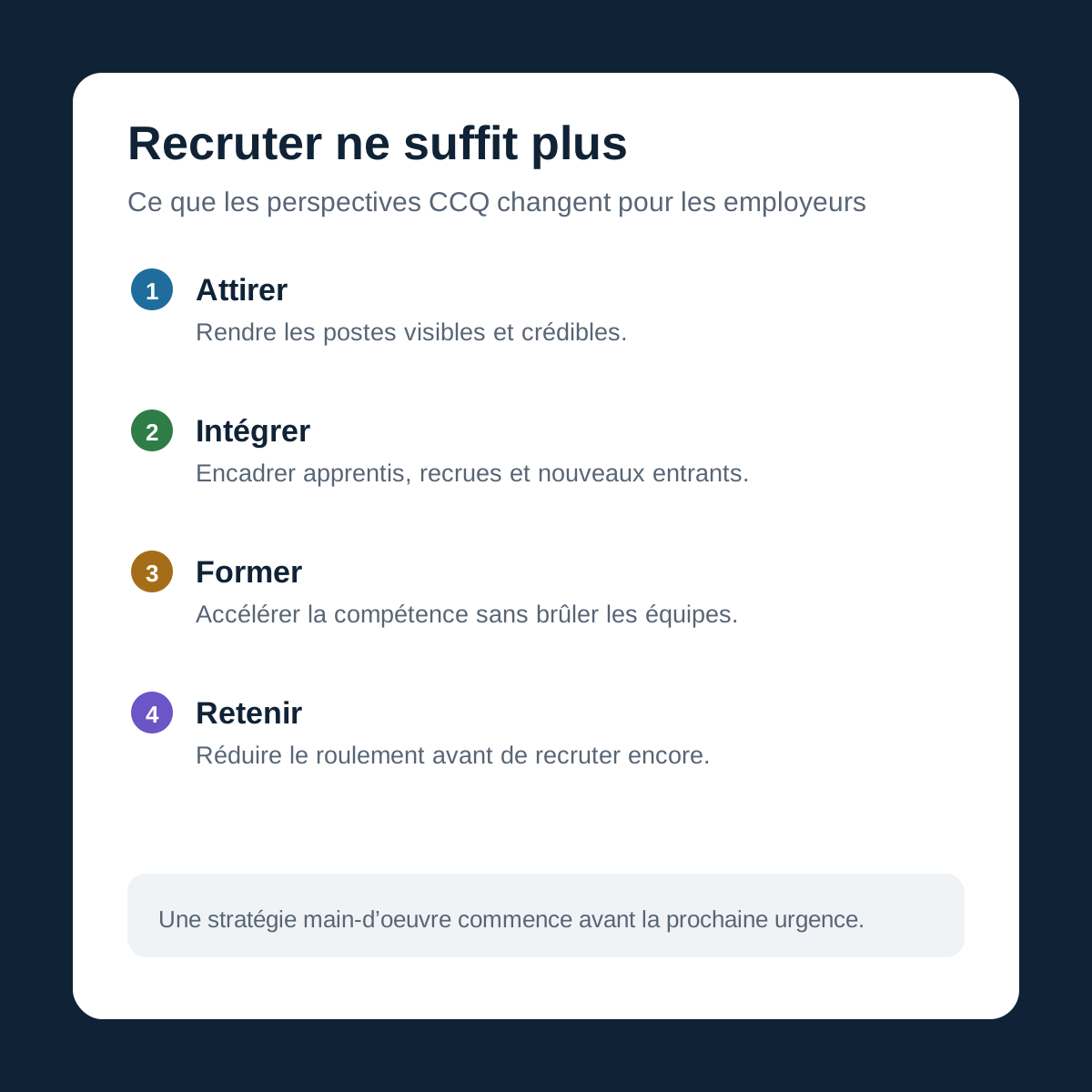
Talking about a shortage sometimes gives the impression that it's just about finding more candidates. In construction, the problem is broader. It's necessary to attract people to the industry, bring them in through the right mechanisms, train them, support them, and keep them long enough to become productive.
A worker who enters the industry but leaves quickly does not solve the problem. A poorly supported apprentice can slow down a team instead of strengthening it. An employer who recruits in a rush risks repeating the same cycle every season.
The question then becomes: how to transform recruitment into a sustainable system?
For contractors and managers, the CCQ outlook changes the way workforce planning is done. Recruitment should no longer start only when a site is short-handed. It should be linked to the project schedule, critical trades, peak periods, and succession needs.
A company that waits until it is short-staffed often finds itself in direct competition with several other employers. In a tight market, the recruitment delay becomes an operational risk. Planning earlier allows for better targeting of profiles, preparing integration, and avoiding overloading existing teams.
Apprentices are essential for succession, but they do not become autonomous instantly. The ConstruMD article on how to hire an apprentice in construction in Quebec can help employers better understand entry conditions, hour guarantees, and responsibilities related to hiring.
Integration must be structured: who supervises the apprentice, what tasks are assigned, how progress is tracked, and how to avoid them being perceived only as an additional burden for the team.
Retaining a worker often costs less than replacing them. Employers who want to meet the 2026-2030 needs will have to look beyond salary: quality of supervision, schedule stability, site climate, safety, communication, progression, and work recognition.
Needs will not be identical across all trades. Some sectors may be more sensitive depending on work volumes, regions, and expected departures. The CCQ presents the trades and occupations that structure access to the industry, reminding us that the construction workforce is not a single interchangeable block.
To better understand the types of profiles present on sites, ConstruMD also offers a guide on trades and occupations in construction in Quebec. This link is useful because recruitment must be thought of by trade, experience level, and site reality.
If the industry needs to integrate about 17,000 new workers per year, access to trades becomes a major lever. Workforce pools, graduates, apprentices, experienced workers from other sectors, and new entrants will all need to contribute.
ConstruMD explains how the CCQ workforce pool and access to construction trades work. This topic becomes directly linked to the 2026-2030 outlook because every opening or restriction of access influences companies' ability to meet real needs.
Consideration must also be given to those who want to enter without a traditional path. The ConstruMD article on construction jobs without training in Quebec can help clarify what is possible, what depends on pools, and what requires a more structured approach.
When the workforce is lacking, the effects are quickly visible: extended delays, less available subcontractors, more difficult cost forecasting, stretched teams, quality risks, and increased pressure on foremen.
For project owners and investors, CCQ forecasts are also a planning signal. A project depends not only on the budget and the permit. It also depends on the actual availability of trades at the right time.
The response should not be an isolated recruitment campaign. Employers benefit from implementing a simple but continuous strategy.
Identify critical trades, hard-to-fill positions, peak periods, and potential departures. This mapping allows for recruitment based on upcoming projects, not just weekly emergencies.
A new employee should know what to expect from day one: tasks, tools, safety rules, point of contact, production expectations, and possible progression.
The turnover rate, reasons for leaving, and recurring irritants must be tracked. A company that does not understand why people leave risks recruiting without ever stabilizing its teams.
Foremen play a central role in integration and retention. They cannot bear the pressure of productivity, training, and supervision alone without clear support from the company.
The need for approximately 17,000 new workers per year is not just an impressive figure. It is a strategic warning for the industry.
The companies that will succeed the most will not just be those that post the most job offers. They will be those that attract the right profiles, better integrate newcomers, develop apprentices, and retain skilled workers.
In Quebec's construction industry in the coming years, the workforce will not be a secondary HR issue. It will be at the heart of the ability to deliver projects.
You might like
ConstruMD
Nov 5, 2026
ConstruMD
Nov 5, 2026

ConstruMD
Nov 5, 2026