CCQ Retirement: When Can You Transfer Your Fund to a LIRA?
ConstruMD
Nov 5, 2026
All Posts
SHARE THIS POST
Published : November 5, 2026
Changing careers around the age of 40 can seem risky, especially in construction. Many workers already have a good salary, a routine, a specialty, sometimes a journeyman status or several years of experience in a specific field. Starting over in another trade can then feel like a step backward.
But the question deserves more than a simple "yes" or "no." In Quebec's construction industry, a career change can be a very good decision if well planned. It can also become frustrating if the worker discovers too late that their hours don't count as expected, that income drops more than anticipated, or that the new trade doesn't fit their physical and family reality.
The real issue is not age. It's the clarity of the plan.

The reasons vary. Some want to leave a trade that is too physically demanding. Others seek more stability, a better schedule, better long-term income, a more sought-after specialty, or a path that better suits their body after many years on the job site.
There are also workers who love construction but not their current role. A journeyman in one field may want to become an apprentice in another trade because they see more advancement opportunities, more work in their region, or a better quality of life.
This choice is particularly important in a context where the workforce remains a major issue. The ConstruMD article on CCQ perspectives 2026-2030 shows that the industry will need to continue attracting and retaining workers. Experienced adults in transition are part of this pool, even if they are not always treated like typical beginners.
Changing trades doesn't always mean that all experience disappears. However, in the construction system, the targeted trade, the certificate held, and the recognized hours matter a lot.
The CCQ explains the competency certificates, including the apprentice competency certificate and the journeyman competency certificate. A journeyman competency certificate confirms that a person has demonstrated their qualifications in a trade. An apprentice competency certificate is for someone learning a specific trade.
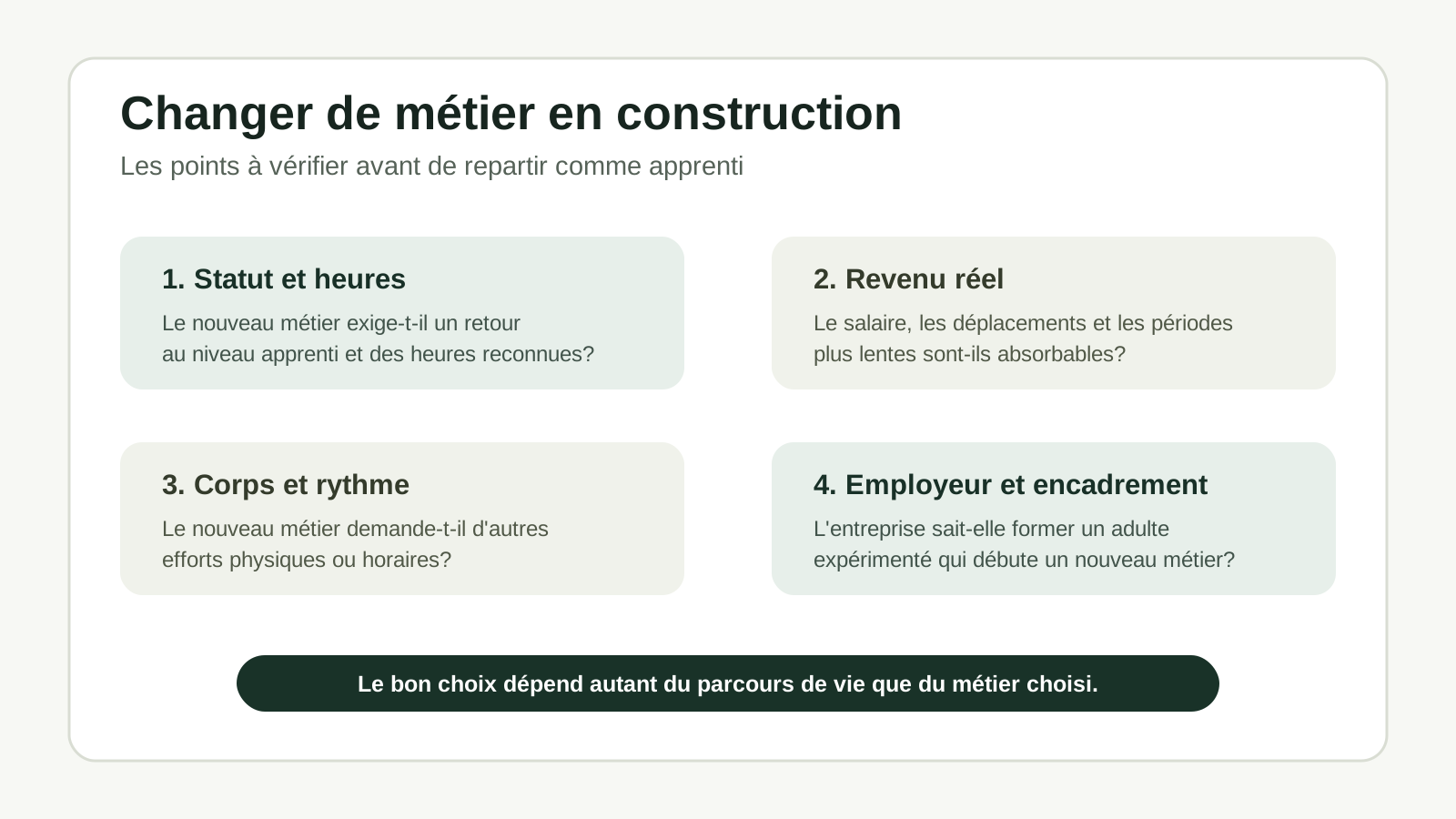
This is where many workers experience a shock. Being experienced in one field does not automatically mean being a journeyman in another trade. A change may therefore involve returning to apprentice status, with the rules, hours, and progression that come with it.
For a worker in transition, hours are often the crux of the matter. The CCQ page on the apprentice competency certificate specifies that the hours recorded in the apprenticeship logbook are those registered by the monthly reports of construction employers or recognized following a request for recognition of hours.
In other words, it's important to distinguish three things: actual experience, declared hours, and hours recognized in the right trade. A worker may have a lot of field experience but still need to have their file analyzed if they want certain hours or training to be recognized.
The CCQ has a page on the recognition of training and work experience. It notably indicates that hours worked outside the scope of the R-20 Act must be submitted to the CCQ for analysis before being credited to the apprenticeship logbook.
The financial aspect must be considered objectively. A 40-year-old worker often doesn't have the same reality as a 19-year-old: mortgage, children, debts, vehicle, insurance, family responsibilities, income habits.
Even if the new trade offers better long-term potential, the first months or years can be tighter. Returning to apprentice status can mean a lower salary, an adjustment period, less control over tasks, and sometimes uncertainty about the volume of hours.
Therefore, a realistic calculation is necessary: current income, possible income as an apprentice, fixed expenses, travel time, seasonality, available hours, costs of tools, equipment, training, and safety margin. This calculation should not kill the project. It should prevent the project from failing for a foreseeable reason.
Even if the official status changes, an experienced adult doesn't start from scratch. They often arrive with better punctuality, a better understanding of risks, an understanding of job sites, maturity in team relationships, and an ability to handle pressure.
For an employer, this is real value. An adult apprentice can learn a new trade faster than a complete beginner because they already understand the logic of the job site: safety, coordination, work sequence, communication with other trades, client requirements, and the importance of quality.
The challenge is not to confuse maturity with qualification. An experienced worker deserves respect, but they still need to learn the skills, standards, methods, and requirements of the new trade.
At 40, the body is not finished. But it speaks louder. A career change can be a good way to leave a trade that wears out too quickly, but it can also lead to another equally demanding trade if the choice is poorly evaluated.
Before making a change, it's important to consider repetitive movements, loads, positions, working at heights, weather conditions, schedules, travel, and the physical demands of the new job. Some jobs are more demanding on the back, others on the shoulders, knees, hands, or overall endurance.
The ConstruMD guide on construction jobs and occupations in Quebec can serve as a starting point for comparing the realities of various career paths. The decision should not be based solely on salary or the comments of other workers.
An adult in transition needs an employer who understands their situation. They are not just looking for a first chance. They often seek a structured opportunity: to learn seriously, be properly evaluated, understand their career path, and know how their hours will be managed.
For the employer, transparency is essential. They must explain the status, tasks, expectations, supervision, possible hours, and potential progression. The ConstruMD guide on how to hire an apprentice in construction in Quebec highlights several useful elements for structuring the onboarding process and avoiding misunderstandings.
A good employer should not sell a career change as a vague promise. They should help the worker understand what is realistic and what is not.
Depending on the desired trade, training can be a decisive step. The CCQ reminds us, on its page about training in the industry, that the apprentice must complete the required number of hours for their trade before becoming a journeyperson, whether or not they hold a DEP.
This does not mean that everyone must return to a full academic path. But it's important to know which trainings are useful, recognized, or necessary. The Government of Quebec also offers an entry point to discover construction trades, which can help compare options before diving in.
For those starting or returning to the industry, the ConstruMD article on essential training to start in construction in Quebec can also serve as a practical guide.
Before leaving a known job, it's important to clarify the desired trade, entry status, recognized hours, starting salary, realistic progression duration, demand in your region, physical effort, site conditions, and the type of employer sought.
You should also ask what will be recognized and what will not. A conversation with the CCQ, a training centre, a serious employer, or a competent advisor can prevent a costly mistake.
For those seeking a first entry point or a transition, construction job offers can help identify available positions, real requirements, and trades that are hiring. The context of a job posting often provides clues: are they looking for an apprentice, a journeyperson, a labourer, a versatile person, or someone already autonomous?
Workers aged 35, 40, or 45 who change careers can be excellent candidates. They often have more stability, better judgment, and a better understanding of the constraints of a construction site. The challenge is to integrate them correctly.
An employer welcoming this profile should explain the learning path, clarify expectations, and avoid treating the experienced adult as a beginner without value. It's important to recognize what they bring while being clear about what they need to learn.
In a market where recruitment remains challenging, this type of candidate can become an asset. But only if the company knows how to train, supervise, and provide a credible trajectory.
Changing careers in construction at 40 is not too late. But it's not a decision to be made on a whim or based on site comments alone.
The worker must understand their status, hours, income, possible recognition of their experience, physical demands, and choice of employer. The employer, in turn, must recognize that the adult in transition is not an ordinary beginner. They may need learning, but they come with maturity and experience that are valuable.
The best career change is one where both sides know exactly what they are getting into.
You might like
ConstruMD
Nov 5, 2026

ConstruMD
Nov 5, 2026

ConstruMD
Nov 5, 2026