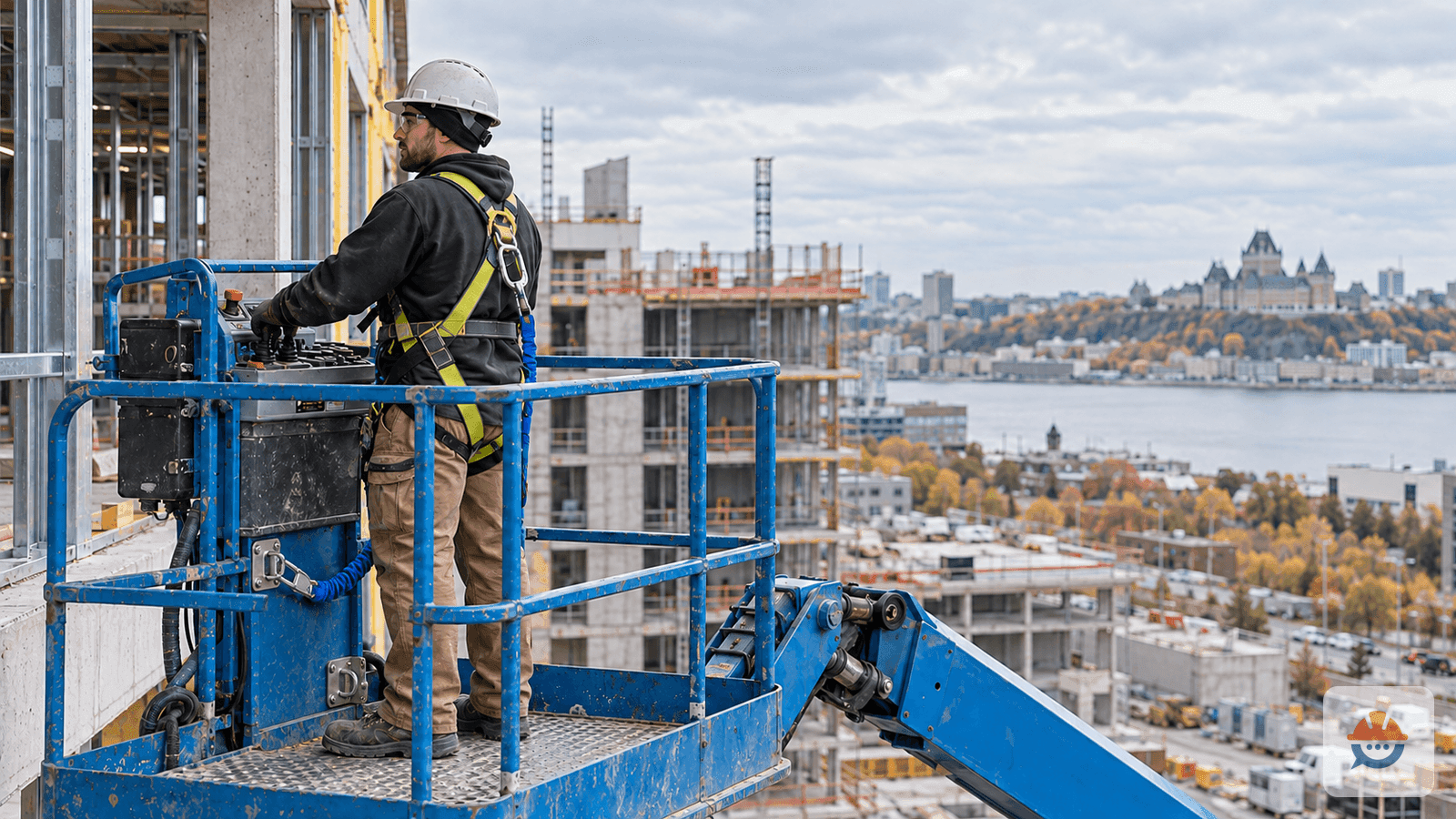
Harness and Aerial Platform: The Rule in Quebec
ConstruMD
Nov 5, 2026
All Posts
SHARE THIS POST
Published : November 5, 2026
Waiting for a result from the Régie du bâtiment du Québec exam can slow down a business project, especially when a contract, financing, or launch is already planned. The frustration often stems from confusion between several administrative steps that do not conclude at the same time.
The key point is simple: passing an RBQ exam does not mean that the company's licence has already been issued. The exam serves to recognize the skills of a person called to act as a respondent. The licence, on the other hand, is issued after the entire company's file has been reviewed.
This guide explains what the RBQ officially confirms about the results, why there is no guaranteed public timeframe in days, what remains to be done after passing, and how to use the waiting period to avoid a second delay being added to the first.

The exam measures a candidate's knowledge in a qualification field or sub-category. The RBQ states that a score of 60% is required to pass an entrepreneur or owner-builder exam. A person who passes can then act as a respondent in the recognized field.
The respondent is the individual whose skills are recognized for the company. Depending on the licence project, the same person can cover multiple fields, or several people can share the responsibilities. For a sole proprietorship, the owner generally must meet the necessary evaluations themselves.
However, the licence belongs to the company. Before issuing it, the RBQ must also verify the legal form, the requested sub-categories, the directors and certain lenders, the financial guarantees, the forms, the documents, and the applicable fees.
Simply put: the exam says the person is qualified; the licence says the company is authorized. It is therefore possible to have passed the exams without yet being able to present the company as holding an active licence.

The official page Exams: Instructions and Results indicates that results are sent by mail as soon as possible following the last exam. This wording is important for someone who must take multiple exams: the sequence is not necessarily treated as several independent results sent immediately after each session.
To properly track their file, one must note the date of the last exam in the series, not just the first. This date serves as a practical reference when it comes time to check if the wait becomes unusual.
The RBQ also specifies that no results will be given by phone. Calling to ask for your score does not allow you to bypass the postal delivery. However, a call can be used to verify an address, ask if a document is missing, or get general guidance on tracking the file.
For exams related to an entrepreneur or owner-builder licence, the passing score posted by the RBQ is 60%. Passing allows one to act as a respondent in the evaluated field, but it does not replace the other conditions for licence issuance.
No, the public page does not set a guaranteed number of days or weeks. It uses the expression "as soon as possible." A timeframe communicated to a person for their file should not be presented as a universal standard applicable to all candidates.
The actual time can depend on the date of the last exam, the mode of administration, the series of exams, the processing load, and the verifications related to the file. Without a published numerical commitment, it would be misleading to claim that a result must necessarily arrive before a specific date.
It is also important to avoid confusing the result timeframe with the processing time for a licence application. On September 18, 2026, the RBQ displayed that it was processing regular applications received on August 17 and priority applications received on September 1. These dates describe the queue of licence issuance or modification requests; they do not constitute an official exam correction schedule.
The RBQ presents eight major steps to obtain a licence. The skills assessment is just one of them. The candidate must also determine if a licence is required, choose the legal form, register the company when necessary, select the correct sub-categories, declare the required information about directors and lenders, provide the applicable financial guarantee, and submit a complete application.
The business can be operated by an individual, a legal entity, or a partnership. This choice influences the documents to be produced and certain obligations. Registration with the Enterprise Registrar generally allows obtaining a Quebec business number, except in certain specific situations described by the RBQ.
The waiting time can be used to seriously structure this aspect, including the choice of the construction company's name, rather than choosing a name that will need to be changed at the time of registration, insurance, or marketing.
The license must cover the work the company intends to perform or have performed. A subcategory that is too narrow may prevent certain contracts; an unnecessarily broad request may add evaluations and obligations that do not correspond to the actual project.
The selection should therefore start from the work actually offered. In case of doubt, the RBQ provides a guide to determine the required license and recommends contacting them.
The application may require information about the executives, targeted shareholders, certain lenders, and their backgrounds. An incomplete section, a missing signature, or an absent appendix can prevent the file from being considered complete.
The RBQ requires a financial guarantee. Depending on the subcategories, this may be a license bond, the New Residential Building Warranty Plan, or both. The official page indicates a bond of $40,000 for a general contractor and $20,000 for a specialized contractor. These amounts represent the value of the guarantee, not necessarily the price paid to obtain it.
The bond is not issued by the RBQ. It must come from an eligible provider, such as an insurance company, an association, a credit union, or a bank.
The RBQ offers priority processing for an additional fee, but it specifies that this route is not accessible when skills still need to be assessed through exams or a professional file.
In other words, paying for priority processing does not allow a candidate to skip the evaluation step. Priority becomes relevant only in situations that meet the official criteria, particularly when qualifications are already recognized and the application is complete.
Since the result is sent by mail, an incorrect address or an improperly reported move can create an avoidable delay. It is important to verify the address listed in the file and keep proof of any updates sent.
Keep the invitations and note the date, location, and title of each exam. Clearly identify the last exam in the series. This timeline facilitates precise follow-up and avoids comparing your file to someone who has not taken the same number of evaluations.
Review the scope of work authorized by each subcategory. A good selection reduces the risk of discovering, after passing, that an additional exam or document is required for the planned contracts.
Gather information on the legal form, registration, executives, lenders, signatures, identification documents, and applicable forms. Use the official list that exactly matches your type of business.
Ask what information will be necessary to obtain the applicable bond or accreditation. However, check the validity period of the documents and coordinate their issuance with the actual submission of the application.
You can build a budget, organize your administrative tools, compare insurance, and prepare your internal models. If you plan to hire, it is also useful to understand now the necessary checks before assigning a worker to a regulated site and the real cost of a CCQ payroll.
This preparation never replaces the license. As long as the company does not have the required authorizations, it should not present itself as licensed or undertake work that requires this license.

A follow-up request is reasonable when the address needs to be corrected, when a letter seems to have been lost, when a document is possibly missing, or when the wait far exceeds the indication given for the file. The goal of the call is not to obtain a grade that the RBQ refuses to give over the phone, but to confirm that the administrative path is still normal.
Prepare your file number, your contact information, exam dates, and a specific question. Note the date of the call, the service contacted, and the information received. This record becomes useful if multiple follow-ups are necessary.
A complaint about the quality of RBQ services is not a request to change a grade. It is used when a person is dissatisfied with the service received, for example, due to deficient follow-up, contradictory information, or a delay that remains unexplained after normal procedures.
The official page on complaints about service quality indicates that the commissioner or their representative will contact the person within 2 business days and respond to the request within 20 days.
Before filing a complaint, it is advisable to gather a factual timeline: exam dates, letters received, calls made, responses obtained, and the concrete consequence of the issue. A precise complaint is easier to analyze than a general message expressing only frustration.
The result letter indicates success or failure. The RBQ directs candidates to its procedure on failure or absence from an exam, and fees may apply for retake procedures.
You must follow the instructions of the decision received and check the current version of the rules before planning a retake. Deadlines and terms may be modified by regulation; an old publication or another candidate's past experience does not replace the official notice sent in the file.
No. The RBQ expressly states that no exam results for contractors or owner-builders are given by phone.
The RBQ links the sending to the last exam. A person taking several exams should therefore use the date of the last exam as the main reference for tracking.
Not by itself. Passing allows you to act as a respondent in the evaluated field. The company must still hold the required license and subcategories before performing or having work performed for which a license is mandatory.
No. The card or competency certificate pertains to the worker's right to practice a regulated trade. The RBQ license pertains to the company's right to perform or have construction work performed. A person can be a journeyman without their company automatically holding a license.
The RBQ provides for priority processing in certain license files but excludes situations where competencies still need to be assessed through exams or a professional file. Therefore, this option should not be presented as a general shortcut to obtain a grade more quickly.
The timeline for an RBQ exam result is difficult to plan precisely because the RBQ does not publish a universal guarantee in days or weeks. However, it confirms that the result is sent by mail after the last exam, no grade is given over the phone, and the passing grade is 60%.
The best strategy is to clearly distinguish between the result, the respondent's qualification, and the issuance of the license. During the wait, prepare a complete file, verify the address, confirm the subcategories, and organize financial guarantees. This will reduce the risk that a success is followed by a new delay caused by a missing document.
Finally, do not start work that requires a license before the company is actually authorized. In case of unexplained delays, conduct documented follow-ups, then use the complaint mechanism on service quality if normal procedures do not provide a satisfactory response.
You might like
ConstruMD
Nov 5, 2026
ConstruMD
Nov 5, 2026
ConstruMD
Nov 5, 2026