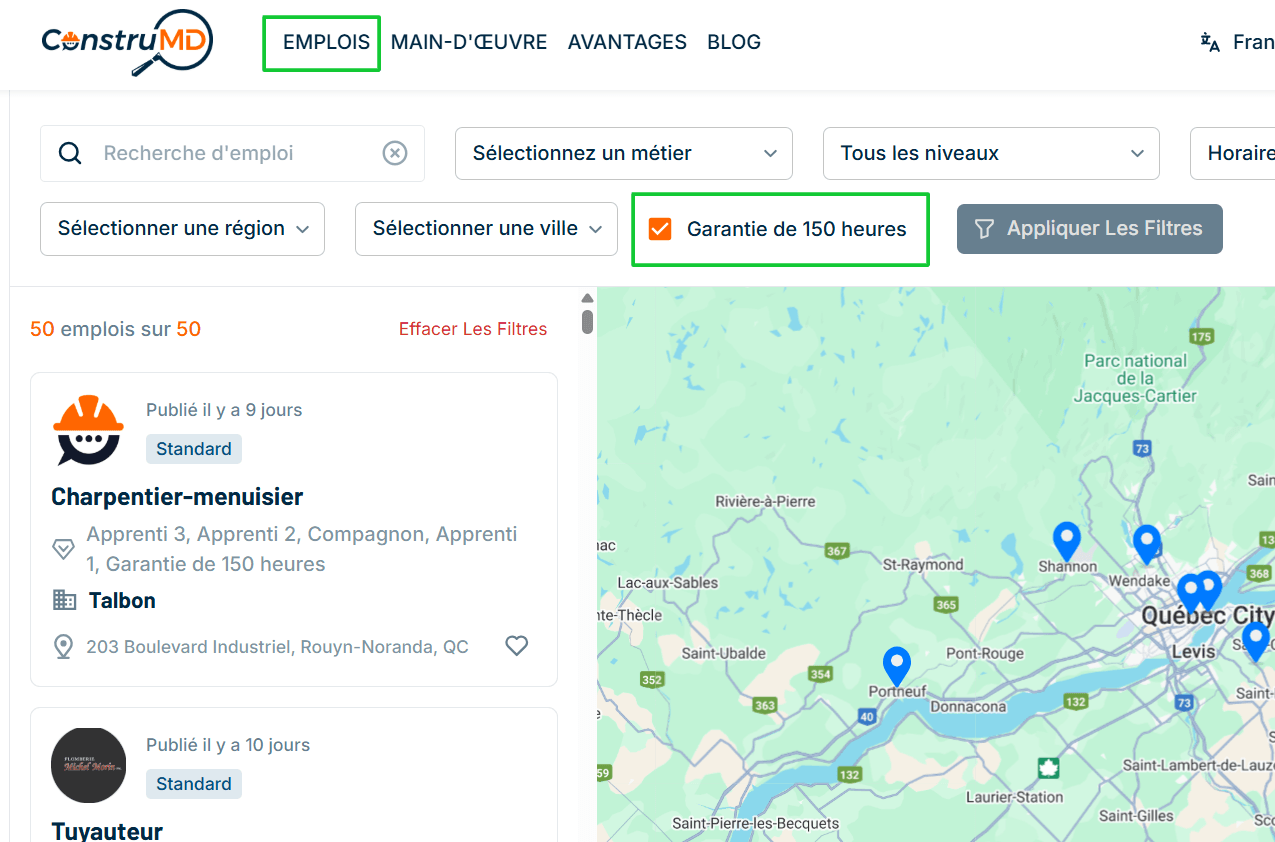
Easily find a 150h construction guarantee
ConstruMD
Nov 5, 2026
All Posts
SHARE THIS POST
Published : November 5, 2026
For a graduate with a DEP in construction, the first real career choice sometimes comes very quickly: accept a job in the sector subject to Law R-20, often called "decree," or go for a "non-decree" position. The dilemma is real, especially in trades like carpentry, where offers can come from very different sites: new construction, residential renovation, finishing, maintenance, small jobs, expansion, commercial projects, or specialized work.
The right answer is not simply "decree" or "non-decree." It depends on the type of work, the applicable legal framework, the hours that will be recognized, the conditions offered, and the worker's career goal. For an employer, it's also an important topic: a new graduate who poorly understands their status risks being disappointed, misdirected, or leaving quickly.

In the common language of the industry, working "decree" generally means working in the part of construction subject to Law R-20 and the construction collective agreements. The CCQ explains the scope of Law R-20, which governs construction work, labour relations, vocational training, and workforce management in the construction industry in Quebec.
In practical terms, this means that the worker may need a competency certificate, that their hours may be declared in the CCQ system, and that working conditions are tied to the rules of the concerned sector. For an apprentice, this is often a major element because recognized hours can count towards their progression to journeyman status.
Working decree can also provide access to a clearer structure: defined trades, apprenticeship progression, established rates, collective protections, mobility between certain sites, and official recognition of experience. For someone coming out of a DEP and wanting to build a career in the regulated industry, this framework can become an important advantage.
Working non-decree does not automatically mean working under the table, working illegally, or working in poor conditions. The expression rather means that the proposed work would not be subject to Law R-20, or that it is in a context where certain exclusions may apply.
The nuance is essential. The CCQ publishes a page on exclusions to Law R-20, notably for certain maintenance, repair, renovation, or modification work depending on the type of employer, the status of employees, and the context of the work. But each situation must be analyzed based on the facts: the location, the client, the nature of the work, the employer, the building, and the project's use can change the answer.
A non-decree position can therefore be perfectly legitimate in certain contexts. It can also be interesting for learning various tasks, engaging in renovation, working in a small team, doing maintenance, or developing field versatility. The risk mainly appears when a worker believes they are accumulating recognized experience for the CCQ while their hours may not necessarily be counted in that way.
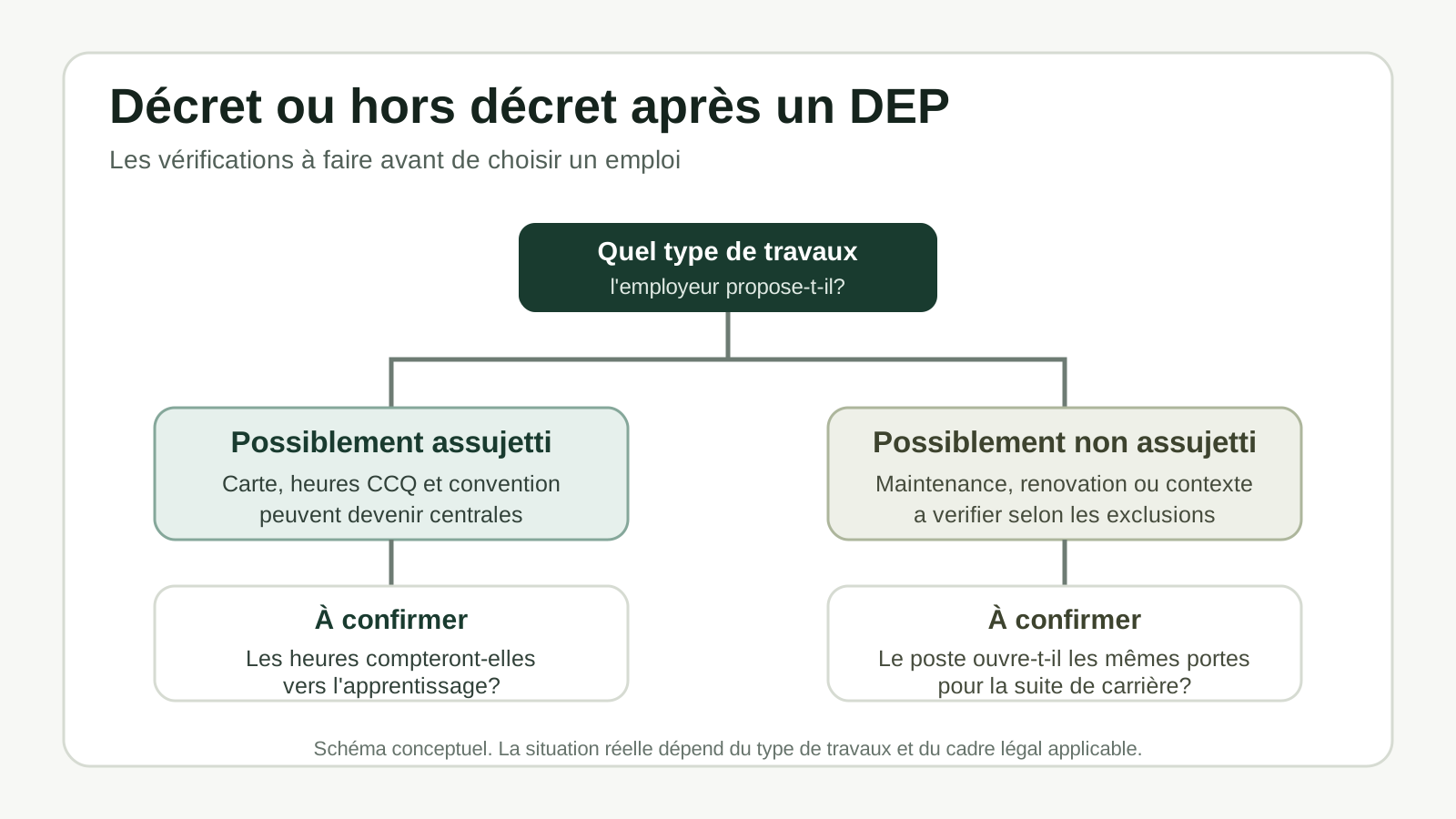
After a DEP, the worker doesn't just need a paycheck. They need to understand where their first job is leading them. Two positions can both be educational but may not open the same doors.
For an apprentice aiming for journeyman status in a regulated trade, recognized hours are central. A job may offer a lot of practical experience, but if the hours are not recognized in the expected framework, the worker may progress on the ground without advancing at the same pace in their official journey.
This is often where misunderstandings arise. A new graduate may accept a position thinking "I'm going to do my hours," while the employer is talking more about general experience, internal training, or non-regulated work. Both can be useful, but they are not the same thing.
The decree generally provides a more standardized framework for conditions applicable to the sector. Non-decree, conditions can vary more from one employer to another: salary, schedule, benefits, stability, supervision, tools provided, travel, training, and responsibilities.
It's not just about comparing the announced hourly rate. It's also about looking at what comes with the position: apprentice supervision, safety, team quality, consistency of hours, advancement opportunities, and project types. For employers, this transparency is a retention tool. An apprentice who knows exactly what they are accepting is less likely to leave after a few weeks.
The boundary between decree and non-decree is not decided solely by the job title. It mainly depends on the work. The CCQ reminds, for example, on its page about performing work, that the construction or expansion of a house is work subject to Law R-20.
Conversely, certain renovation, maintenance, or repair work may fall into different zones depending on the context. That's why it's important to avoid quick answers like "renovation is non-decree" or "everything on a site is decree." The reality is more nuanced.
For a new carpenter-joiner or another graduate with a DEP, the decree can offer a clearer path. Declared hours, learning progression, and access to regulated sites can help build a recognized career in the industry.
The decree can also facilitate mobility. A worker who accumulates hours, keeps their cards in order, and understands the requirements of their trade can eventually move from one employer to another, from one site to another, or from one sector to another with a clearer record.
For an employer, recruiting an apprentice within this framework requires a good understanding of the rules and supervision needs. The ConstruMD guide on how to hire an apprentice in construction in Quebec can help better structure this step, especially when the company wants to train and retain its new workers.
The decree is not automatically the best option in all cases. Access to work can depend on the region, trade, state of the labour pools, busier or slower periods, and the real needs of contractors.
A new worker may also find the framework more rigid: types of tasks, trade rules, access conditions, sector-related mobility, and administrative expectations. For someone who wants to quickly engage in various types of work, a small non-decree company may sometimes seem more flexible.
The question then becomes: does this flexibility truly help the intended career, or does it delay an important goal like becoming a journeyman in the regulated sector?
A non-decree job can allow quick entry into the market, learning in a small team, working on varied projects, and developing field autonomy. Some workers enjoy this more direct pace, especially in renovation, maintenance, finishing, or non-regulated residential work depending on the context.
This type of position can also be useful to confirm interest in the trade, improve dexterity, learn to communicate with clients, and understand the reality of a smaller company. For a worker who is not yet certain of their path, this can have real value.
But this value must be recognized for what it is: practical experience. It should not be automatically confused with hours recognized in the CCQ system.
The main risk is confusion. If the position is presented as an entry point into regulated construction, it is important to ask exactly how the hours will be treated, what tasks will be performed, and if the work is truly outside the scope of Law R-20.
Another risk is trivializing regulation. When a site should be regulated, the situation can create problems for the employer, the worker, and the client. In case of serious doubt, the Administrative Labour Tribunal explains the recourse related to regulation under Law R-20, especially when there is difficulty in interpretation or application.
The worker should also compare the real protections and conditions. A higher short-term salary may be less advantageous if the hours do not count, if supervision is weak, if safety is neglected, or if the position does not lead to the desired career type.
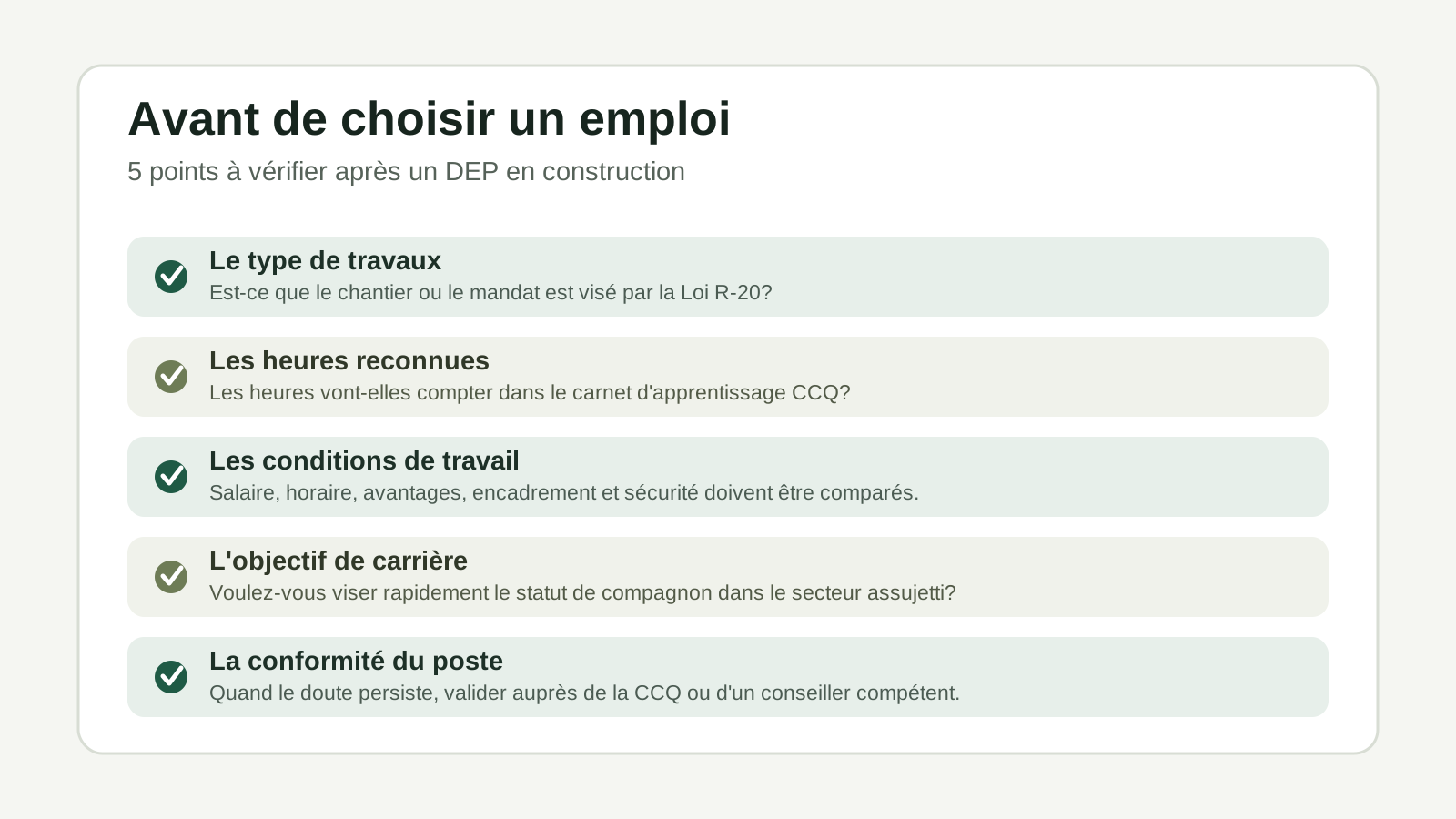
Before saying yes, a DEP graduate should ask what type of work they will do, on what types of sites, with what status, under what supervision, and with what expectations. They should also check if the hours will be declared to the CCQ, if they will count towards their apprenticeship, and what the employer means exactly by decree or non-decree.
The discussion should also cover conditions: salary, schedule, transportation, tools, protective equipment, training, permitted tasks, trial period, and advancement opportunities. For trades and paths, the ConstruMD guide on trades and occupations in construction in Quebec can help situate options in a broader picture.
A worker starting without all their cards or exploring entry possibilities in the industry can also consult the ConstruMD article on finding a construction job without training, while keeping in mind that a DEP often changes goals and expectations.
For employers, clarity is a mark of seriousness. A candidate coming out of a DEP often wants to know if they will progress towards their trade, accumulate recognized hours, and move closer to journeyman status. If the job is non-decree, it should be explained straightforwardly. If the job is decree, the requirements, documents, tasks, and learning path should be explained.
This transparency can prevent a lot of frustration. It also helps attract the right candidates: some want a structured CCQ path, others are looking for a small team, versatility, or renovation experience. Both profiles can be valid, but they are not looking for the same thing.
For workers starting out, the essential training for entering construction can also serve as a reference to understand what pertains to training, safety, qualification, and site access.
The real choice is not between a good camp and a bad camp. The real choice is between two trajectories that do not always produce the same results.
Working under decree can be very advantageous if the goal is to have your hours recognized, progress in the CCQ apprenticeship, and build a career in the regulated sector. Working outside the decree can also be relevant if the context is appropriate, the conditions are good, and the worker understands that the experience gained does not always lead to the same official path.
Before accepting, it is important to check the type of work, the status of the position, the recognition of hours, the working conditions, and the career objective. And when there is doubt about the application of Law R-20, the best response is to validate with the CCQ, the TAT, or a competent professional.
You might like
ConstruMD
Nov 5, 2026

ConstruMD
Nov 5, 2026
ConstruMD
Nov 5, 2026