Site documents: access on your cellphone
ConstruMD
Nov 5, 2026
All Posts
SHARE THIS POST
Published : November 5, 2026
Your team needs to return to complete a project, but the employees are already scheduled elsewhere. The first visit was scheduled; the second was left to be organized. You now have a date to meet with the client, without having reserved the people for this return.
The return should be planned from the preparation of the project, just like the first intervention. You can then organize work elsewhere between the two visits, taking into account the date when the team needs to return.
Some work requires multiple interventions. The team may need to let another contractor proceed before returning to continue. Their departure does not end your commitment to this project.
If only the first visit appears on the schedule, these employees may seem available for other projects after their departure. The calendar then represents only part of the work promised to the client.
When the project is ready to receive the team, you need to find a spot in an already filled schedule. This may require moving another intervention, finding replacements, or proposing a new date to the client.
A change of team also adds preparation work: explaining what has been done, specifying what remains to be completed, and conveying instructions. By planning the second visit before filling the interval, you can keep the same people for the continuation of the work.
The ConstruMD resource planner allows you to schedule multiple work periods for the same employees on a project. The Projects view shows the first visit and the return on their respective lines. The second intervention is therefore visible when you prepare the rest of their schedule.
To establish these periods, you associate the employees with the project and specify, for each visit, a start date, the number of workdays, and the planned hours per day. The return dates are chosen with the people preparing the previous stage, according to their schedule and the estimated duration of your intervention.
In the demonstration, Marie Tremblay and Nicolas Gagnon are scheduled at Madison on November 23 and 24, then on November 30 and December 1, for eight hours per day. The two visits represent 32 hours per worker on this project. The return is already scheduled before assigning them work elsewhere.
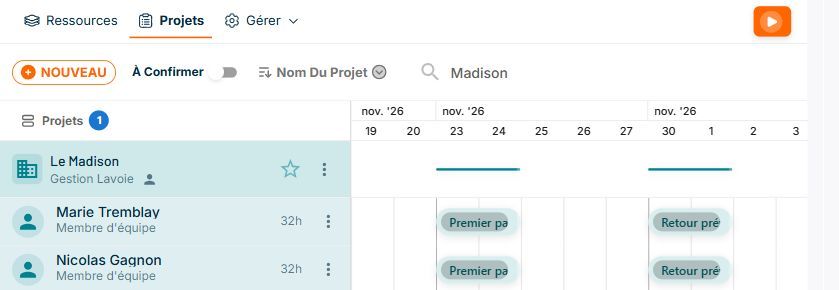
Demonstration data. The two turquoise periods for each worker correspond to their visits to "The Madison". The return is scheduled before adding the intermediate project.
Once both visits are scheduled, the interval becomes a period to examine for another project. In our planner, the Resources view groups projects under each employee. You can compare a new intervention with their commitments, particularly to check overlapping periods.
The two workers were then scheduled at the Park Clinic from November 25 to 27. This intervention ends before their return to Madison, whose periods remain unchanged. The following capture shows this organization for Marie Tremblay.
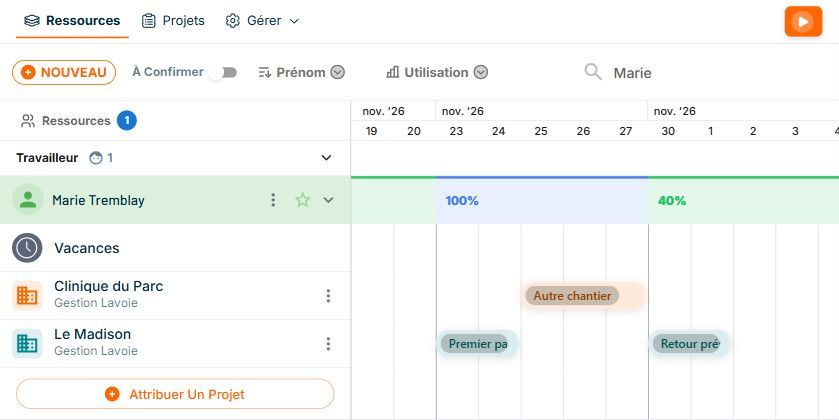
Demonstration data. Marie Tremblay is at the Park Clinic from November 25 to 27, between her two visits to Madison. The orange period fits between the two turquoise periods, with her return preserved.
This reading completes the allocation of employees between multiple projects: you assess the work to be done between the two visits, the travel, and the necessary materials before committing. The question is no longer just about finding work during the interval, but about choosing an intervention that the team can complete before their return.
You can reserve the dates of the intermediate project by already seeing when the same employees will need to return. Their departure no longer makes the continuation of the work disappear from your planning, and you can prepare the instructions for both visits with the people concerned.
As the return approaches, confirm with the other stakeholders that the project will be ready to receive the team, that access will be possible, and that the materials will be ready. If the date changes, the commitments gathered in the ConstruMD planner allow you to review the interventions concerned before agreeing on the new schedule.
Try the ConstruMD planner for free for seven days and prepare the different visits of your team on a project, with their return already scheduled in the calendar.
You might like
ConstruMD
Nov 5, 2026
ConstruMD
Nov 5, 2026

ConstruMD
Nov 5, 2026