
Harness and Aerial Platform: The Rule in Quebec
ConstruMD
Nov 5, 2026
All Posts
SHARE THIS POST
Published : November 5, 2026
In a construction company, the owner or partner is not always just in the office. They can also be on the site, managing teams, coordinating work, lending a hand, and assuming the same physical risks as the employees.
This is where the questions begin: if a partner gets injured, falls ill, or becomes unable to work, are they covered by MÉDIC Construction? Does the CNESST intervene? Can employment insurance pay anything? Is additional private insurance necessary?
The answer rarely depends on a single word. It depends on the actual status of the person, the applicable MÉDIC plan, the cause of the disability, the protections held, the claim deadlines, and sometimes rules specific to employment insurance, the CNESST, or a private policy.
To limit team interruptions, employers can consult available skilled workers according to their needs.
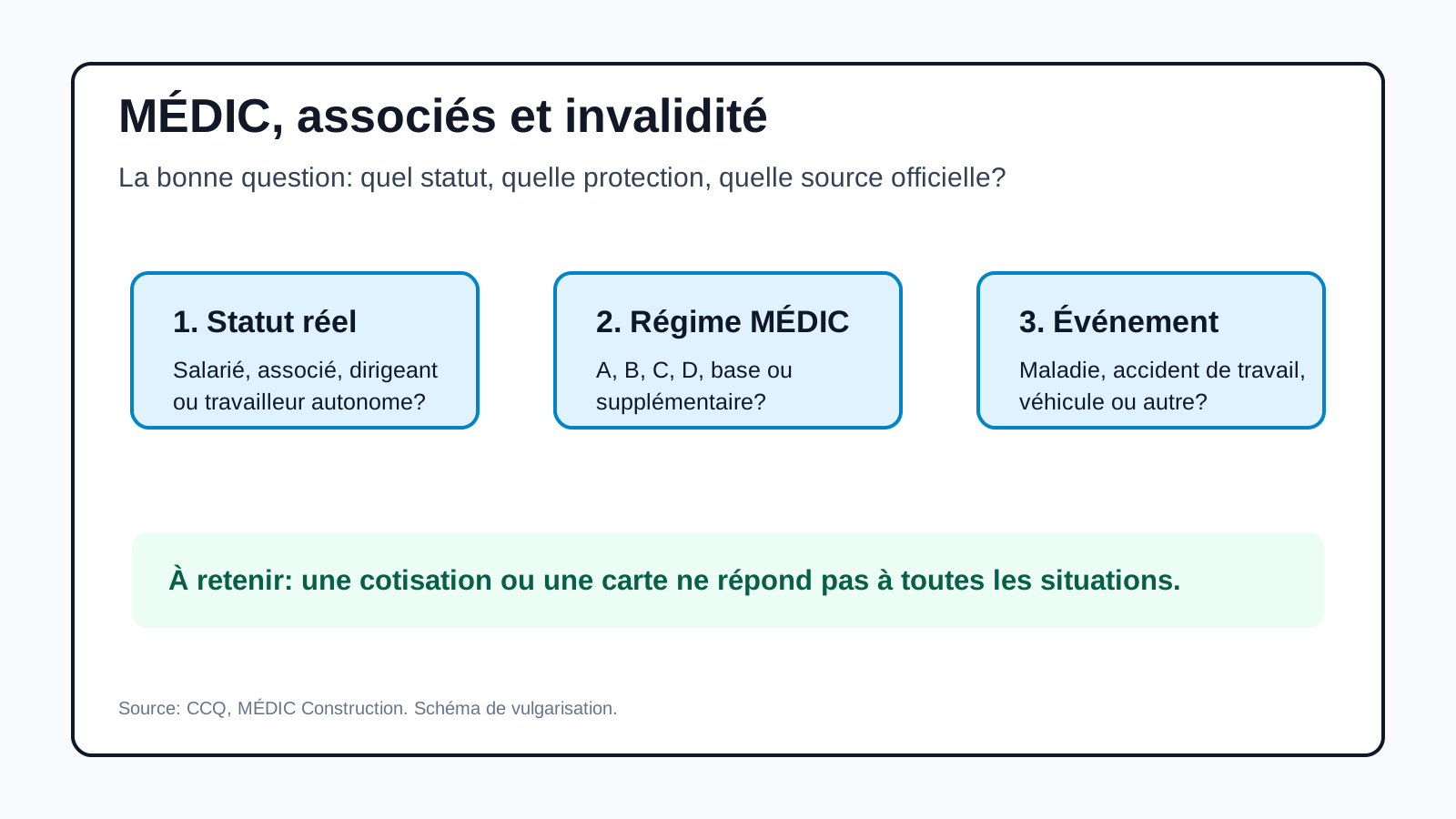
The first instinct should be to clarify the person's status. Are they an employee of the company? A partner? An executive? Do they actually work on the sites? Are they paid as an employee, as an administrator, or otherwise?
This distinction is important because the protections do not all follow the same logic. An employee covered by a MÉDIC plan is not necessarily in the same situation as a majority partner, an executive, a self-employed worker, or a person receiving business income.
On the ground, the problem often arises from the fact that the person wears multiple hats. They can be a shareholder, manager, estimator, foreman, and active worker. For insurance, these roles must be separated, otherwise the answer becomes unclear.
The CCQ page on wage insurance, hour credits, and insurance maintenance indicates that in the event of total disability of an employee, MÉDIC Construction provides wage insurance protection to partially compensate for a loss of income, as well as hour credits and insurance maintenance to allow the employee to remain insured.
The CCQ also specifies that only certain plans offer wage insurance protection, notably the basic and supplementary plans A, B, and C. Hour credits and insurance maintenance are offered by plans A, B, C, and D, both basic and supplementary.
The simplification is straightforward: MÉDIC can offer significant protections, but it is not a universal insurance that automatically covers all people, all functions, and all types of incapacity. The applicable plan must be read and eligibility verified.
A point from the CCQ deserves to be highlighted: specific conditions, limits, or exclusions may apply, and only the Regulation on Supplemental Social Benefits Plans in the Construction Industry has legal value.
In plain language, this means that an explanatory page, a bulletin, an informal response, or a company habit can help understand, but does not replace the official text applicable at the time of the event.
For an active partner or employer, this nuance is major. Before deciding that a protection is sufficient, the plan, the regulation, the person's status, and possible exclusions must be verified.
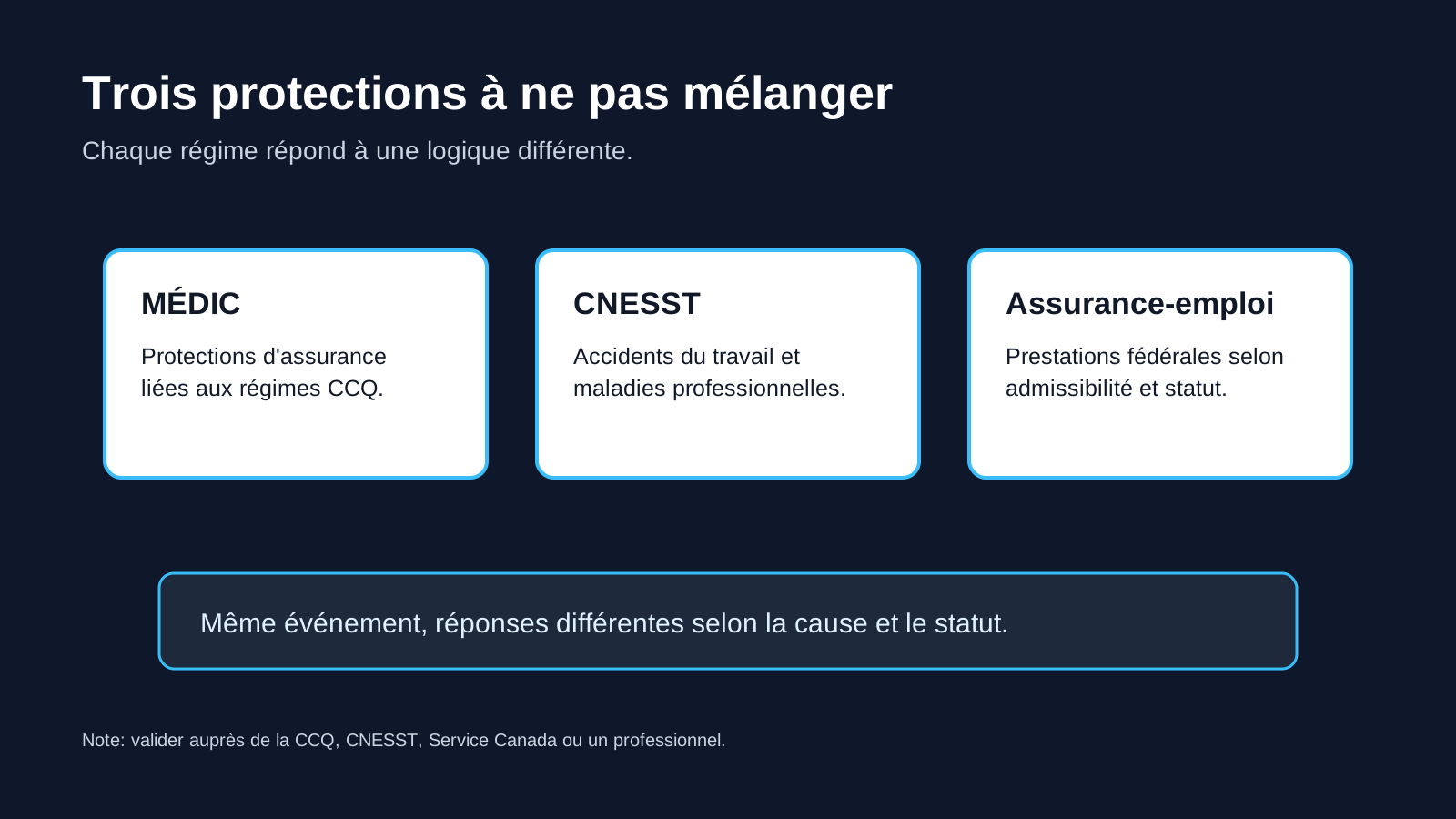
An injury or incapacity can suggest several protections at the same time. However, MÉDIC Construction, the CNESST, and employment insurance do not answer the same question.
The CNESST intervenes in the context of work accidents and occupational diseases, according to its own rules. Employment insurance falls under the federal regime and depends on the person's eligibility and type of benefits. MÉDIC Construction is a social benefits plan related to the construction industry and the protections held.
In other words, the entry points should not be mixed. The cause of the incapacity, the person's status, and the protections held determine which door can open, and in what order.
The most sensitive case is often that of the partner or executive who actually works on the sites. This person may contribute to certain plans, be present in the company, consider themselves a worker, but not have exactly the same treatment as a regular employee in all systems.
Therefore, quick answers like "you are covered" or "you are not covered" should be avoided. The right question is rather: covered by what, for what event, with what status, in which plan, and under what conditions?
For a company, this verification should be part of administrative planning just like liability insurance, licenses, payroll, and employer obligations. Employers structuring their team should also keep in mind that the status of individuals and site rules directly influence compliance, as seen in issues related to hiring a construction apprentice.
The CCQ indicates that a wage insurance claim must be submitted within certain deadlines. A late claim can result in the loss of benefits for a past period, and a claim submitted more than a year after the start of the disability may be refused.
For a business owner, this is an important practical point. When the injured or sick person is also the one managing the administration, deadlines can easily be forgotten. The company should therefore plan who will handle claims, medical documents, and communications if an active executive becomes unable to work.
Private insurance often comes up because it can fill in areas that public or group plans do not cover as the company envisions. But it should be chosen after analysis, not as a reaction.
Before concluding that private insurance is necessary, existing protections, exclusions, deadlines, amounts, the definition of disability, the treatment of shareholders or partners, and coordination with other plans must be compared.
The CCQ page on MÉDIC Construction's basic insurance can serve as a starting point to understand protections, but the analysis of an active partner should ideally be validated with the CCQ, an insurance advisor, an accountant, or a competent professional.
Before choosing or refusing coverage, the company should identify the person's actual status, confirm their MÉDIC plan, check wage insurance protections, distinguish between work accident, illness, vehicle accident, and non-occupational disability, validate employment insurance according to status, and compare possible private protections.
Documentation should be kept. A company that relies solely on a verbal conversation risks discovering too late that it misunderstood an exclusion, a deadline, or a condition.
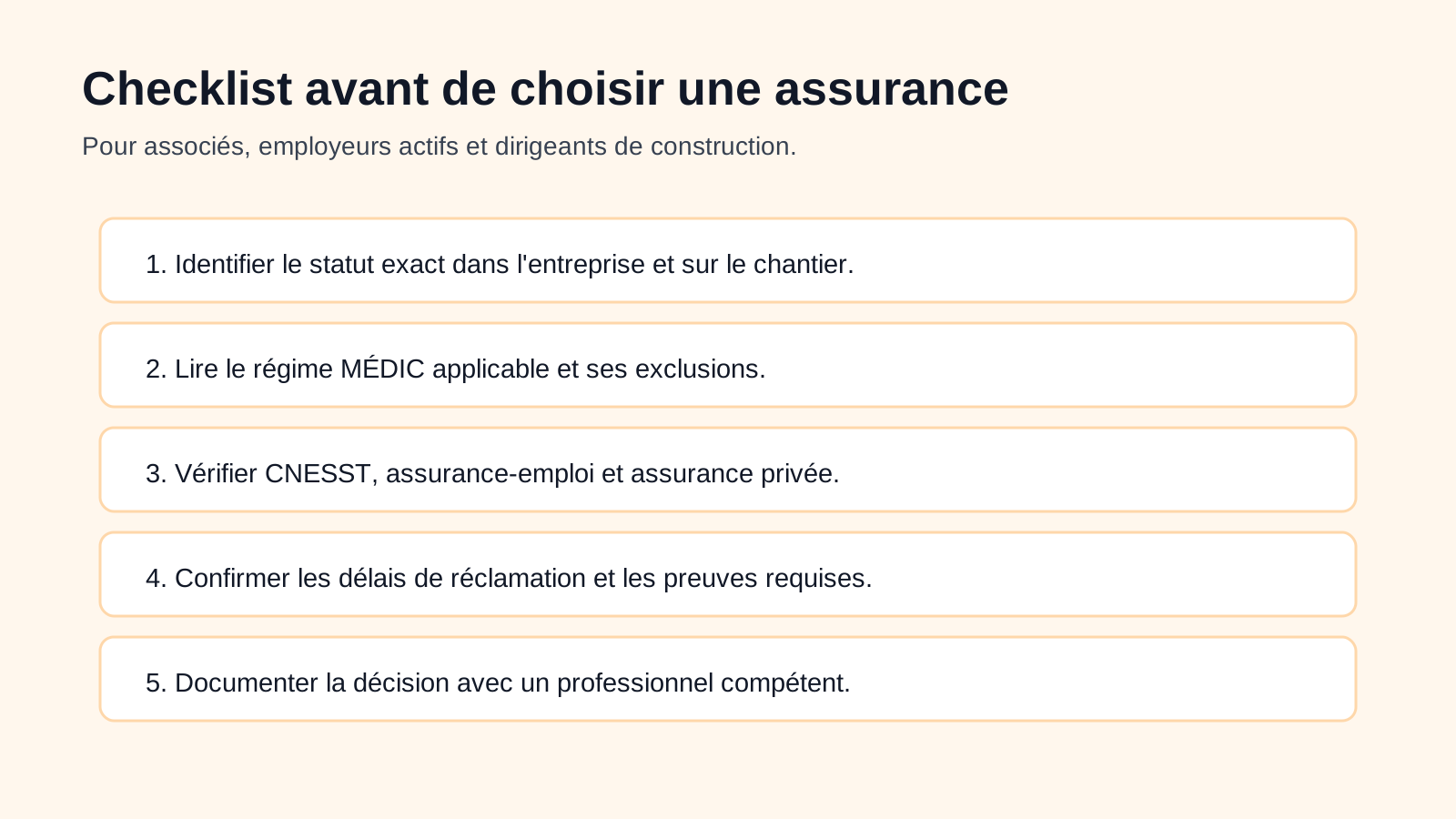
For a partner, executive, or active employer in construction, the real question is not just "do I have MÉDIC?" The real question is: what is my status, what protection applies, for what event, and under what conditions?
MÉDIC Construction can offer wage insurance, hour credits, and insurance maintenance according to the applicable plan, but these protections have conditions, limits, and exclusions. The CNESST, employment insurance, and private insurances also follow their own rules.
The best reflex is therefore to validate before the problem arises: read official pages, check the applicable regulation, document your status, and consult the right resources. When incapacity occurs, it is often too late to discover that the protection was not what you thought.
You might like
ConstruMD
Nov 5, 2026
ConstruMD
Nov 5, 2026

ConstruMD
Nov 5, 2026