
Harness and Aerial Platform: The Rule in Quebec
ConstruMD
Nov 5, 2026
All Posts
SHARE THIS POST
Published : November 5, 2026
The Commission de la construction du Québec has confirmed that a cybersecurity incident detected on August 24, 2026, is linked to a cyberattack. According to information published by the CCQ, some client and employee information has been stolen, and affected individuals are beginning to receive written notices with details of free protection offered by Equifax.
For construction workers, the question is no longer just whether CCQ services have been restored. The real question now is: what concrete steps can be taken to reduce the risk of fraud or identity theft when a notice mentions sensitive information such as name, address, date of birth, a CCQ client number, or, in some cases, the social insurance number.
This article explains the steps to follow without dramatizing or minimizing. It is based on public information from the CCQ, guidelines from the Commission d’accès à l’information du Québec, and advice from the Office of the Privacy Commissioner of Canada.
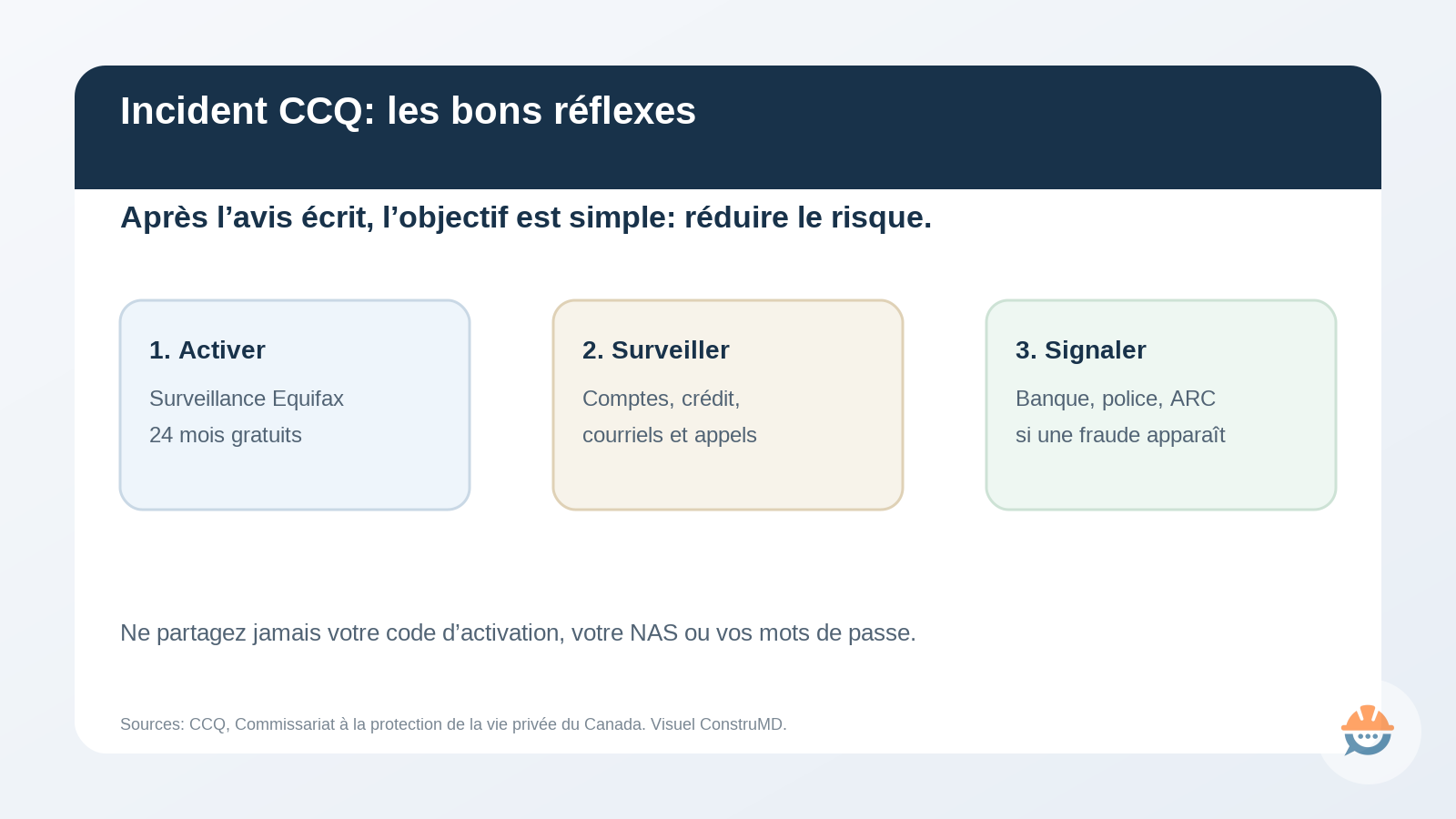
The CCQ indicates that the incident discovered on August 24, 2026, is linked to a cyberattack. It also specifies that this cyberattack is not related to the Chantier numériccq, that some personal information has been stolen, and that an independent expert will be appointed to conduct an external audit of its practices.
Online and telephone services were restored on September 8, 2026, but the issue of personal information continues to evolve. The CCQ explains that notices are sent by email or mail, depending on the contact information it holds, and that mailings will continue throughout September.
Another important point: the CCQ indicates that it is not possible to obtain confirmation of compromised personal information by phone. The details specific to each person must be consulted in the written notice received.
Such a notice does not automatically mean that fraud has already occurred. The CCQ mentions that, to date, nothing necessarily indicates that the information has been used to commit fraud or identity theft. But the notice means that one must act as if the risk is real.
The distinction is important: the protection offered is intended to detect suspicious use of your information more quickly. It does not render the stolen information unusable, and it does not replace checking your bank accounts, government accounts, and suspicious communications.
In the construction industry, many workers have frequent interactions with the CCQ, employers, unions, insurance companies, banks, and government services. This is why an incident affecting identity information can have concrete consequences far beyond the CCQ file.
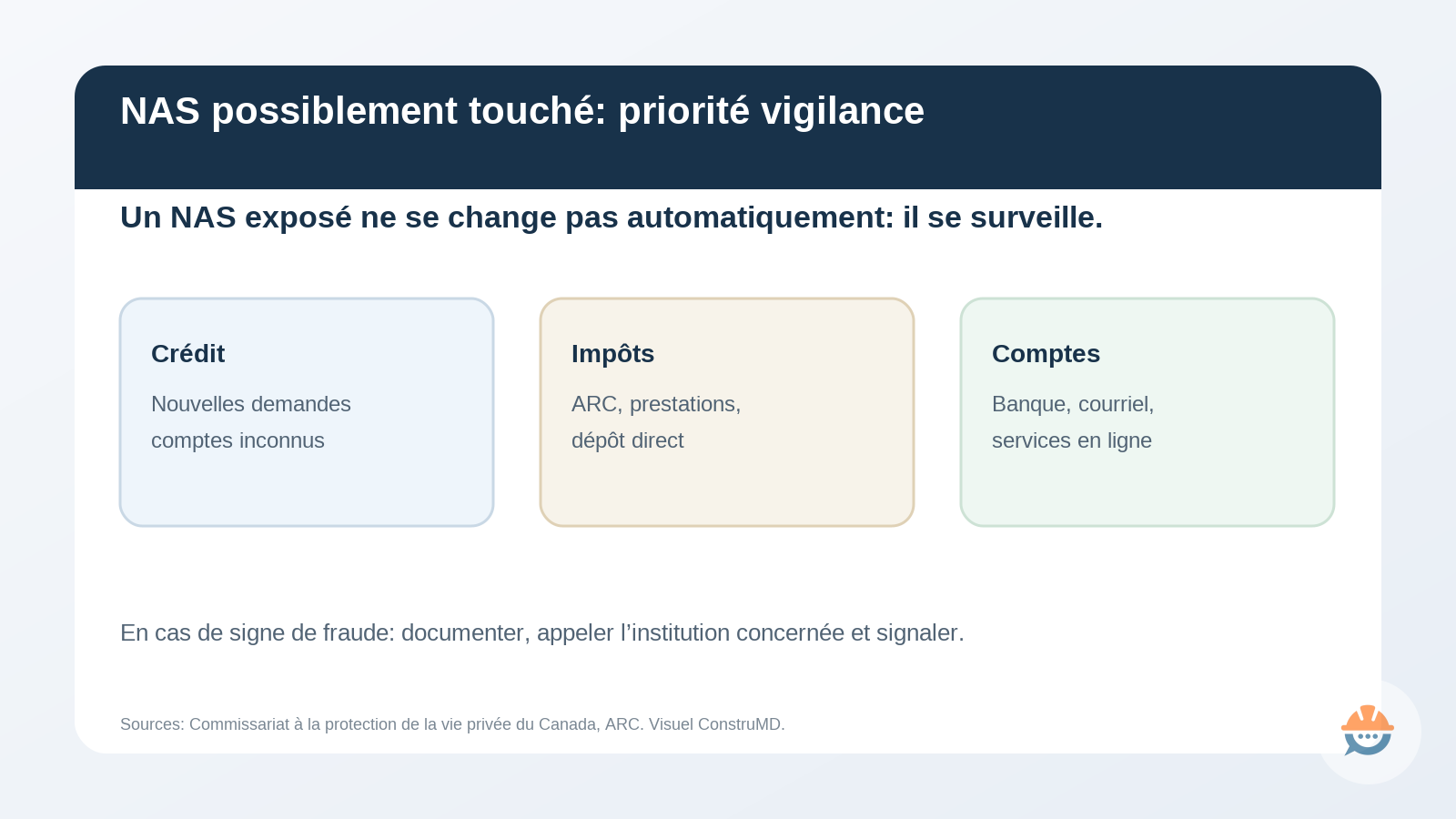
The social insurance number is a very sensitive identifier because it can be used in tax, financial, or administrative contexts. It does not, by itself, allow identity theft in all cases, but combined with a name, date of birth, and address, it can increase the risk of fraudulent applications.
It is also important to understand one thing: a SIN is not automatically changed because it may have been exposed. Authorities recommend instead monitoring for signs of misuse and promptly reporting any problems. This is why a credit monitoring service becomes useful.
Practically, a worker should pay attention to new credit applications, unknown accounts, unauthorized changes in their records, unusual collection notices, emails that mimic a known institution, and communications requesting confirmation of personal information.
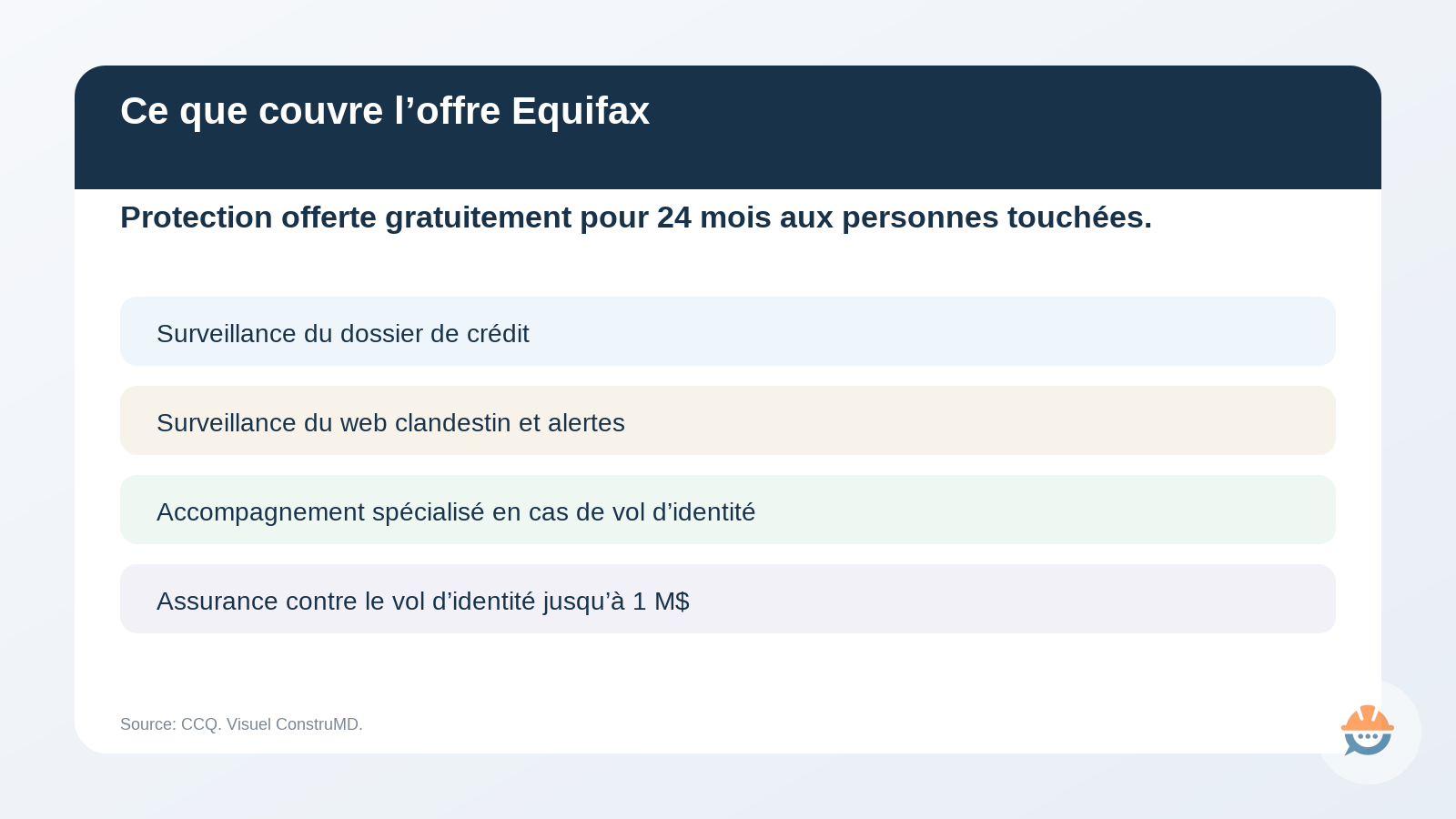
The CCQ offers, through Equifax, 24 months of free protection to affected individuals. According to the CCQ, the service includes credit monitoring, dark web monitoring, alerts in case of unusual activity, specialized assistance in case of fraud or identity theft, and identity theft insurance up to 1 million dollars.
The 24-month period begins upon registration. If a person already has Equifax protection, the CCQ indicates that the offered coverage can be added to the existing one. In this case, the CCQ recommends contacting Equifax after receiving the notice to validate the procedure.
To activate the protection, one must use the instructions received in the written notice. The public activation page for Equifax is available here: equifax.ca/en/activate. The activation code is personal. It must not be shared, published, sent to someone else, or kept in an easily accessible place.
Credit monitoring can help identify certain unusual financial activities, such as a new credit application or a change associated with the credit file. It can therefore reduce the time between a fraud attempt and when the affected person becomes aware of it.
It's useful because when it comes to identity theft, speed matters. The sooner a problem is detected, the easier it is to prevent further damage, contact the right institutions, and document the steps taken.
But it's important to stay realistic: credit monitoring doesn't cover all risks. It doesn't necessarily monitor every online account, every phishing attempt, every fraudulent call, or every possible change with a government service. It's part of a protection plan, not the complete plan.
First step: verify the sender and the content of the notice. The CCQ indicates that notices can arrive by email or by mail. Before clicking, you should verify that the sender's address matches exactly the one indicated by the CCQ in its FAQ. If in doubt, it's better to go through the official CCQ website rather than a link received in a forwarded message.
Second step: activate Equifax protection quickly. The offer is free for affected individuals and is planned for 24 months. Activation allows you to receive alerts sooner if unusual activity is detected.
Third step: change passwords for sensitive accounts. Prioritize email, banking, government, CCQ, insurance, cell phone, and any service that could be used to reset other accesses. The email password is particularly important because it often serves as a gateway to recover other accounts.
Fourth step: activate two-factor authentication. When possible, add a second validation to the login process. It's a simple protection that can block several attempts even if a password is compromised.
Fifth step: monitor accounts and keep records. Over the next few weeks and months, regularly check bank accounts, credit cards, confirmation emails, password change notices, and government communications. Keeping a dated note of the steps taken can help if fraud needs to be reported.
If a transaction, credit application, account, or communication seems suspicious, act quickly. The Office of the Privacy Commissioner of Canada recommends protecting accounts, informing the concerned banks or card issuers, reporting to police authorities when it's a crime, and keeping evidence.
If the issue seems to involve the Canada Revenue Agency, such as an unauthorized change, an unknown benefit application, or unusual activity in the account, the CRA indicates that you should contact them and also inform other relevant authorities. The CRA's page on scams, frauds, and identity theft details the situations to report.
If you suspect someone is using your SIN, Service Canada may need to be contacted. It's also wise to inform your financial institution and credit reporting agencies, depending on the situation.
After a publicized incident, fraudsters often take advantage of the confusion. They may send fake emails, call pretending to represent a known organization, or ask to confirm a SIN, activation code, date of birth, or banking information.
A simple rule: never give an activation code, password, validation code, or your SIN to someone who contacts you unsolicited. If a message creates a sense of urgency, contains a strange link, or asks to confirm sensitive data, slow down. Go through the official website or a number found directly on the organization's site.
The Equifax activation code should be used for your own registration. It is not used to prove your identity to someone who calls you. It should not be transmitted by text, email, in an unknown form, or in a private conversation.
Even though the article is mainly aimed at workers, employers have a useful role to play. Teams may receive questions from concerned workers, especially if their SIN is mentioned in the notice. The best response is not to improvise: direct them to official sources, remind them not to share personal codes, and avoid unnecessarily collecting sensitive information.
Companies can also remind employees of basic best practices: verify suspicious emails, do not transmit identity documents through unsecured channels, protect access to internal tools, and limit the number of people handling personal information.
This incident adds to the broader episode of the CCQ cyberattack and its impacts on services. For employers, it also highlights the importance of understanding the sensitive data circulating around payroll, reports, and worker files. Our guide on CCQ payroll and salary deductions can help put some payroll information into context.
Do not conclude that fraud is already underway just because a notice is received. Nor should you conclude that everything is resolved because Equifax is activated. Between the two, there is the right posture: take protection, monitor, document, and report quickly if there is a concrete sign.
Avoid publicly sharing your notice, activation code, client number, SIN, or a full screenshot. Even if the intention is to seek advice, this information can be copied and used elsewhere.
If you receive a notice from the CCQ, activate Equifax protection with your personal instructions, monitor your accounts, change sensitive passwords, enable two-factor authentication, and be alert to fraudulent communications.
If your notice mentions a potentially affected SIN, take the situation seriously but proceed methodically. Credit monitoring is a detection tool. Real protection also comes from your regular checks, caution with incoming communications, and prompt reporting of any suspicious activity.
Finally, always use official sources for procedures: the CCQ FAQ, the Equifax activation page, advice from the Office of the Privacy Commissioner of Canada, your financial institution, the CRA, or Service Canada depending on the nature of the issue.
You might like
ConstruMD
Nov 5, 2026
ConstruMD
Nov 5, 2026

ConstruMD
Nov 5, 2026