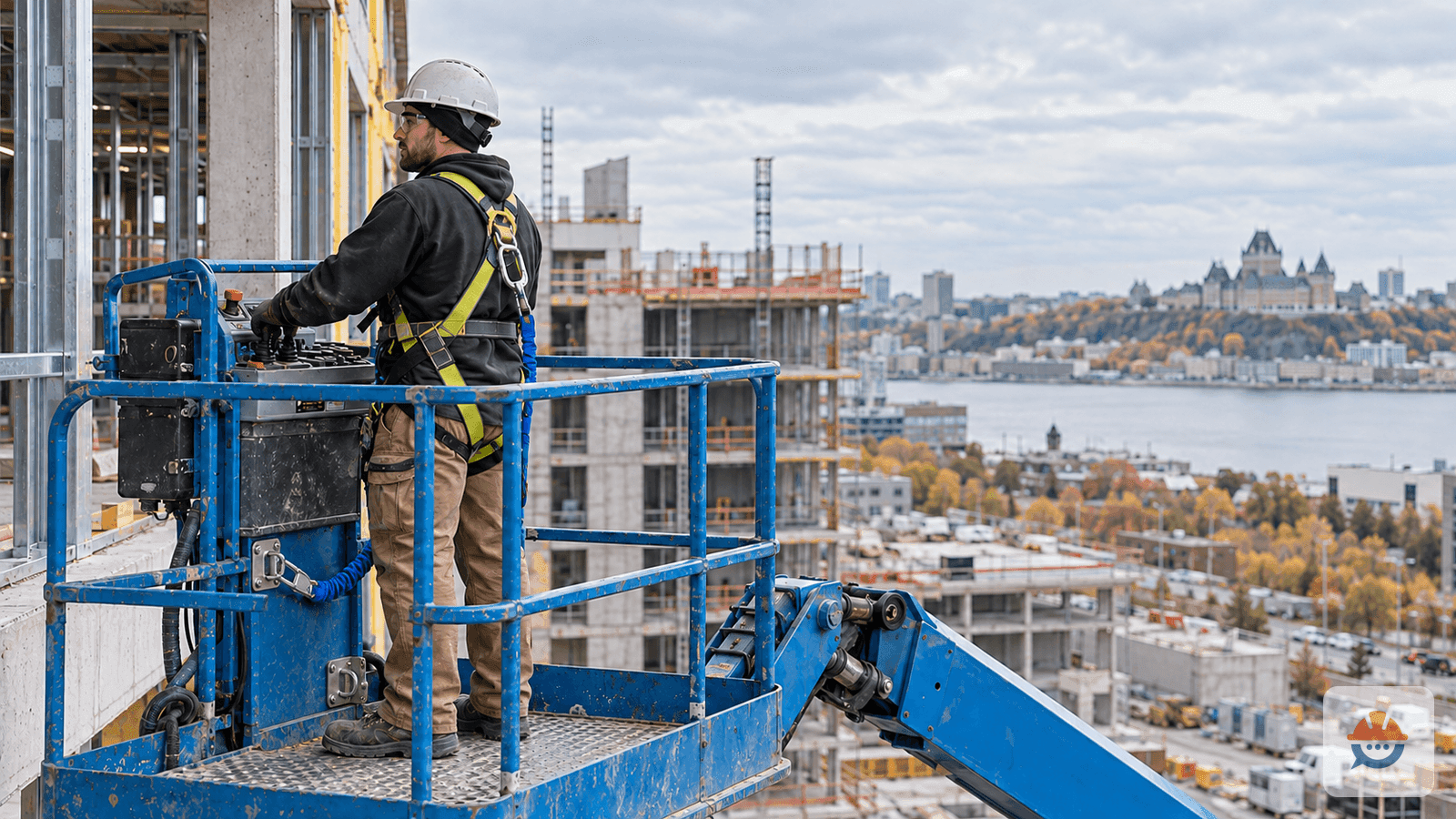
Harness and Aerial Platform: The Rule in Quebec
ConstruMD
Nov 5, 2026
All Posts
SHARE THIS POST
Published : November 5, 2026
The consumption of alcohol, drugs, cannabis, medication, or even severe fatigue can become a major safety issue on a construction site. The topic is delicate because it touches on safety, privacy, discipline, addiction, team culture, and employer responsibility.
Two dangerous reflexes must be avoided. The first is to trivialize: "everyone knows, it's always been like this." The second is to turn every suspicion into a public accusation. On a site, the right approach is simpler and more solid: understand the rule, recognize observable risks, remove the immediate danger, and apply a clear policy.
The goal of this article is to clearly explain what workers and employers need to remember in Quebec. It is not about judging people. It is about protecting the site, colleagues, the public, and the company's credibility.
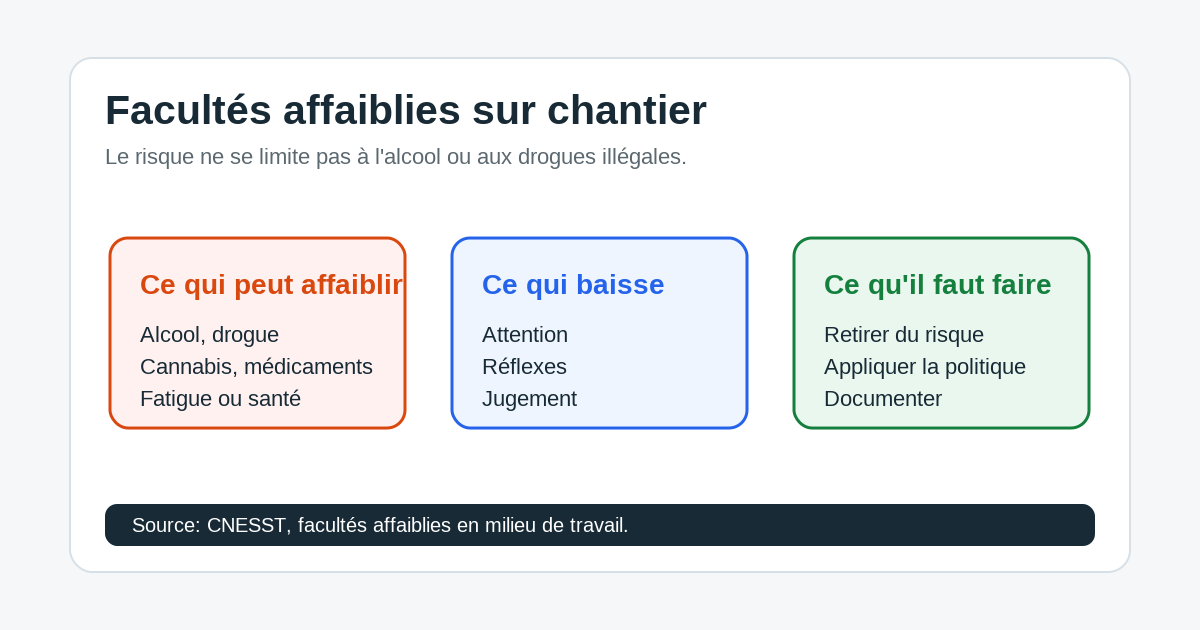
The CNESST is clear: a person under the influence of alcohol, drugs, or similar substances can pose an accident risk because their reflexes, attention, or judgment may be diminished. It also specifies that the legalization of cannabis does not change the obligations regarding occupational health and safety.
The practical rule is therefore straightforward: if a person's condition poses a risk to their health, safety, or that of others, they should not perform the work. And the employer must ensure that this person does not perform their work under these conditions.
For a construction site, this rule takes on particular importance. The CNESST page on impaired faculties in the workplace provides examples of high-risk tasks and explicitly includes all work on a construction site, in addition to driving vehicles, heavy machinery, working at heights, and confined spaces.
One of the pitfalls of the subject is reducing it to illegal drugs. In reality, faculties can be impaired by several factors: alcohol, cannabis, illicit substances, certain medications, fatigue, illness, health disorders, or side effects of treatment. The Canadian Centre for Occupational Health and Safety reminds us that several causes can affect attention, judgment, or the ability to perform a task safely.
This distinction is important. A worker can be dangerous without being "stoned" in the popular sense. A person who is severely sleep-deprived, taking medication that slows their reflexes, or experiencing an uncontrolled health problem may also not be fit to perform certain tasks.
On a site, the question is not just "did they consume?". The real question is: is the person in a condition to perform their work without endangering anyone?
Construction is an environment where mistakes can quickly become costly. There are sharp tools, suspended loads, vehicles, scaffolding, excavations, heavy equipment, openings, confined spaces, noise, dust, traffic, and teams often working in parallel.
In this context, a lapse in attention or coordination can affect more than one person. A distracted worker near a backing zone, an operator slowed by a substance, an installer lacking judgment at height, or a colleague unable to react to a signal can create a risk for the entire team.
This is why preventive measures must be treated as a normal part of site management. The same reflex that applies to PPE, working at heights, or lifting zones should apply to impaired faculties: identify the risk, control it, and eliminate it at the source when possible. ConstruMD articles on site prevention during heat periods and work gloves adapted to risk follow the same logic: prevention must be concrete, visible, and applied before an accident.
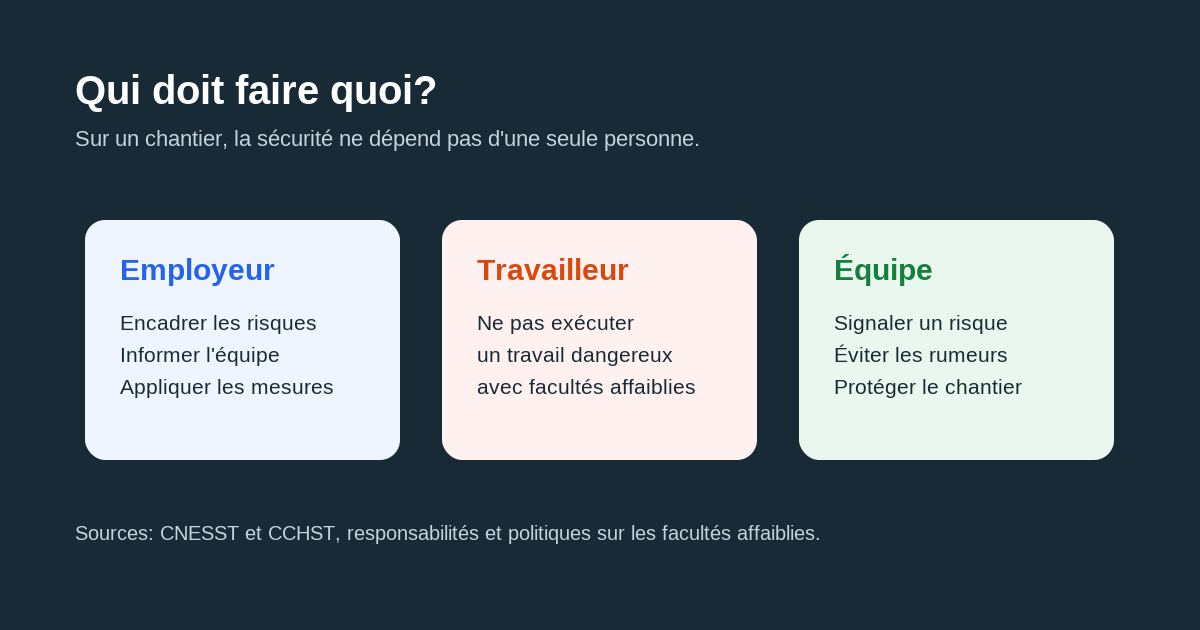
The employer cannot simply say they do not tolerate consumption. The CNESST indicates that they must take measures to manage impaired faculties, inform staff of the measures taken, and ensure their application. In other words, the rule must be known before the problem, not improvised on the morning of an incident.
A company policy should specify expectations, targeted locations, high-risk tasks, what is prohibited, how to report a situation, possible measures, and available support resources. It should also distinguish urgent safety cases, disciplinary issues, and situations where a person may need help.
For contractors and managers, this aligns with general prevention obligations. The CNESST reminds that the employer must identify, control, and eliminate hazards, inform workers, provide necessary training, supervise work, and ensure safety standards are met. On a site, specific prevention measures exist precisely to structure this management.
The worker also has a direct responsibility. If they know that their abilities are impaired and that their condition may pose a risk, they must not perform their work. It's not just a matter of discipline. It's a matter of protecting their health, safety, and that of their colleagues.
The worker must also participate in identifying and eliminating risks. This means they must report a dangerous situation, follow instructions, collaborate with prevention mechanisms, and avoid covering up a serious risk out of misplaced loyalty to a colleague.
Reporting does not mean publicly accusing. Reporting means bringing the information to the right person, with observable facts: unusual behaviour, difficulty speaking clearly, unsteady gait, lack of coordination, dangerous work method, near-miss incident, or apparent inability to follow instructions.
The supervisor should not diagnose dependency. The CCOHS clearly states: the role of the employer or supervisor is to recognize possible signs of impairment and take appropriate measures according to the organization's policy, not to diagnose a substance abuse or dependency problem.
Therefore, avoid phrases like "he's on drugs" or "he has a problem." A serious intervention should instead document what is observable: actions, words, mistakes, smell, coordination, behaviour, incident, refusal to follow a procedure, confusion, or inability to perform a task safely.
This rigour protects everyone. It protects the worker from unfounded accusations. It protects the employer from improvisation. It also protects the team because the action is based on real risk, not on a rumour.
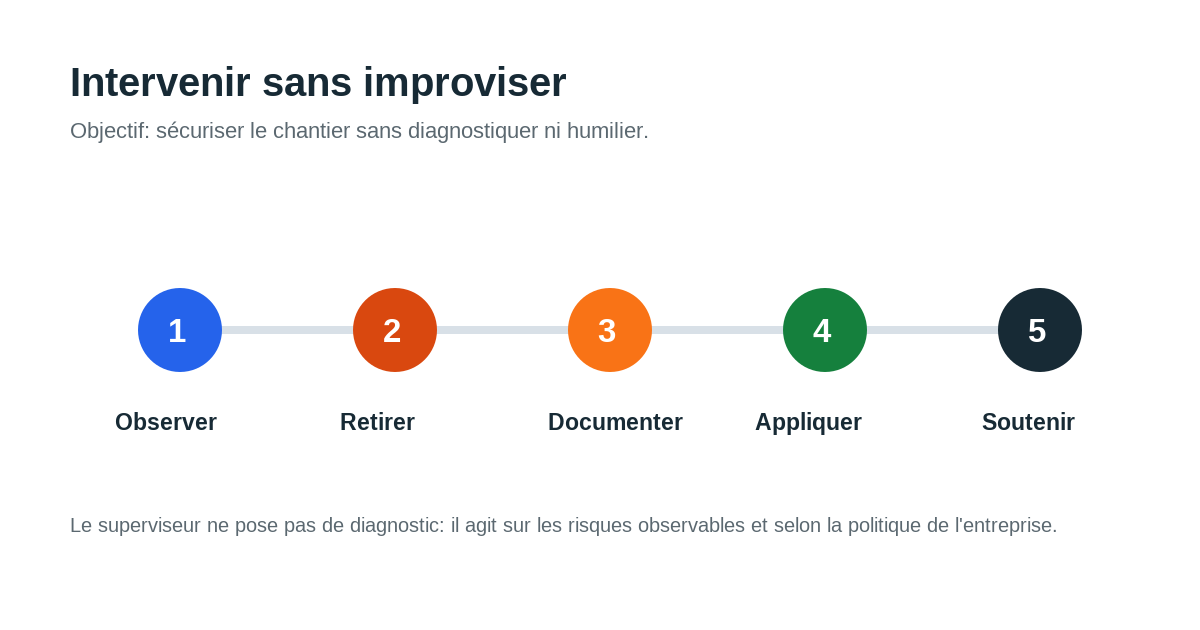
The first step is to secure the site. If the person seems unable to perform a task safely, they must be removed from the risky task. The cause is not debated while a load is suspended, a vehicle is moving, or work at height is underway.
The second step is to involve the right person: foreman, supervisor, OHS officer, health and safety representative, or management, depending on the site structure. When possible, the observation should be confirmed by another qualified person to avoid a decision based on an isolated perception.
The third step is to document the facts. Time, place, planned task, observed behaviours, identified risk, people present, and action taken. This level of detail allows for professional action, especially if the situation leads to removal from the site, an administrative measure, a disciplinary measure, or a request for support.
The fourth step is to apply the policy. If the company does not have a clear policy, the incident often becomes more difficult to manage. This is precisely why prevention must be prepared before a case arises.
Drug or alcohol screening is a sensitive topic. It should not be presented as an automatic solution to all problems. The CCOHS indicates that a policy can describe the circumstances under which screening will be conducted, the test modalities, and the interpretation criteria. This implies that the company must act with a clear, proportionate, and known framework.
Discipline may be necessary when a worker puts the site at risk, does not follow a policy, or refuses to cooperate with safety measures. But support may also be necessary, especially when there is a dependency, a health problem, or medication affecting abilities. A serious policy must therefore provide for both dimensions: immediate safety and appropriate support.
In practice, extremes should be avoided. Allowing a dangerous person to work out of fear of creating conflict is irresponsible. Humiliating a worker or drawing medical conclusions without factual basis is also irresponsible.
Certain signs may justify intervention: smell of alcohol or drugs, red or glassy eyes, unsteady gait, difficulty speaking clearly, lack of coordination, unpredictable behaviour, unsafe work method, accident, incident, repeated tardiness, frequent absences, or unusual drop in quality.
But these signs must be interpreted with caution. The CCOHS reminds us that several situations can explain similar behaviours: temporary health problem, fatigue, stress, work conflict, personal problem, or side effect of medication. The goal is not to guess the cause. The goal is to decide if the person can work safely now.
This nuance is essential for sites. A responsible intervention does not start with an accusation. It starts with factual observation and risk assessment.
When rules are unclear, the site culture fills with rumours. Some downplay. Others accuse too quickly. Foremen hesitate. Workers don't know what to report. Employers intervene only when an incident has already occurred.
A clear policy reduces this grey area. It states what is prohibited, how to ask for help, how to report a risk, who intervenes, which tasks are critical, what happens when a person is removed from work, and what resources are available.
For employers looking to improve retention and reputation, preventing impairment should be part of a more mature HR management. A safe worksite better attracts and retains serious workers. ConstruMD often addresses this issue from a recruitment perspective, particularly in the article on how to recruit skilled labour for construction sites: quality management becomes a concrete argument to attract the right workers.
On a construction site, impairment is not a secondary issue. It directly affects safety, supervision, compliance, employer liability, and worker protection.
The simple rule is as follows: a person whose condition poses a risk should not perform the work, and the employer must prevent the work from being carried out under these conditions. The cause may be alcohol, a drug, cannabis, certain medications, fatigue, or a health problem. The risk, however, must be taken seriously immediately.
The best approach is neither lenient tolerance nor a witch hunt. It is a clear policy, factual observations, prompt intervention, serious documentation, and appropriate support when the situation demands it.
You might like
ConstruMD
Nov 5, 2026
ConstruMD
Nov 5, 2026
ConstruMD
Nov 5, 2026