
MÉDIC Construction 2027: changes in reimbursements
ConstruMD
Nov 18, 2026
All Posts
SHARE THIS POST
Published : November 5, 2026
On a construction site, hands are constantly exposed: drilling, screwing, handling, cutting, vibration, dust, cold, heat, adhesives, sealants, solvents, abrasives, and sharp materials. Yet, the response "wear gloves" doesn't solve everything.
In many trades, especially when drilling, screwing, adjusting, or handling small parts, workers explain that some gloves slow them down, reduce their precision, or make the task less safe. The real issue is not choosing between wearing gloves or not. It's about choosing the right glove for the right risk, at the right time.
A poorly chosen glove often ends up in the pocket. A well-chosen glove becomes a work tool.

Hands are used for everything on a construction site. They are close to the tool, the material, and the danger. An injury to a finger, a deep cut, a burn, an irritation, or dermatitis can quickly limit the ability to work.
The problem is that risks are rarely the same from one task to another. A glove useful for handling metal may be unsuitable for screwing small parts. A glove resistant to certain products may be too slippery for handling a tool. A warm glove may protect in winter but become damp and uncomfortable after a few hours.
That's why an effective prevention policy should not just say "gloves mandatory." It should explain what type of glove is expected according to the task, the risk, and the level of dexterity required.
The CNESST reminds us that personal protective equipment is used to protect workers when risks cannot be eliminated or otherwise controlled. In other words, PPE is part of a prevention approach, but it does not replace risk analysis.
For hands, this nuance is important. Before imposing a glove, it's necessary to understand what we are trying to prevent: cut, abrasion, puncture, burn, chemical irritation, vibration, cold, heat, or repeated contact with aggressive materials.
Cuts, punctures, abrasions, and pinches often require resistant gloves, but resistance should not eliminate the necessary dexterity. A glove that's too thick can reduce precision and increase clumsy movements.
Some products, dust, sealants, glues, or solvents can irritate the skin. In these cases, the glove material becomes essential. Not all gloves protect against all products.
A wet, cracked, cold, or irritated hand becomes more vulnerable. Creams can help in some cases, but they do not replace a prevention strategy if the work constantly exposes the skin to irritants or abrasion.
When a worker removes their gloves, it's not always because they neglect safety. Often, it's because the provided PPE does not match the task.
The most common reasons are simple:
An employer or foreman who ignores these signals risks achieving only superficial compliance. Gloves are available, but they are not actually worn at the critical moment.
The IRSST offers a tool to properly choose protective gloves according to risks and uses. This approach is useful because it starts from the real danger rather than the product to buy.
Before choosing a glove, the task must be described: drilling, screwing, cutting, handling metal, installing insulation, working with ducts, applying a product, transporting materials, or adjusting a part.
A glove cannot be optimal for everything. The priority risk must be chosen: cut, abrasion, irritating product, heat, cold, vibration, or fine precision.
A glove must be tested in a real task, not just tried on at the counter. The worker must be able to hold the tool, handle the parts, feel the pressure, and maintain sufficient control.
A glove that's too large reduces precision. A glove that's too tight tires the hand. Fit influences safety as much as comfort.
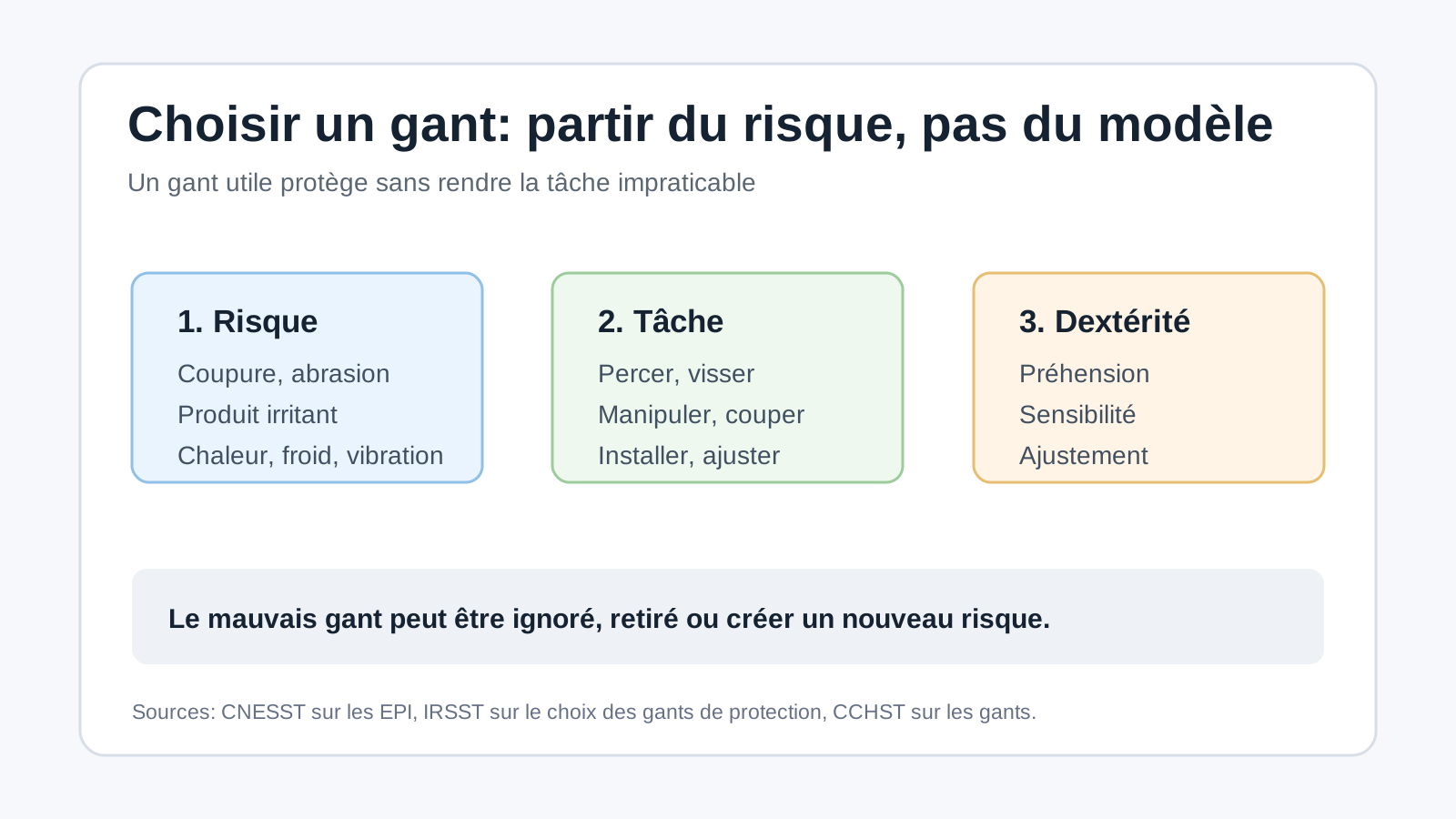
The CCOHS reminds us that protective gloves must be chosen according to the targeted danger. A glove designed for cuts does not necessarily protect against a chemical product. A glove resistant to certain products may be poor for heat or tool grip.
This is a common mistake on construction sites: buying a "robust" model and believing it covers everything. In reality, a good program may require several types of gloves depending on the tasks.
For a residential HVAC worker, for example, needs can change within the same day: handling ducts, drilling, screwing, handling sheet metal, accessing a tight space, contact with dust or insulation. A single universal glove rarely perfectly meets all these situations.
An employer is not only required to provide gloves. They must ensure that the chosen PPE matches the risks and can be used correctly.
List the recurring tasks and associate the main risks with each task. This work can be done with the workers, as they quickly know where a glove hinders movement or becomes unusable.
Having too many models complicates management. But having only one may be insufficient. The goal is to have a few clear options: precision, cut/abrasion, irritating product, cold, heavy handling.
The training should explain when the glove is required, when another glove is preferable, how to recognize a worn glove, and what to do if the provided PPE hinders the task.
If gloves are not being worn, it is important to understand why. Repeated non-use is often an indicator that the model, size, or procedure is not suitable.
Workers also have a role in prevention. If a glove prevents proper work, it should be reported rather than simply abandoned.
The useful information to convey is specific:
This information allows for correcting the PPE choice instead of turning the issue into a conflict between production and safety.

Hand protection may seem very operational, but it also affects retention. A worker who ends each week with cracked, irritated, or painful hands can quickly lose comfort, efficiency, and motivation.
In a market where companies want to attract and retain good workers, on-the-ground details matter. ConstruMD already addresses the importance of better understanding the realities of trades and occupations in construction in Quebec. Prevention is part of this reality: it influences work quality and team sustainability.
For employers training new workers, especially apprentices, the topic also deserves early integration. In the context of hiring apprentices in construction in Quebec, learning to choose and use the right PPE is part of integrating into the trade.
The right question is not “should gloves be worn?”. The right question is: which glove truly protects for this specific task without creating another problem?
An effective approach starts with the risk, considers dexterity, tests models with workers, and adjusts the policy according to the field. It is more demanding than a simple safety reminder, but it is also what makes prevention applicable.
On a construction site, the protection that works is the one that workers can actually use while doing the job.
You might like
ConstruMD
Nov 18, 2026

ConstruMD
Nov 15, 2026

ConstruMD
Nov 11, 2026