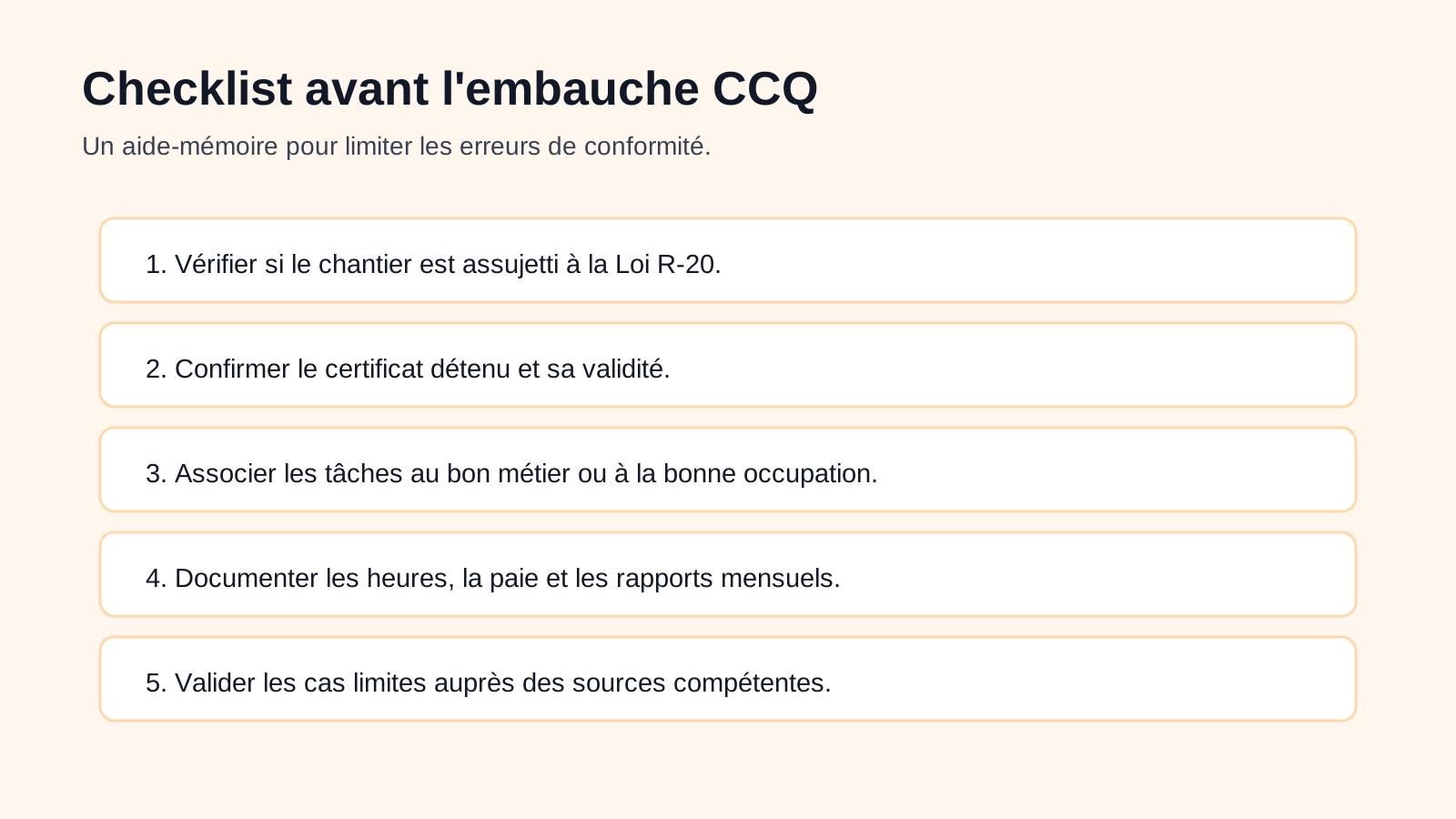
Hiring Without a CCQ Card: What Employers Must Check
ConstruMD
Nov 5, 2026
All Posts
SHARE THIS POST
Published : November 5, 2026
To enter the construction industry as an apprentice, many candidates look for a company capable of "guaranteeing hours" for them. On the ground, the expression spreads quickly: you need a company, a guarantee of 150 hours. But what this guarantee actually means is often less clear.
The 150-hour guarantee is not just a phrase thrown around in conversation. In some pathways to obtaining an apprentice competency certificate, it serves to demonstrate that an employer registered with the CCQ commits to offering a minimum volume of work to a person who wants to enter a trade.
For the candidate, it's a potential entry point. For the employer, it's a responsibility. And for both, it's a commitment that must be understood before promising anything.

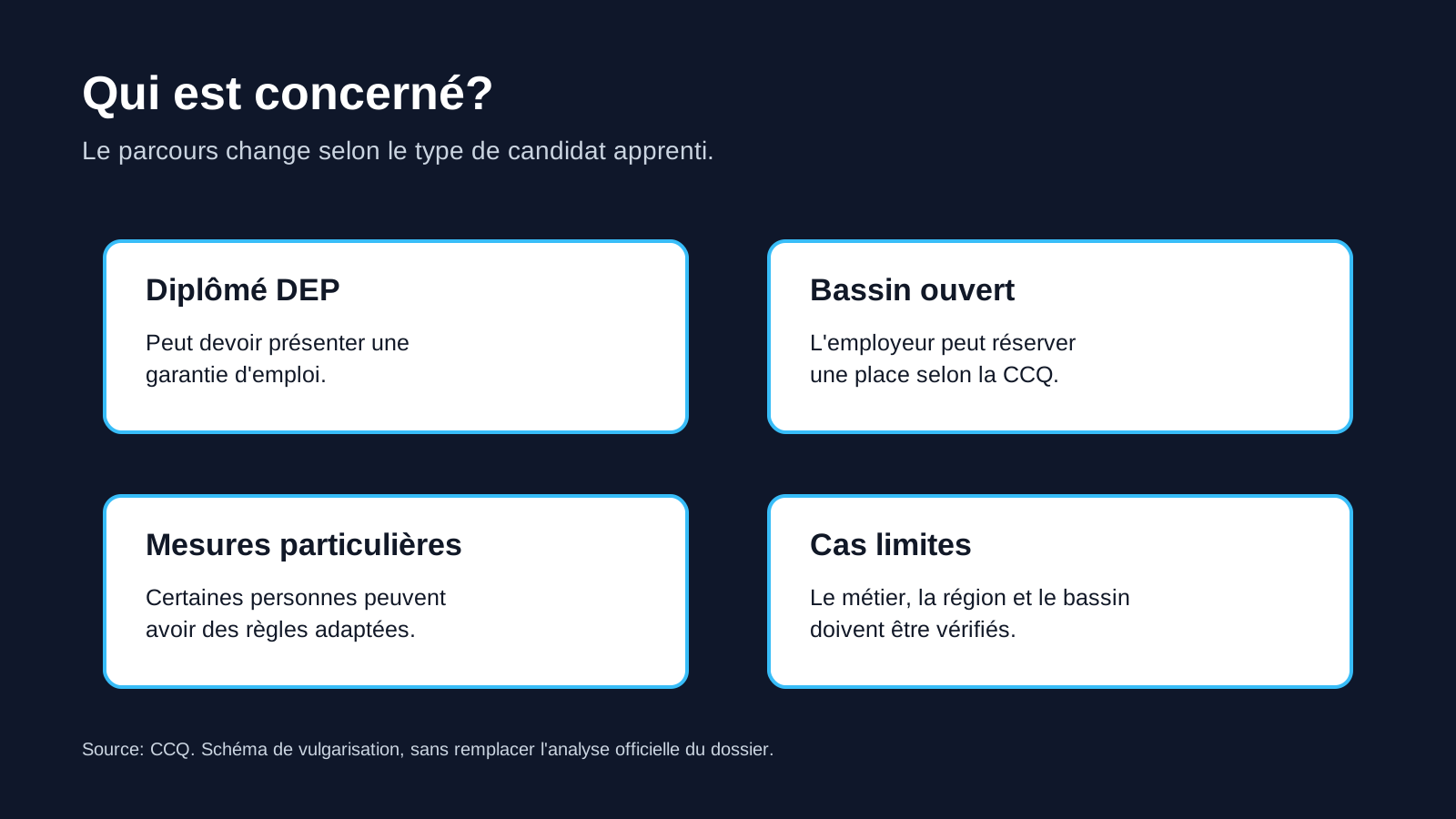
The CCQ page on the apprentice competency certificate indicates that a person who wants to obtain a CCA can take different paths depending on their type of candidate: graduate of a recognized program, entry according to the labour pool status, recognition of experience, student, journeyman, employer, or candidate from abroad.
In some cases, the CCQ requires an employment guarantee. For a graduate candidate, this guarantee must come from an employer registered with the CCQ and be for a duration of at least 150 hours, spread over a period of no more than three consecutive months.
The CCQ also indicates that, for a candidate entering according to the labour pool status, the employer who reserves a spot guarantees the candidate at least 150 hours of work over a period of no more than three consecutive months.
In simple terms, the 150-hour guarantee means that an employer is not just saying "I might take you." They commit to providing a minimum number of hours within a defined timeframe, according to the applicable pathway and CCQ terms.
It's not the same as a vague promise, a positive interview, or an intention to call the candidate back. It's a commitment linked to a process of entering the trade. The employer must therefore be able to plan the work, supervision, pay, reports, and assigned tasks.
For the candidate, this does not mean that everything is automatically settled. They must also meet the general CCQ requirements, such as the minimum age, social insurance number, identification documents, the General Health and Safety course on construction sites, and other documents required according to the file.
The logic of labour pools is important. The CCQ uses pools to manage access to the industry according to labour needs by trade and region. When a pool is open, certain people can obtain an apprentice competency certificate if they meet the conditions.
When a pool is closed, access may be more limited, except in certain specific situations provided by the CCQ, particularly for groups targeted by access measures. This is why two candidates in two different trades can receive different responses.
The employer and the candidate must therefore check the trade, the region, the pool status, and the type of candidate. A 150-hour guarantee is never fully understood without this context.
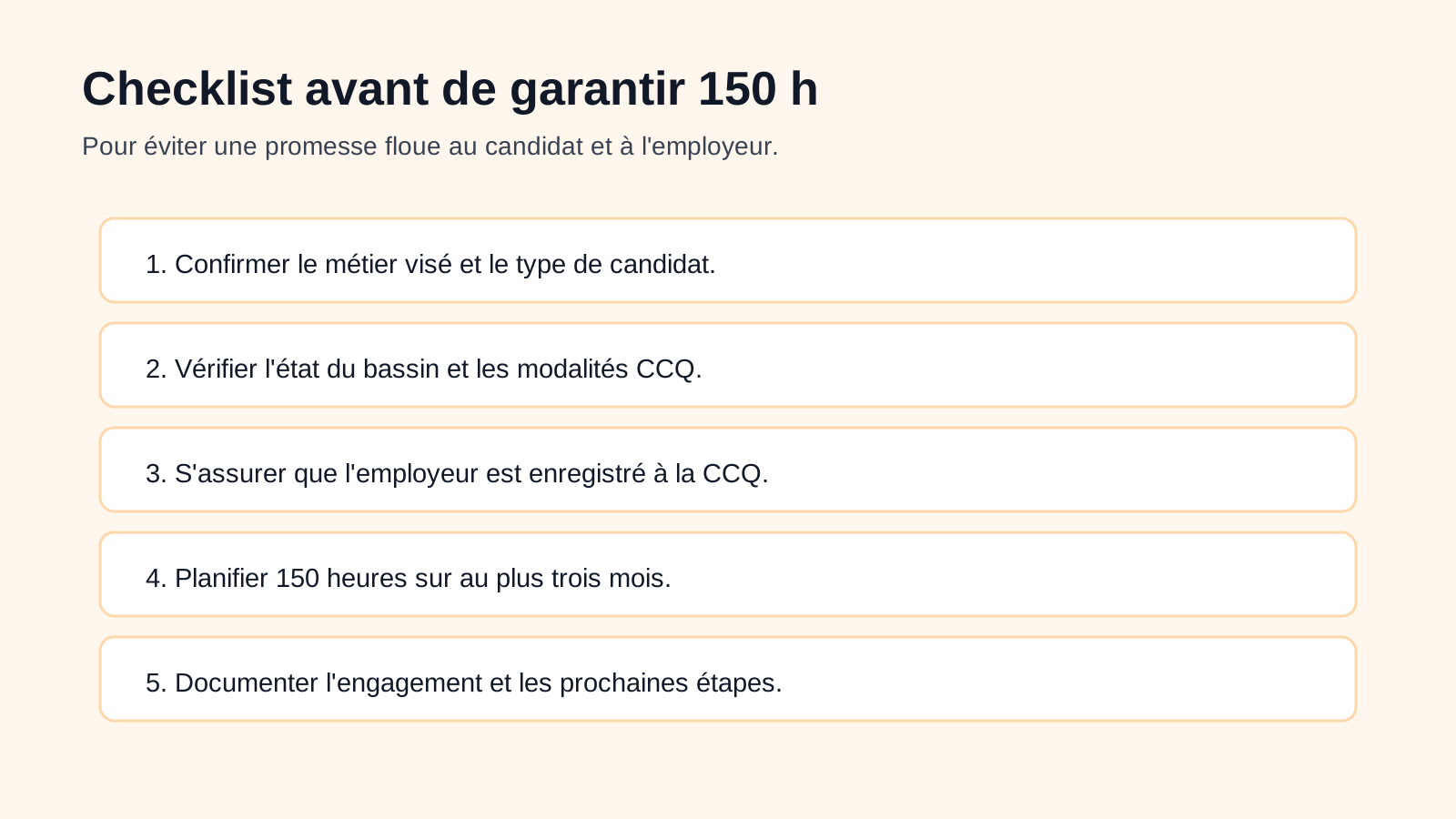
Before guaranteeing 150 hours, the employer should confirm that they are properly registered with the CCQ, that the targeted trade corresponds to the actual need, that the site or sites can provide the hours, and that the team can properly supervise an apprentice.
They must also check the apprentice-journeyman ratios, the planned tasks, the work region, and the administrative capacity to report the hours correctly. A guarantee does not help if the hours are not well planned or if the candidate is placed in a context that does not match their trade.
For employers specifically looking for candidates in this framework, construction job offers with a 150-hour guarantee can help make this need clearer from the start, instead of leaving the candidate guessing which companies understand this pathway.
The candidate should ask in which trade the guarantee is offered, where the hours will be worked, over what period, with what type of site, and who will accompany them in the CCQ process.
They should also confirm if their profile corresponds to an entry as a graduate, an entry according to the pool status, or another pathway. The conditions are not the same for everyone.
A good practice is to keep written records: company name, targeted trade, number of hours, planned period, responsible person, and remaining steps. This avoids misunderstandings when it comes time to assemble the file.
The 150-hour guarantee does not instantly transform a person into a self-employed worker, journeyman, or permanent employee. It does not replace the documents required by the CCQ, bypass the trade rules, or exempt the employer from their obligations.
It also does not guarantee a complete career within the company. It primarily serves to support a process of entering the industry within a specific framework.
This is an important nuance. A candidate may see the guarantee as a promise of long-term stability, while the employer sees it as a minimal commitment to allow entry. Expectations must therefore be clarified from the start.
In a market where succession remains a challenge, the 150-hour guarantee can become a concrete tool to connect employers and candidates. It allows a company to say: we have a real need, we are ready to support someone, and we understand the entry procedures.
But this tool only works if the employer is serious. Welcoming an apprentice requires time, supervision, and a good understanding of the trade. The ConstruMD article on how to hire an apprentice in construction in Quebec delves into this aspect of integration and supervision.
For the worker, the ConstruMD guide on construction trades and occupations can also help validate if the targeted trade truly matches their interests, physical abilities, and goals.
The 150-hour guarantee is a serious commitment in certain pathways to obtaining an apprentice competency certificate. It must come from an employer registered with the CCQ and, according to the terms indicated by the CCQ, cover at least 150 hours over a period of no more than three consecutive months.
For the employer, it is not just an aid to the candidate. It is a promise of work, supervision, and compliance. For the candidate, it is not an automatic career guarantee. It is a step in a process that must be completed correctly.
The best approach is simple: verify the trade, the state of the pool, the type of candidate, the required documents, and the employer's obligations before promising the guarantee.
You might like
ConstruMD
Nov 5, 2026


ConstruMD
Nov 5, 2026