
MÉDIC Construction 2027: changes in reimbursements
ConstruMD
Nov 18, 2026
All Posts
SHARE THIS POST
Published : November 5, 2026
When we talk about "quick and poorly done" work, the conversation often falls into two extremes. On one side, some say that everyone cuts corners. On the other, some respond that a visible defect proves nothing and that the critics come from people who don't know the construction site. The reality is more useful than that: construction quality is verified with rules, steps, evidence, and responsibilities.
In Quebec, a compliant building does not rely solely on the goodwill of a contractor or the client's eye at the end of the project. It relies on the Building Code, plans and specifications, manufacturers' requirements, inspections, corrections, and documentation. When these elements are neglected, defects can appear months or years later.
The goal of this article is to clarify what inspection really changes, why certain steps are critical, and how workers, contractors, site managers, owners, and investors can assess quality beyond a simple visual impression.
A building can look beautiful on the surface and contain serious problems. Conversely, a construction site can look messy during work while respecting important technical steps. That's why quality should not be judged solely by the cleanliness of the site, the speed of execution, or the final appearance.
The most costly defects are often those that are no longer visible after the walls are closed, the cladding is installed, the interior finishing is done, or the landscaping is completed. Insulation, waterproofing, structure, ventilation, drainage, flashings, anchors, plumbing, and electricity must be checked at the right time. A late inspection can spot some signs, but it does not always allow seeing what is already hidden.
This is the first idea to remember: doing things quickly is not automatically doing them poorly. But going too fast to the point of closing a step without sufficient verification increases the risk of non-compliance, rework, and conflict.
On a construction site, "well done" does not mean "as I would have done it." Quality must be linked to references. The basis is the applicable Building Code, regulations, plans and specifications, contractual obligations, manufacturers' requirements, and recognized technical rules in the trade.
The Régie du bâtiment du Québec reminds that the contractor must apply the Building Code for the work they are responsible for. The RBQ can also inspect work to verify if regulatory obligations are met. If an inspector finds defects, the contractor may receive a correction notice with a deadline to fix them.
The simplification is simple: a contractor must not only deliver something that "looks okay." They must deliver work that complies with applicable requirements. And if an authority or inspection body requests a correction, they must be able to correct and demonstrate that the correction has been made.
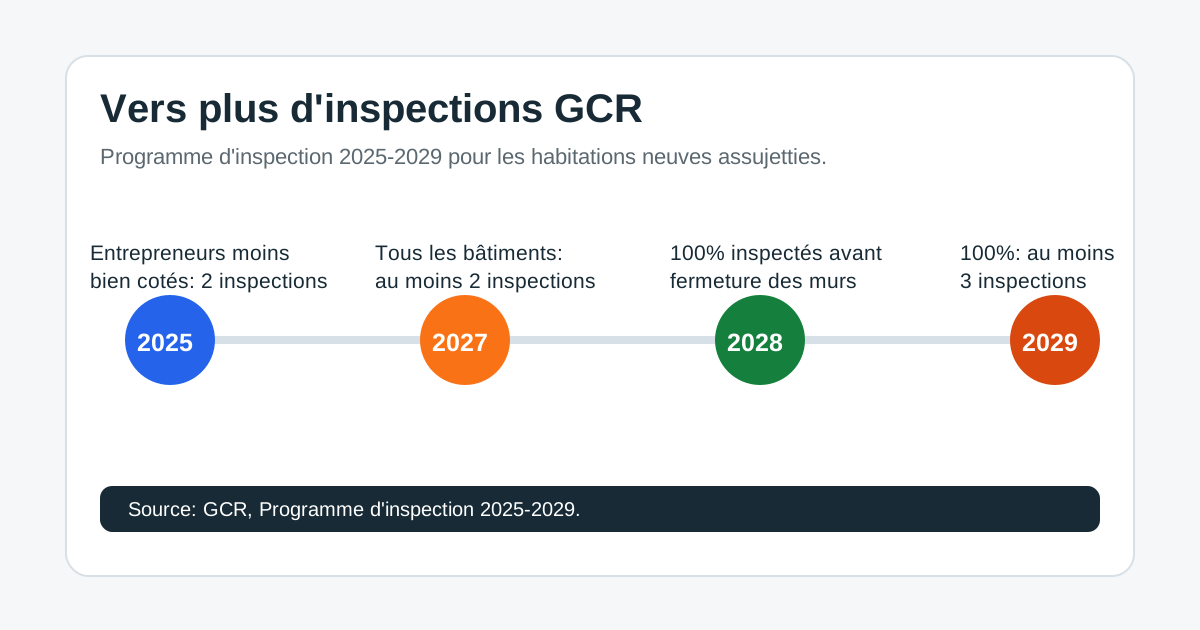
Garantie de construction résidentielle explains that its inspection program aims to ensure construction quality, prevent defects and poor workmanship, and reduce potential claims. For new residential buildings subject to the warranty plan, GCR is deploying a 2025-2029 program that gradually increases the number of inspections.
The change is significant. GCR indicates that buildings have been inspected at least once since 2023. The program then plans a progression to at least two inspections for all buildings in 2027 and at least three inspections for all buildings registered from the beginning of 2029. An inspection before wall closure becomes a central element of this strategy.
This is not just an administrative measure. It is a concrete response to a construction site problem: many important elements disappear behind walls, ceilings, claddings, or finishes. The earlier the inspection occurs at the right time, the simpler the correction is to execute.
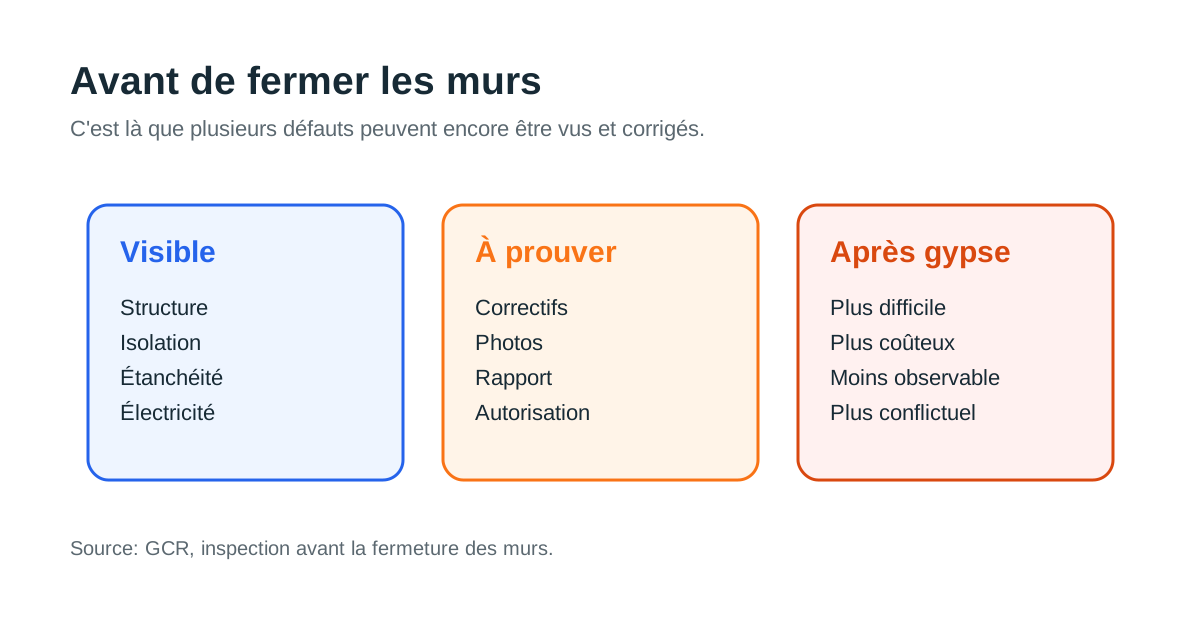
GCR explains that inspection before wall closure allows for the verification of the greatest number of elements because it occurs before the drywall is installed. Once the walls are closed, many elements simply cannot be observed without opening them.
This inspection covers, in particular, the work prior to drywall installation: structure, insulation, waterproofing, electricity, plumbing, heating, ventilation, and air conditioning. If corrections are required, the contractor must provide evidence so that GCR authorizes the wall closure.
The practical point is significant for contractors and site managers. Closing too quickly can cost more than slowing down properly. GCR even indicates that a contractor who closes walls without authorization may be asked to reopen them so that the inspection can be conducted in accordance with the program.
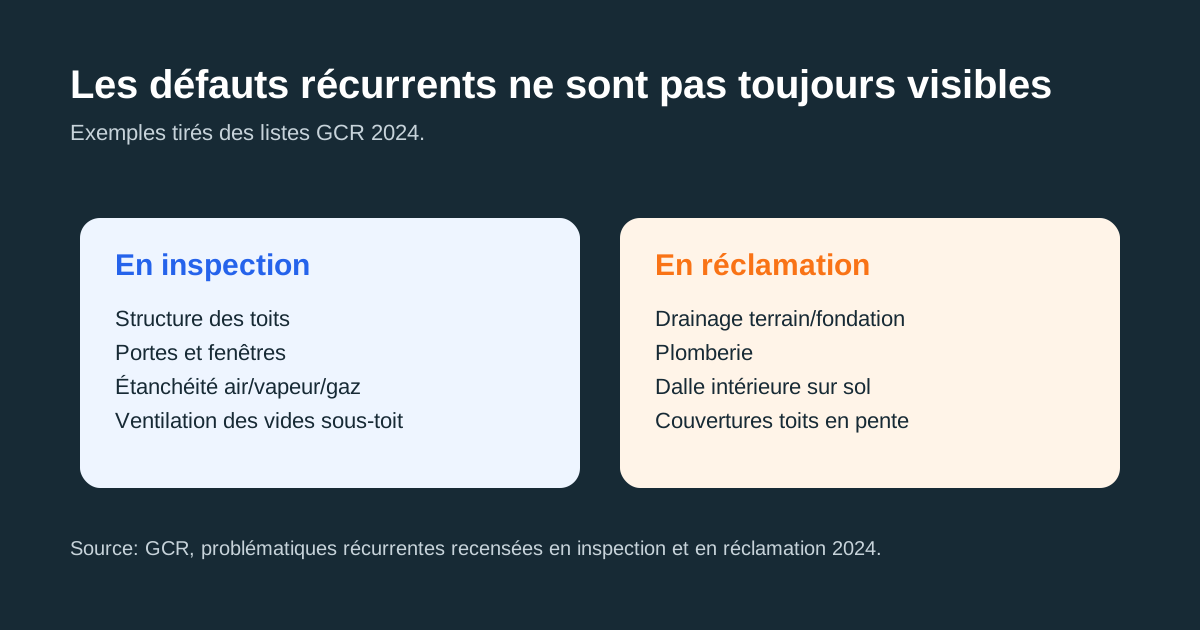
GCR publishes lists of recurring issues observed during inspections and claims. For 2024, the non-conformities identified during inspections include roof structures, door and window installation, air, vapour, and gas tightness, fire protection, wood structure, weather barriers, thermal performance, attic ventilation, electricity, and certain exterior claddings.
On the claims side, GCR notably mentions land and foundation drainage, plumbing, interior slabs on grade, masonry, exterior claddings, doors and windows, exterior concrete works, gypsum and joints, as well as sloped roof coverings, including asphalt shingles and metal.
These examples show why quality cannot be reduced to a single photo or video. A roof, window, wall, foundation, or cladding may seem acceptable in the short term, then reveal a problem later if installation, ventilation, sealing, or drainage were not executed correctly.
It is also important to avoid mixing all inspections. The RBQ intervenes within its powers of verification and control to ensure compliance with applicable laws, regulations, and codes. GCR administers the mandatory warranty plan for new residential buildings and inspects the homes subject to its program. The pre-reception inspection is carried out jointly by the contractor and the beneficiary before the building is received.
The pre-reception inspection is mandatory for a house covered by the new residential buildings warranty plan. The official warranty plan site indicates that it serves to verify compliance with construction laws, regulations, and standards, using a form approved by the RBQ.
In other words, each inspection has its role. The RBQ checks regulatory compliance within its areas of intervention. GCR aims to prevent defects, poor workmanship, and claims in buildings subject to the warranty plan. The pre-reception inspection serves to record the work to be completed or corrected before the building is officially received.
Documentation is not a useless formality. It becomes proof that the site was executed, verified, and corrected properly. Photos, reports, dates, notices, plans, technical sheets, proof of correction, communications with the inspector, and written confirmations can prevent long conflicts.
The RBQ indicates that a correction notice mentions the defects and the deadline to correct them. It also specifies that additional documents or proof may be required to certify the compliance of the work. GCR also requires proof of corrections when non-conformities need to be corrected before certain stages.
For a company, this means that quality must be integrated into the process. A good site system does not just tell teams to "be careful." It plans who checks what, at what time, with what proof, and according to which technical reference.
The owner or investor should not manage a site based only on impressions. They must understand which stages will be inspected, which work will be hidden, which proof will be kept, and which documents will be provided.
Before signing or accepting a reception, it is reasonable to ask what has been verified, what remains to be corrected, what reports exist, and what warranties apply. In new residential subject to the warranty, GCR's accredited companies directory also allows consulting public information about a company, including its accreditation status, RBQ license, certain detected non-conformities, and certain recognized claim files.
On ConstruMD, the article on work supervision and compliance certification complements this logic: verification should not happen only at the end, when correction options are more costly.
Workers have a direct role in quality. Poor installation, a forgotten step, poorly installed protection, or ignored manufacturer instructions can become a problem long after the team has left. The pressure to produce quickly should not erase technical requirements.
For an apprentice or less experienced worker, a good question to ask is: "What is the reference for this method?" Is it the plan? The Code? A manufacturer sheet? A foreman's directive? A GCR requirement? This question is not arrogance. It is a way to understand the trade and reduce rework.
Quality is also a training issue. Specialized trades are not just about going fast with the right tools. They require understanding why a method exists. The ConstruMD article on trades and occupations in construction in Quebec reminds us that tasks and responsibilities vary according to roles, jurisdictions, and contexts.
For employers, quality is not just a matter of reputation. It affects claims, rework, deadlines, client relationships, technical ratings, inspections, profitability, and the ability to recruit good workers.
A project that cuts corners often ends up transferring the cost elsewhere: service callbacks, complaints, correction notices, conflicts with the client, decreased team confidence, or difficulty attracting serious workers. Conversely, a well-managed project provides teams with a clear method and reduces impromptu decisions.
This aspect directly relates to recruitment. Good workers generally want to work in teams where quality is taken seriously. In a market where skilled labour is in demand, the way projects are managed becomes a selling point. The ConstruMD article on how to recruit skilled labour specifically addresses the importance of organization, credibility, and real conditions.
The best protection is to structure critical steps. Before closing a wall, applying a coating, pouring a slab, insulating, waterproofing, or delivering a finish, it is essential to know if the previous step has been verified. Quality control must be scheduled, not added as an afterthought.
A serious company should also clarify responsibilities. Who checks compliance? Who takes the photos? Who keeps the technical sheets? Who responds to the inspector? Who authorizes the closure of a step? Who confirms the corrections? These questions may seem burdensome, but they prevent grey areas.
Finally, it is important to accept that a verification delay can prevent a much more costly delay. Redoing a detail before closing the walls is often simpler than explaining it two years later in front of a client, an inspector, an arbitrator, or an insurer.
Construction quality is not judged solely at a glance. It is verified with references, inspections, evidence, and corrections. Applicable rules, the Code, plans, manufacturer requirements, and site documentation together form the basis of defensible work.
The move towards more inspections in new residential construction, particularly before wall closure, shows that the industry recognizes a simple reality: the most costly defects must be identified before they are hidden.
For contractors, it's a matter of management and credibility. For workers, it's a matter of method and professionalism. For owners and investors, it's a matter of proof, timing, and understanding the steps. Building quickly can be efficient. Building quickly without control is where the risk begins.
You might like
ConstruMD
Nov 18, 2026
ConstruMD
Nov 15, 2026

ConstruMD
Nov 11, 2026