
Easily find a 150h construction guarantee
ConstruMD
Nov 5, 2026
All Posts
SHARE THIS POST
Published : November 5, 2026
Construction jobs frequently appear in Quebec's immigration processes. In 2026, invitations published in Arrima for the Skilled Worker Selection Program mention several construction-related professions, including concrete finishers, tile setters, plasterers, roofers, glaziers, painters, floor installers, heavy equipment operators, and trade helpers.
This presence can create significant confusion: being invited to apply for immigration does not mean that a person can automatically start working on a site subject to the CCQ. These are two different processes. One concerns selection or the immigration journey. The other concerns the right to perform construction work in Quebec.
The goal of this article is to clarify the steps, without detours. An Arrima invitation can be good news in an immigration journey, but it does not replace a CCQ card, an exemption, or another valid work right.
Quebec is seeking labour in several sectors, and construction is one of the areas where needs are visible. Arrima invitations from the PSTQ published on Québec.ca include, depending on the exercises, construction or construction-related professions. This attracts the attention of foreign-trained workers, candidates already in Quebec, and employers looking to recruit.
The risk is mixing three realities: immigration, skills recognition, and legal access to the site. A person may be eligible for an immigration process while still having steps to complete before being able to practice a regulated trade on a subject site.
For a worker, this nuance avoids false expectations. For an employer, it avoids believing that an immigration file automatically resolves the hiring obligations provided by the CCQ.
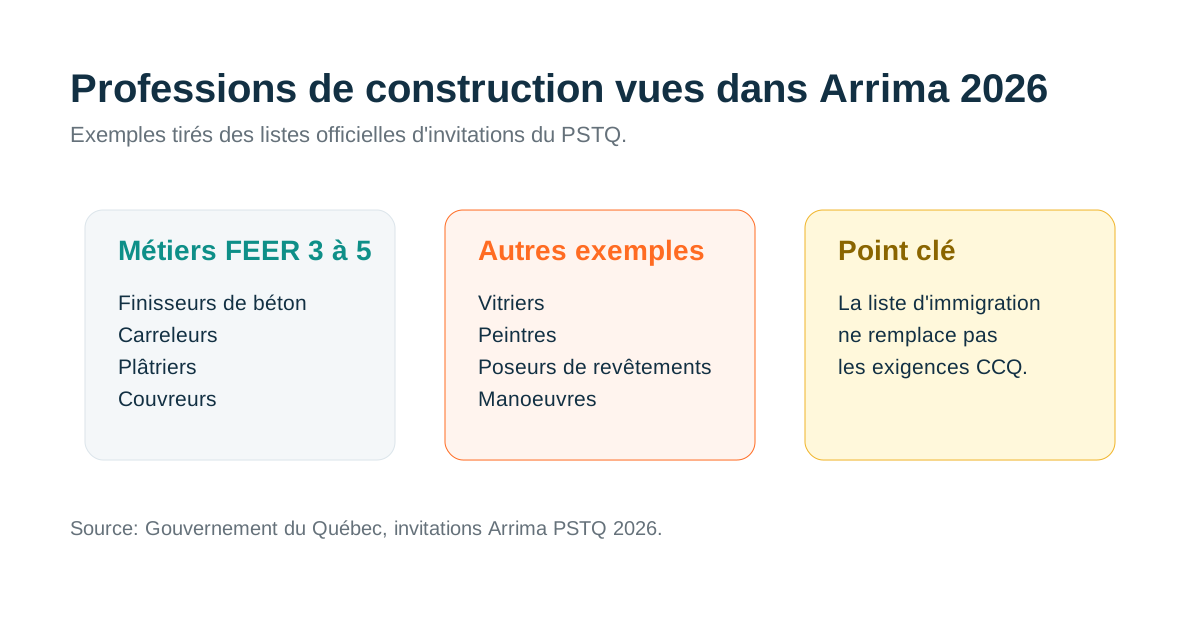
An Arrima invitation under the Skilled Worker Selection Program means that a person is invited to apply for permanent selection based on specific criteria. Québec.ca explains that invitations are made separately in the program's streams and that the stream depends notably on the main profession indicated, the FEER category, and the criteria applied to the invitation exercise.
In other words, the invitation is an entry point into an administrative process. It does not in itself constitute authorization to work in a regulated trade. It also does not confirm that the person can perform all the tasks of a construction trade in Quebec.
The official page of the 2026 Arrima invitations from the PSTQ shows that construction professions may be targeted in certain exercises. It is an important signal for the labour market, but it is not the same document as a CCQ work right.
On a subject site, the basic rule is clear: the person performing construction work as defined by law must hold a valid work right. The CCQ indicates that this right may include a competency certificate, an exemption, or another applicable status depending on the situation. It also specifies that the employer must verify the validity of this right before hiring and assigning tasks.
The CCQ page on hiring, pay, and workforce mobility rules summarizes this principle: hire workers who hold a valid competency certificate and assign them tasks respecting their trade jurisdiction.
The simplification is straightforward: Arrima may concern your immigration journey. The CCQ concerns your right to perform subject work on a site. The two may intersect, but one does not replace the other.
One detail often complicates understanding. Some professions may be regulated only when practiced in the construction industry. Québec.ca gives the example of carpenters: jobs associated with this profession are regulated by the CCQ when practiced in the construction industry.
In practice, this means that the professional title or experience abroad does not always suffice to determine what a person can do here. It is necessary to look at the actual work context: subject site or not, tasks performed, trade or occupation, required certificate, possible exemption, and applicable limits.
To better distinguish roles, the ConstruMD guide on trades and occupations in construction in Quebec can help understand that the industry does not operate solely by general titles, but by trades, occupations, jurisdictions, and tasks.
For a person trained abroad, skills recognition may be part of the journey. Québec.ca explains that when a profession is regulated in Quebec, one must have their training recognized by the body that oversees this profession. For work on construction sites, the Commission de la construction du Québec is among the cited organizations.
This recognition can help establish the level of competence or the steps to be completed. However, it should not be confused with a general permission to start working the next day. Depending on the case, the person may need to provide documents, complete steps, obtain a certificate, or meet specific conditions.
The Québec.ca page on recognition of foreign-acquired skills for a regulated trade reminds us that the regulatory body monitors and controls the practice of the trade or profession. This is exactly the point to remember for construction: experience counts, but access to the site must be compliant.
In section 3 of the PSTQ, which targets regulated professions, Québec.ca indicates that the invited person must present a document issued by the regulatory authority overseeing their profession in Québec. The list of possible documents includes, among others, a license to practice, a competency certificate, a professional qualification certificate, an apprentice card, or proof of full or partial recognition of equivalence.
This passage is important because it shows the link between immigration and professional regulation. The government does not simply say: you have an in-demand profession, so you can practice immediately. It requires a document that connects the person to the competent authority or official recognition.
For a candidate in construction, this reinforces a practical idea: one must prepare their skills dossier at the same time as their immigration dossier. Waiting until the end of the process to discover the CCQ requirements can delay actual entry onto the site.
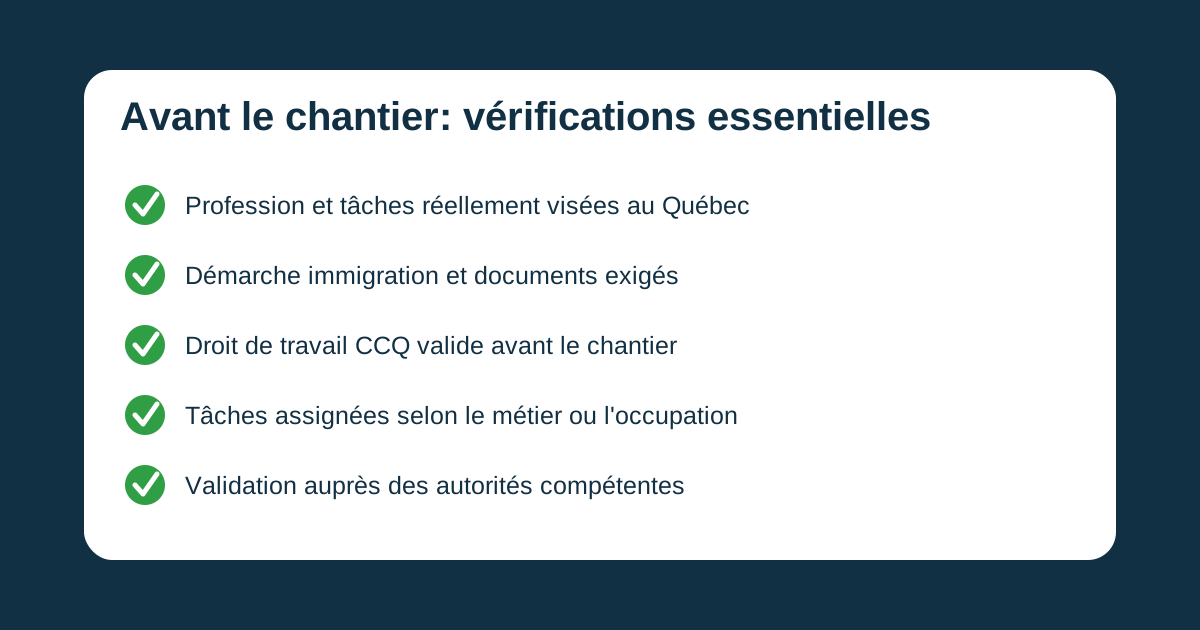
The first check is the actual trade or occupation targeted. The titles used abroad do not always perfectly match the trades, occupations, and tasks recognized in Québec. A person may present themselves as a carpenter, painter, operator, tiler, or labourer, but it is necessary to verify how this role translates into the Québec system.
The second check is the type of site. CCQ rules apply to work subject to Law R-20. Some related jobs, some off-site work, or certain contexts may fall under other rules. Therefore, one should not only ask "is it a construction job?" but "is it subject work and what work rights are required?"
The third check is the document held. An invitation, experience, a resume, a diploma, or a job offer are not automatically a CCQ work right. The person must know what document they have, what it allows, and its limitations.
The employer must verify the validity of the work right and assign tasks according to the trade or occupation. This obligation is central. An employer recruiting an immigrant candidate must therefore avoid relying solely on immigration status, diploma, or declared experience.
It is also necessary to avoid promising a start on the site before the conditions are clear. For a candidate looking for an entry point into the industry, construction jobs with a 150-hour guarantee can help identify employers ready to support an access process, but the guarantee never replaces the validation of the required work right.
The ConstruMD guide on what to check before hiring without a CCQ card complements this reading well, as it explains why compliance must be confirmed before arrival on the site.
The first mistake is believing that an Arrima invitation grants the right to work. It provides access to an immigration step, not automatically to a site.
The second mistake is believing that foreign experience directly translates into a CCQ card. The experience may be relevant, but it must be analyzed within the framework provided by the competent authorities.
The third mistake is confusing immigration permit, residency right, work right in Canada, and the right to perform subject work in Québec. These concepts may be related, but they are not identical.
The fourth mistake is looking only at the job title. In construction, the actual tasks and the site context count as much as the trade name.
For a worker, the logical order is as follows. First, identify the targeted profession in Québec and check if it is regulated. Then, understand the applicable immigration process. Next, verify with the CCQ or the competent authority the required right to practice. Then, prepare the training, experience, and recognition documents. Finally, accept a job only when the status, tasks, and work right are clear.
For an employer, the sequence is similar. Identify the real need, confirm the trade or occupation, check if the work is subject, validate the candidate's work right, document the process, and avoid any non-compliant assignment.
This process may seem longer than an ordinary hire. But it avoids a much heavier problem: a candidate who thinks they can start, an employer who plans their workforce, then a blockage because the work right or documents do not meet the requirements.
Arrima invitations indicate that several construction-related professions may be relevant to Quebec's needs. However, to work on a regulated construction site, one must comply with the specific rules of the construction industry.
An immigration invitation, foreign experience, or a job offer does not replace a valid CCQ work permit. The best approach is to handle both processes separately: immigration on one side, regulated site access on the other.
For workers, this distinction safeguards their journey. For employers, it ensures compliance. For the industry, it allows the integration of new talent without creating false starts.
You might like
ConstruMD
Nov 5, 2026

ConstruMD
Nov 5, 2026
ConstruMD
Nov 5, 2026