
MÉDIC Construction 2027: changes in reimbursements
ConstruMD
Nov 18, 2026
All Posts
SHARE THIS POST
Published : November 5, 2026
The Quebec Construction Code is not just an administrative detail. When a new edition comes into effect, it can change the way a project is planned, a bid is prepared, professionals are coordinated, and risks are calculated.
In Quebec, the update to the Building chapter of the Construction Code, which includes the 2020 National Building Code modified for Quebec, came into force on April 17, 2025. The Régie du bâtiment du Québec provides a transitional period until October 17, 2026, for several buildings and equipment intended for public use.
However, a new nuance changes the reading of the file: the Minister of Labour, Jean Boulet, has indicated a desire to postpone certain provisions that were to apply in October 2026 by one year. If the postponement proceeds, they would instead come into effect on October 17, 2027. For contractors, developers, site managers, and project owners, the issue is not only knowing the new Code. It is also about knowing which rules apply at what time.
The RBQ indicates that the amendments to Chapter I, Building, of the Construction Code came into force on April 17, 2025. This chapter replaces the previous version in effect since January 2022 and is based on the 2020 National Building Code, with modifications specific to Quebec.
The transitional period is important. Construction or transformation work that begins between April 17, 2025, and October 17, 2026, can, according to the RBQ, comply with the previous version or the new edition of the Building chapter. After this period, the buildings and equipment concerned whose work begins on October 17, 2026, or after that date must comply with the new edition.
This is the basic point to remember: the start date of the work can have a direct impact on the applicable Code. For a project in design, permit approval, or awaiting financing, this detail can change the technical and budgetary scope.
According to a Canadian Press dispatch reported by L'Éclaireur Progrès, Quebec wants to postpone the implementation of certain new provisions by one year. The postponement would aim for an application on October 17, 2027, rather than October 17, 2026, if the change is adopted.
The mentioned provisions notably affect accessibility, such as corridor width, installations related to electric vehicles, and seismic protection standards. The government seeks to give the industry more time to adapt in a context where every housing unit counts and where several projects are already advanced.
However, caution is advised. An intention to postpone is not the same as a definitively modified rule. As long as an official modification is not in effect, project teams should continue to validate their assumptions with the responsible professionals, the RBQ, and the competent authorities.
The debate is not just about being for or against stricter standards. The new requirements can meet real public objectives: accessibility, safety, aging population, electrification of transport, harmonization with the National Building Code, and building resilience.
At the same time, the industry fears impacts on costs, timelines, and the feasibility of certain projects. A requirement that seems simple on paper can alter design, available space, structural lots, electrical entries, coordination between professionals, and the construction sequence.
In a market where labour, costs, and timelines are already under pressure, these adjustments can become significant. The ConstruMD article on CCQ Perspectives 2026-2030 reminds us that the industry will need to continue dealing with a sustained need for workers. A regulatory change that requires more coordination can therefore amplify an already present pressure.
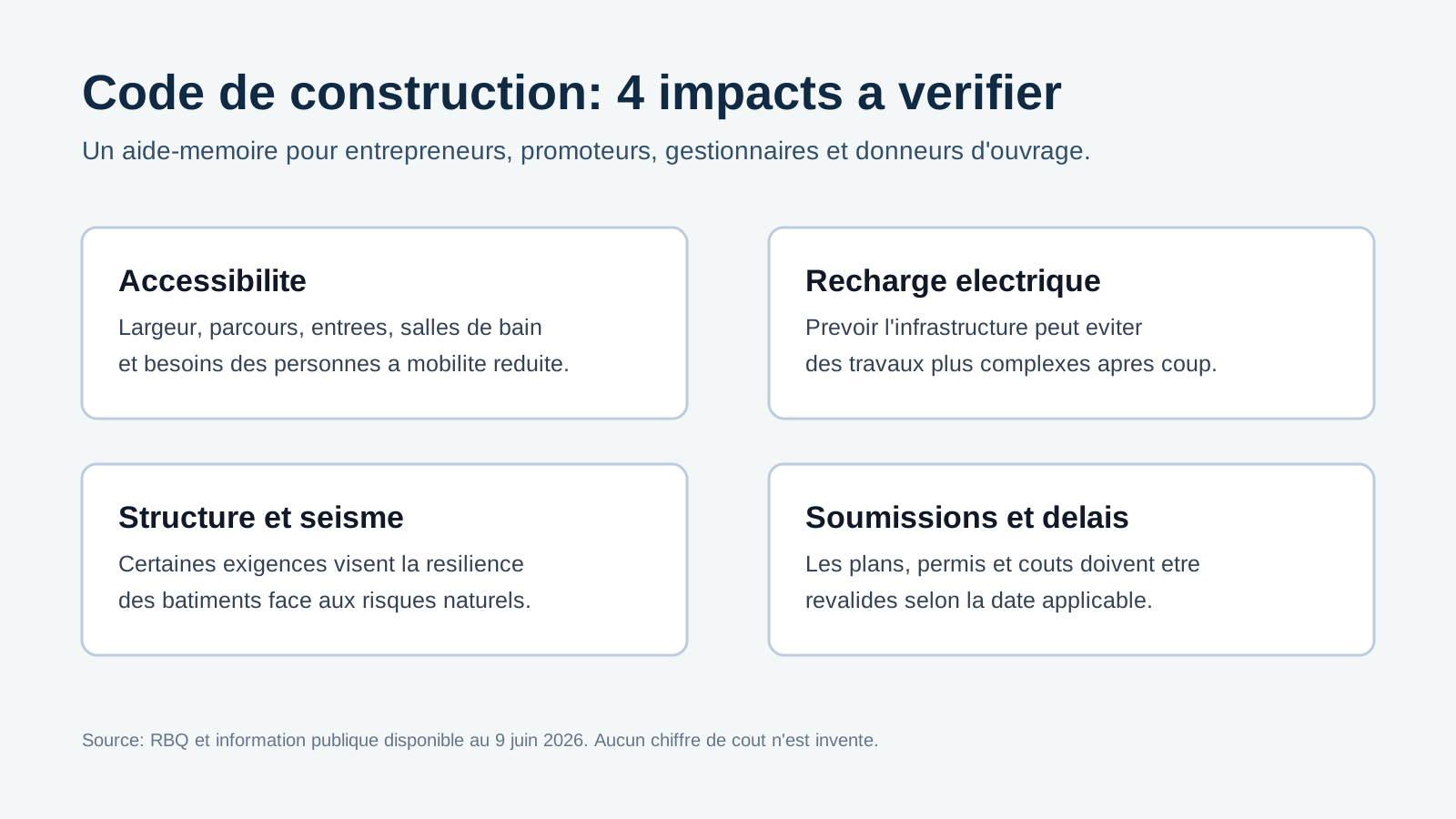
Rules related to accessibility aim to make buildings more usable for people with functional limitations. On the ground, this can affect pathways, entrances, corridors, maneuvering spaces, sanitary equipment, and certain layout choices.
For a contractor, the impact is not limited to checking a box. It is necessary to verify whether the plans, dimensions, materials, coordination with the architect, and site constraints truly allow compliance with applicable requirements.
Requirements related to electric vehicles do not always mean that each space must immediately receive a complete charging station. The issue can also be capacity, infrastructure preparation, electrical distribution, or the possibility of adding equipment later.
The difference is significant. Planning the infrastructure from the design stage can be simpler than returning to a completed building. For contractors and developers, it is therefore important to clarify early what is required, what is planned, and what remains the responsibility of the owner or future occupant.
Seismic standards are often misunderstood. They are not just to respond to a frequent event. They aim to reduce risks for occupants and to regulate the performance of buildings according to Code requirements.
For targeted projects, the issue must be addressed with competent engineers and professionals. Contractors should not improvise the interpretation of these requirements in a bid. An overly optimistic assumption can create a significant gap between the submitted price and the project's reality.
The right approach is to bring the matter down to concrete questions. What is the planned start date for the work? Is the building subject to the Building chapter? Is the project a new construction, a transformation, or an expansion? Were the plans prepared according to the old version, the new version, or a transitional assumption? Does the contract specify what happens if a requirement changes before the work begins?
These questions should be asked before finalizing a bid. They should also be documented. A contractor who estimates a project without clarifying the applicable Code version risks extras, conflicts, or delays.
For employers who will need to adjust their site planning, access to the workforce can also become a factor. The ConstruMD page on available CCQ workforce can help visualize certain pools by trade, especially when technical coordination increases pressure on teams.
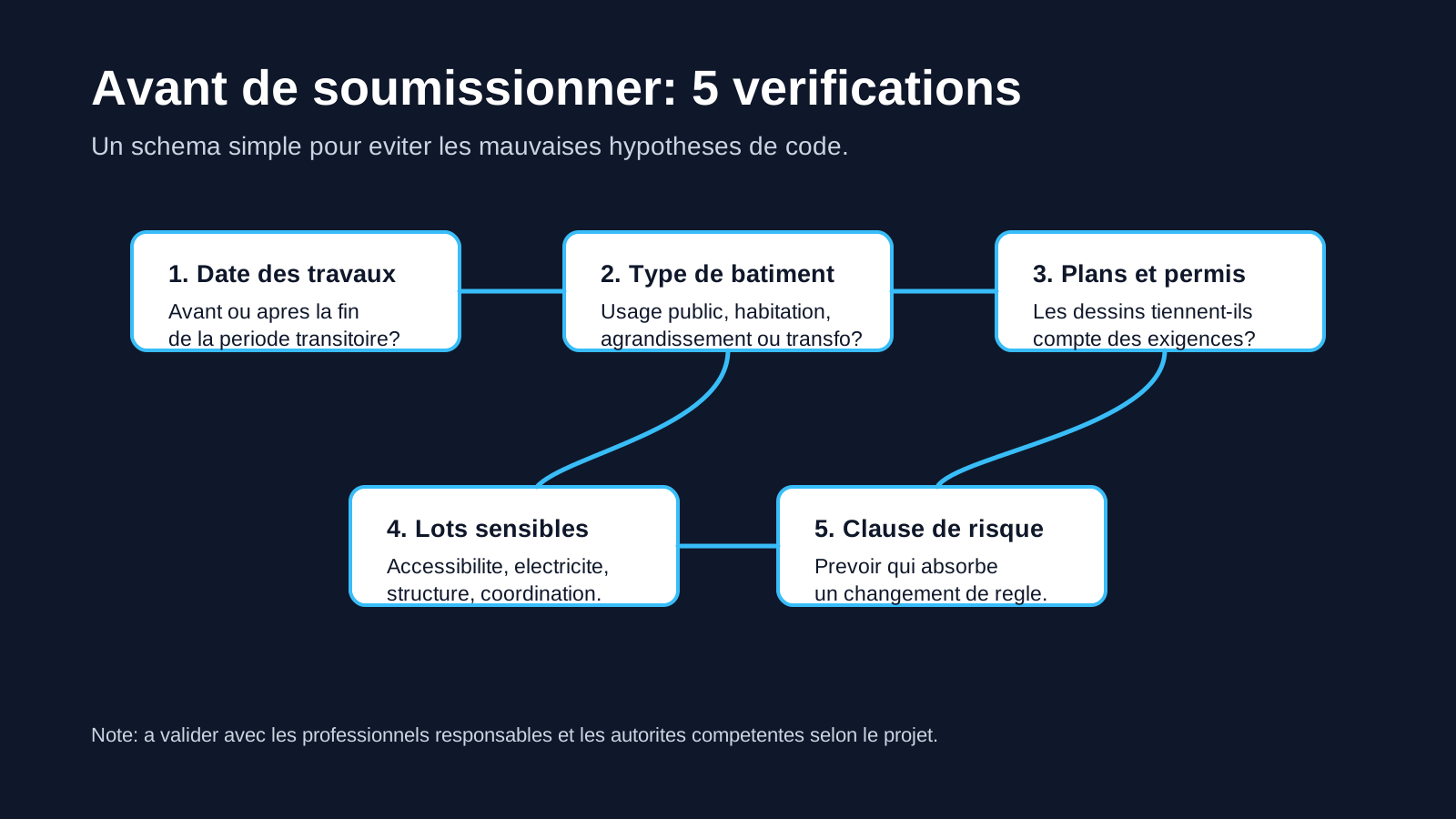
For an owner or investor, the subject may seem very technical. Yet, it directly affects financial feasibility. If a project changes regulatory regime between the design stage and the start of work, some costs may need to be reviewed.
Prudence involves asking professionals to clearly specify the Code used to design the project, sensitive elements, risk margins, and possible scenarios if an application date changes. It's not just a matter of compliance. It's a matter of budget, schedule, and project value.
The most important point is the uncertainty surrounding the postponement. As of June 9, 2026, available information indicates a governmental intention to postpone certain provisions by one year. This does not replace an official regulatory check for a specific project.
Industry players should therefore avoid two mistakes. The first would be to completely ignore the new Code, assuming everything will be postponed. The second would be to panic and modify all projects without validating which provisions are actually applicable.
The right approach is more nuanced: follow official announcements, document assumptions, involve professionals early, and plan in contracts who assumes the risk of a regulatory change.
The new Quebec Construction Code is not just a compliance issue. It's a planning issue. It can influence plans, costs, timelines, bids, and coordination between trades.
For contractors, the central question is simple: which version of the Code applies to this project, on this date, with these plans and these contractual conditions? As long as this answer is unclear, the bid rests on a grey area.
In an already tight market, this clarity can make the difference between a well-framed project and a site that accumulates adjustments.
You might like
ConstruMD
Nov 18, 2026
ConstruMD
Nov 15, 2026

ConstruMD
Nov 11, 2026