Harness and Aerial Platform: The Rule in Quebec
ConstruMD
Nov 5, 2026
All Posts
SHARE THIS POST
Published : November 5, 2026
Construction holidays are not just two weeks off on the calendar. For contractors, project managers, foremen, workers, and clients, it is a period that directly affects site planning, deliveries, payroll, emergencies, and coordination with subcontractors.
In 2026, the official summer period indicated by the Commission de la construction du Québec runs from July 19 at 12:01 AM to August 1 at 12:00 AM. The general rule is clear: sites must be closed during this period. But as often in construction, some exceptions exist and must be handled correctly.
The goal is not to bypass the holidays. The goal is to understand what closes, what can continue, how work should be compensated, and what employers should check before organizing a team during this period.
To plan for returns from vacation, employers can find available construction workers.
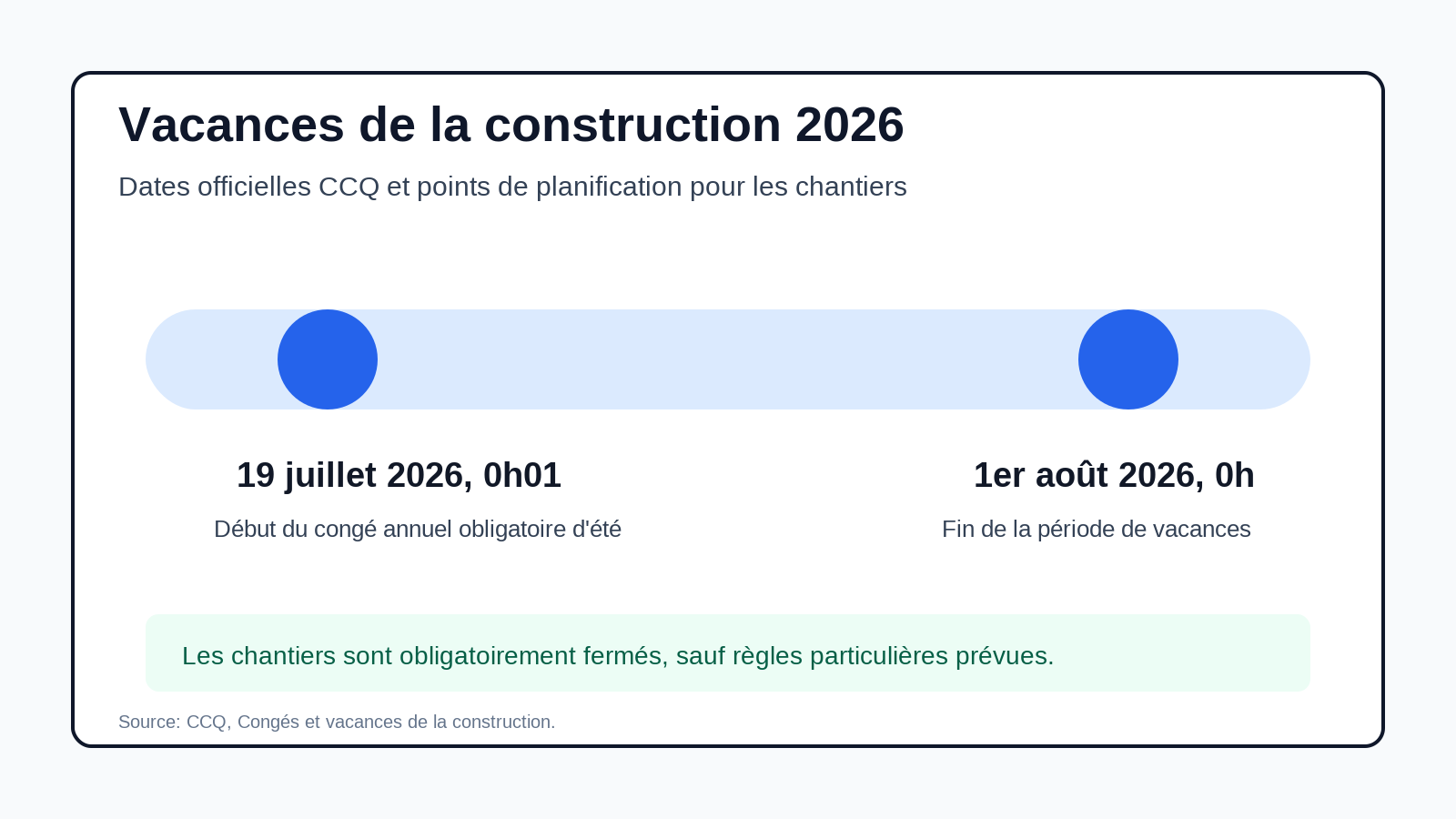
For summer 2026, construction holidays run from July 19 at 12:01 AM to August 1 at 12:00 AM. The CCQ also publishes the dates for the following years: from July 25 to August 7, 2027, and from July 23 to August 5, 2028.
These dates are important because they serve as a reference point for site schedules, material orders, team presence, client timelines, and agreements with subcontractors.
In many projects, the problem does not stem from the closure itself. It rather comes from poor anticipation. A delivery scheduled too late, an unavailable subcontractor, a poorly informed client, or an unframed emergency can turn a planned break into an operational conflict.
The CCQ indicates that during this period, sites must be closed. This means a contractor cannot simply decide to continue a regular site because the project is behind schedule or because a client insists.
For workers, this rule protects a common annual leave period for the industry. For employers, it creates a planning obligation. Timelines must incorporate the closure, especially for projects nearing a delivery date, an inspection, an occupancy, or a critical stage.
The fact that a site is important, costly, or urgent is not enough on its own to justify work during the holidays. It is necessary to check if the situation falls under a specific rule provided in the collective agreements or the conditions applicable to the sector.
The CCQ specifies that specific rules are provided and that agreements can be made between employers and employees for certain sites. The examples mentioned include maintenance, repair, modification, renovation, or emergency work, light and new residential construction, as well as certain civil engineering and roadwork projects.
This nuance is central. An exception is not a general permission to keep everyone working. It must be analyzed according to the type of work, the sector, the applicable agreements, and the specific conditions of the site.
An employer planning to keep a team active during this period should therefore document the reason, confirm the applicable rule, and ensure that workers understand the framework. It is a matter of compliance, but also of work climate.
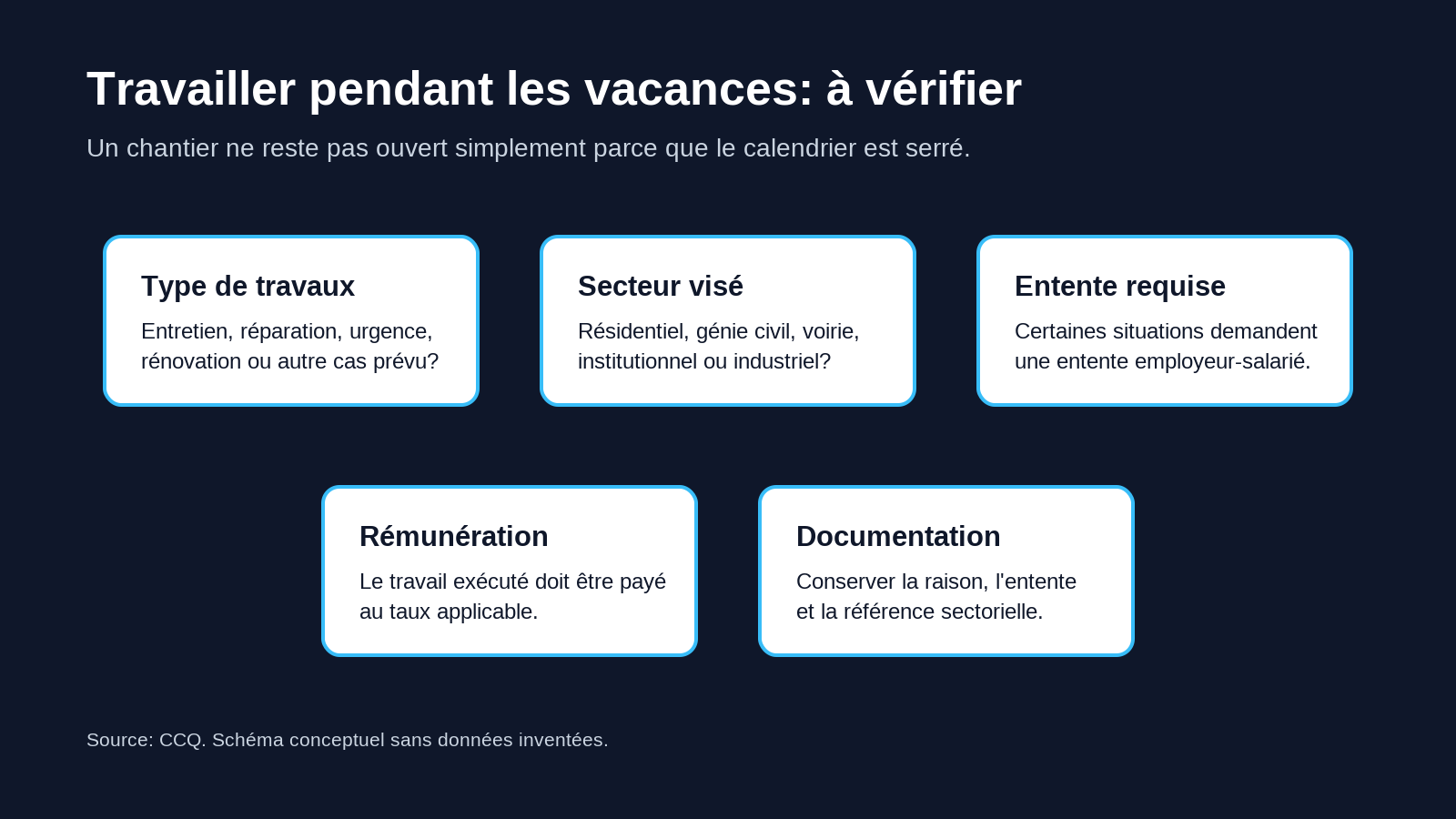
The CCQ indicates that any work performed during this period must be compensated at the applicable wage rate, according to the provisions of the sectoral collective agreements. This is a point not to be taken lightly.
For an employer, this means validating the applicable rate before promising a schedule or accepting a client request. For a worker, this means that working during a planned closure period must be framed, declared, and compensated correctly.
Rules may vary depending on the sector and type of work. Employers should therefore avoid vague verbal arrangements. A clear agreement and verification with the employer association, union, or CCQ can prevent claims afterward.
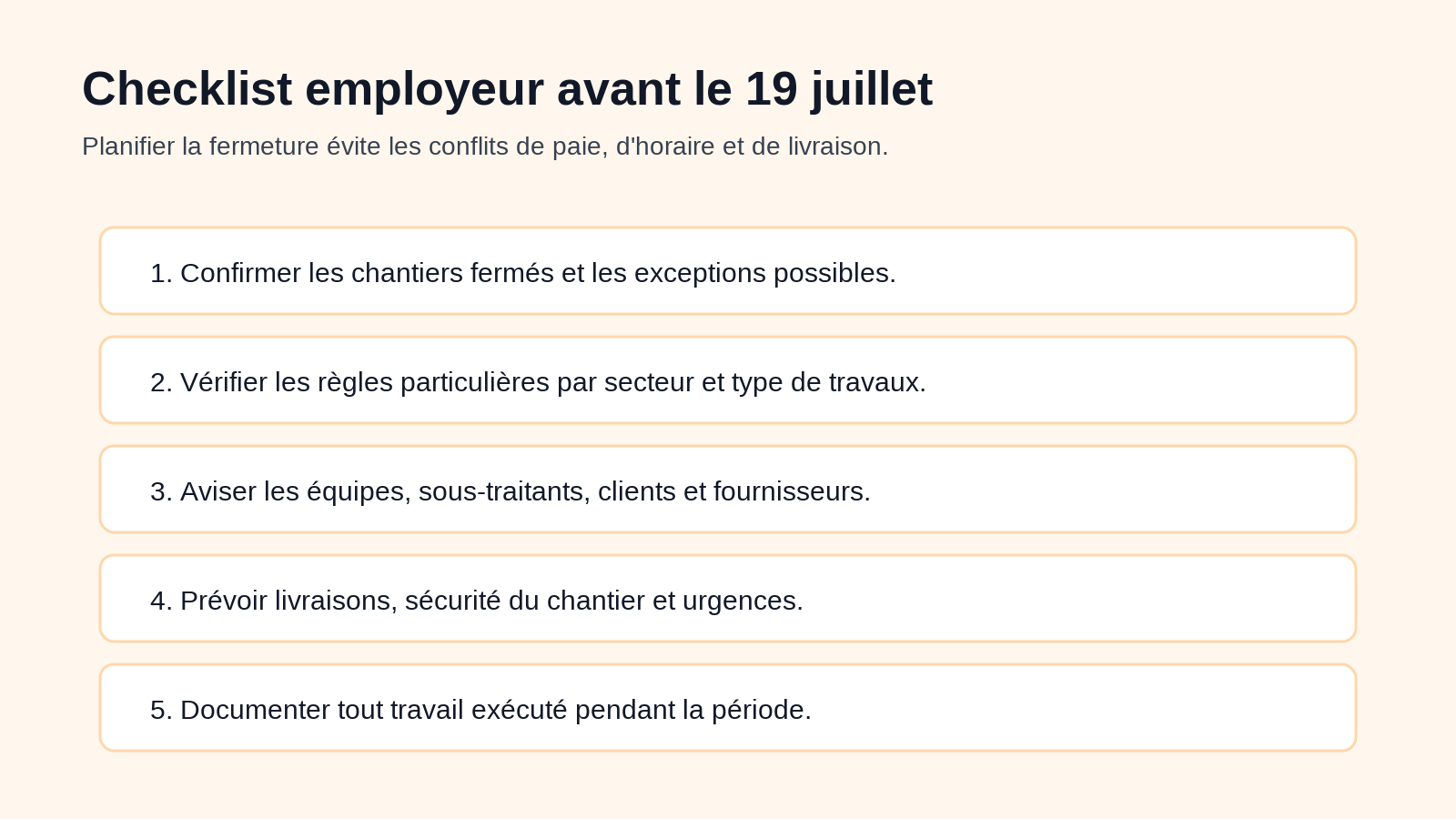
The first step is to identify the sites that will be closed, those that might require minimal presence, and those that might fall under a specific rule. Then, early communication with workers, subcontractors, suppliers, and clients is necessary.
Material orders must also be aligned with the closure. A closed site is not helpful if materials arrive during the absence of teams, if rented equipment remains unused, or if a critical delivery blocks access.
The ConstruMD page on available CCQ workforce can be useful for visualizing certain pools of workers when employers need to plan the post-holiday resumption or fill a temporary need. In the same spirit, workers who want to compare available opportunities after the period can check construction jobs in Quebec.
Workers should confirm their schedule, expected return, conditions if an employer requests presence during the holidays, and how hours will be reported. It's also important to distinguish between construction holidays, statutory holidays, vacation pay, and other situations like layoffs or lack of work.
Questions about employment insurance, sector-specific exceptions, or specific rights should be validated with the appropriate sources. Individual situations may vary depending on the worker's record, employer, sector, and applicable agreement.
For workers taking this time to review their career path, the ConstruMD article on CCQ perspectives 2026-2030 also provides context on upcoming labour needs in the industry.
Construction holidays occur on a fixed date, but the same grey areas often reappear: an urgent project, a client wanting to move forward, a poorly timed delivery, an employer believing they can continue, or a worker unsure if their presence is mandatory.
The best way to avoid problems is to treat the period as a management constraint from the project's planning stage. This involves scheduling timelines, notifying parties, documenting exceptions, and clarifying pay before the project is under pressure.
In 2026, construction holidays will take place from July 19 at 12:01 AM to August 1 at 12:00 AM. The general rule is the mandatory closure of sites. Certain specific situations may allow work, but they must be verified, regulated, and compensated according to applicable rules.
For employers, the topic is primarily a matter of planning and compliance. For workers, it's a matter of rights, schedule, and compensation. For clients and contractors, it's a period to integrate into timelines rather than discover at the last minute.
You might like
ConstruMD
Nov 5, 2026
ConstruMD
Nov 5, 2026
ConstruMD
Nov 5, 2026