
Harness and Aerial Platform: The Rule in Quebec
ConstruMD
Nov 5, 2026
All Posts
SHARE THIS POST
Published : November 5, 2026
Every summer, the construction holidays bring up the same question in many companies: is it necessary to issue a Record of Employment (ROE) for workers during the site closures?
The short answer is: not automatically. A Record of Employment is primarily used to document a situation where an employee in insurable employment stops working and experiences an interruption of earnings, or when requested by Service Canada. Construction holidays may raise questions, but they should not be treated as a standard layoff in all cases.
For 2026, the summer construction holidays are scheduled from July 19 at 12:01 AM to August 1 at 12:00 AM, according to the official construction holidays and vacations page. The challenge for the employer is to distinguish a planned closure as part of mandatory annual leave from a real job interruption or a specific situation that requires an ROE.
For the operational context of construction sites, the ConstruMD article on construction holidays 2026 already explains the dates, site closures, and possible exceptions. Here, we focus on payroll, employment insurance, and the Record of Employment.
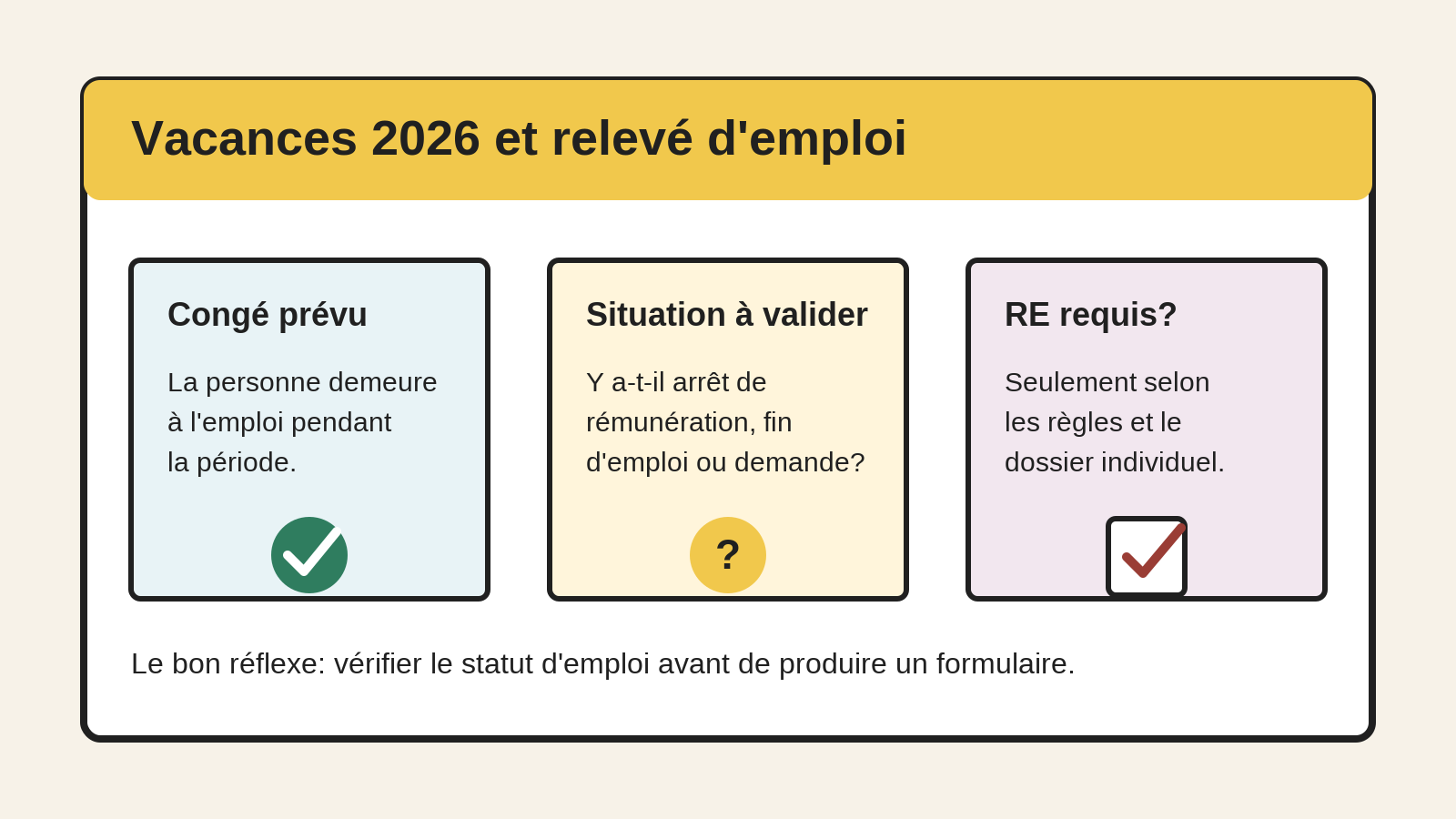
Service Canada presents the Record of Employment as the document used to determine a person's eligibility for employment insurance benefits, as well as the possible amount and duration of benefits. The employer must therefore complete it accurately when a situation outlined by Service Canada's rules arises.
The official Service Canada guide on the Record of Employment indicates that an ROE is issued when an employee in insurable employment experiences an interruption of earnings, or when Service Canada requests it. This point is important: the ROE is not a form to be issued reflexively every time a site slows down or a holiday period appears on the calendar.
In simple terms, the employer should first ask what is really happening to the employment relationship. Is the worker still employed? Is the holiday period planned? Is there an end of employment, a layoff, a change of status, or an official request from Service Canada?
The Service Canada guide explains that there is generally an interruption of earnings when an employee has been or is expected to be without work and without insurable earnings from their employer for seven consecutive calendar days. This rule is often the first reference used by employers.
But it must be applied with caution. The same guide also provides for exceptions and specific situations, particularly for certain schedules or holiday periods where the person is still considered employed. That's why a planned holiday period should not be too quickly confused with a cessation of employment.
In construction, the summer closure is a period known in advance, governed by collective agreements, and published in the industry calendar. If the worker remains employed and the situation corresponds to mandatory annual leave rather than a layoff, the conclusion may differ from a work stoppage caused by a lack of work.
The useful question is not just: is the employee working during the two weeks? The question is rather: why is the employee not working, and what is their status during this period?
If the person is taking planned leave, remains employed, and receives or has received accumulated vacation pay for this period according to applicable rules, the employer should avoid automatically treating the situation as an end of employment. Conversely, if the employment relationship ends, if a real layoff occurs, if the person is no longer on the active list, or if Service Canada requests an ROE, the analysis changes.
This nuance also protects workers. An ROE issued at the wrong time can create confusion in an employment insurance file. Conversely, an ROE not issued when required can delay a legitimate claim.
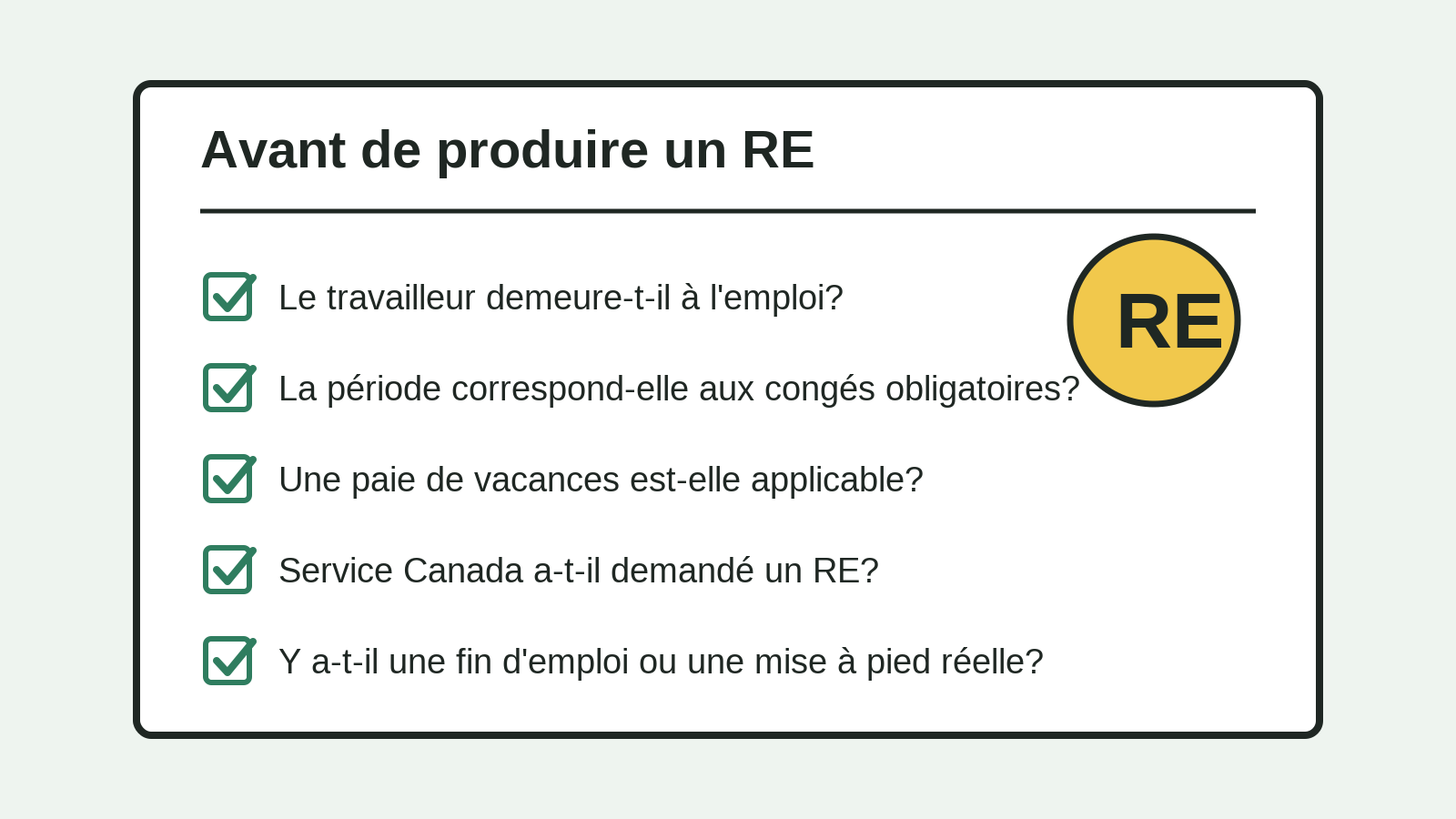
Before issuing a Record of Employment for the holiday period, the employer should check if the worker remains employed, if the closure corresponds to mandatory annual leave, if vacation pay is applicable, if a return date is planned, and if there is a formal request from Service Canada.
It is also necessary to distinguish cases where a team continues certain permitted work during the holiday period. The official holidays and vacations page indicates that specific rules may apply to certain maintenance, repair, modification, renovation, or emergency work, as well as situations specific to residential or civil engineering and roadwork.
In these cases, the issue is not just the ROE. It is also necessary to look at applicable remuneration, the consent or agreement required according to the sector, the declaration of hours, work limits, and the payroll record. An active site during the holidays does not necessarily mean an ROE must be issued; it mainly means the employer must properly document what is being done.
On the workers' side, it's important to avoid two opposite reflexes: thinking that vacations automatically entitle you to employment insurance, or thinking that no action is ever possible during an actual interruption.
The right approach is to clarify the situation with the employer: am I still employed? What is my expected return date? Have I received my vacation pay? Is this a normal site closure or a layoff? Has Service Canada requested an ROE?
If the personal situation goes beyond the simple mandatory annual leave, such as an end of employment, a prolonged absence, illness, layoff, or a case with multiple employers, it is necessary to validate directly with Service Canada or with the applicable official sources. Two workers on the same site may have different answers if their status or case is not the same.
The first mistake is to issue an ROE for everyone because the site is closing. This approach seems simple, but it can create unnecessary cases or contradictory signals if people remain employed during a planned leave period.
The second mistake is to never issue an ROE during vacations, even when a real layoff, end of employment, or a request from Service Canada occurs. The industry's calendar does not replace the analysis of the individual case.
The third mistake is to confuse vacation pay, regular salary, insurable hours, and eligibility for employment insurance. The ROE is used to transmit information; it does not guarantee by itself that a person will receive benefits.
For employers, the best protection remains a documented decision. The file should show why an ROE was issued or not: worker's status, period concerned, vacation pay, return date, Service Canada request, planned closure, or particular situation.
This documentation is useful for payroll, for workers' questions, and for quickly correcting the course if a situation changes. It also helps avoid improvised responses at the end of July when offices, sites, and teams are less available.
Employers who are already preparing for the resumption can also keep an eye on construction jobs in Quebec and workforce needs after the holidays, especially if some sites restart with a tight schedule.
The 2026 construction holidays do not automatically trigger the issuance of a record of employment. The right starting point is to check if there is actually a stoppage of remuneration according to Service Canada rules, if the worker remains employed, if the period corresponds to a mandatory annual leave, and if a particular situation requires an ROE.
For the employer, the goal is not to produce fewer documents at all costs. The goal is to produce the right document at the right time. For the worker, the goal is to understand their real status during the holidays before drawing conclusions about employment insurance.
In case of doubt, official sources should prevail: the Service Canada guide for the record of employment, the dates and rules published for the construction holidays, and the collective agreements applicable to the sector.
You might like
ConstruMD
Nov 5, 2026
ConstruMD
Nov 5, 2026

ConstruMD
Nov 5, 2026