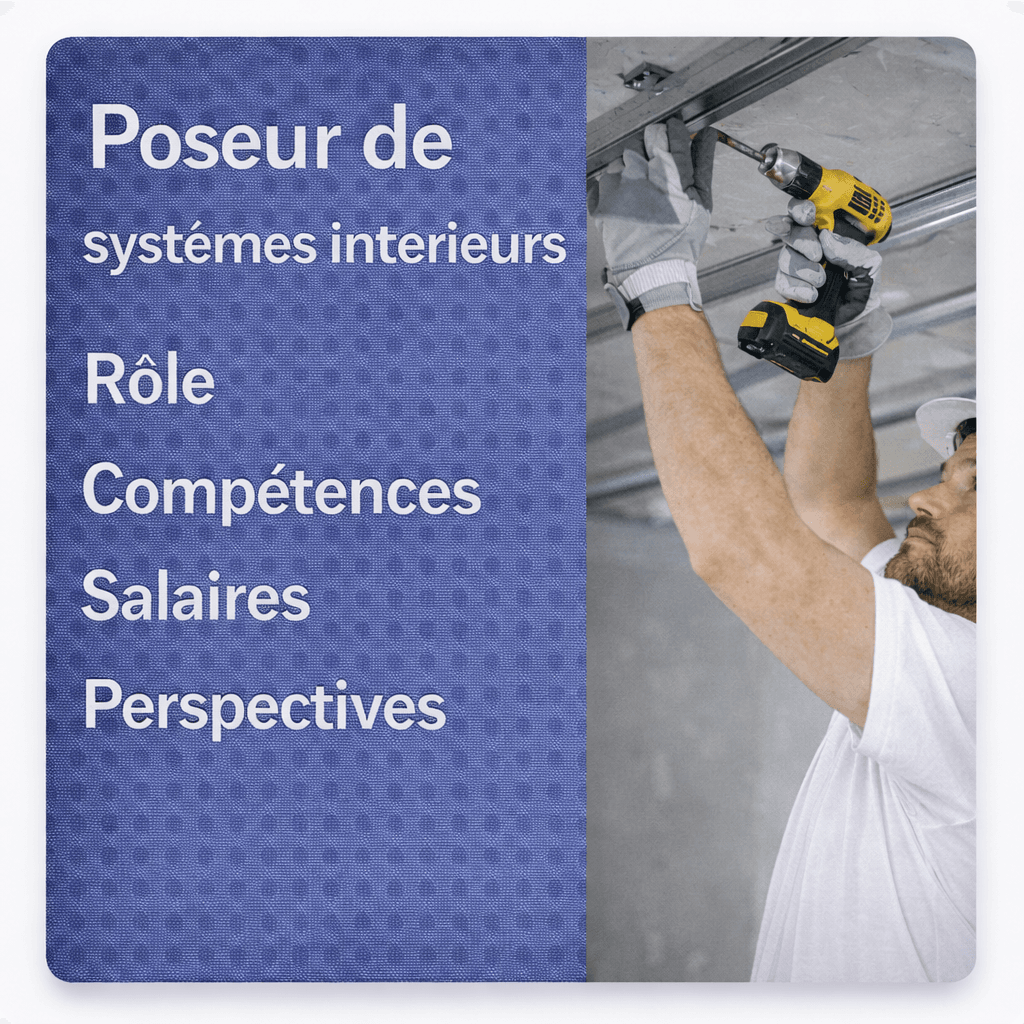
Interior Systems Installer: Training, Salary, Tasks
ConstruMD
Nov 5, 2026
All Posts
SHARE THIS POST
Published : November 5, 2026
The building painter is the one who arrives when things need to be straight, clean, and finished. On a construction site, your job isn't just "putting on paint": you prepare surfaces, manage products, and deliver a durable finish that will last over time.
It's also a profession where reputation is quickly established: an efficient, meticulous, and safe painter can easily find work, especially when they can keep up with other trades and respect work sequences.
If you're looking for contracts or a position, you can directly check the painter job offers on ConstruMD.

The painter works in residential, renovation, institutional, commercial, and industrial projects. They work with rollers and brushes as well as spray guns (depending on the assignments), and must master preparation: that's where the job is won.
On a daily basis, you will often:
prepare rooms (protect, mask, ventilate, organize materials);
repair and even out surfaces (patch, sanding, caulking, primers);
apply coats according to the planned system (primer, first coat, finish);
manage quality: touch-ups, retouches, lighting, final inspection;
work in a team with plasterers, carpenters, flooring installers, etc.
The pace varies depending on the type of site: in housing, it moves quickly; in ICI, the finishing, compliance, and coordination requirements are often tighter.
Read plans and understand the requested finishes (gloss level, colour, protection, areas).
Prepare surfaces: cleaning, scraping, stripping if necessary, sanding, repair.
Apply primers and paint coats (interior/exterior) according to the method.
Use the right tools: rollers, brushes, poles, spray guns, trays, abrasives, knives, etc.
Control dust and protect adjacent surfaces (doors, floors, furniture, glazing).
Follow OHS instructions (ventilation, products, PPE, working at heights).
Maintain a clean site: waste, rags, containers, product management.
| Aspect | Concrete Examples |
|---|---|
| Safety | PPE (respiratory/eyes/hands), ventilation, solvent handling, fall prevention, contaminated waste management |
| Operations | Surface preparation, application (roller/brush/spray gun), quality control, touch-ups, drying and sequences |
| Administration | Reading specifications, tracking quantities, product labelling, simple reports (if required) |
The most common path involves recognized training (building painting), followed by on-site progression with supervised learning up to the journeyman level.

To quickly guide you on possible paths, the article essential training to start in construction in Quebec helps to understand the typical routes according to trades.
Depending on your profile, you often see:
training in building painting (preparation, application, safety, products);
useful complementary training (e.g., lifts/platforms, WHMIS, working at heights), depending on site requirements.
| Stage | What to Expect |
|---|---|
| Training | Acquisition of basics: preparation, application methods, painting systems, safety |
| On-site Learning | Development of speed, quality, site reflexes, and progression to more complex tasks |
| Advanced Training | Possible specializations: drywall and touch-ups, high-end finishing, industrial, spraying, epoxy and specialized systems |
To explore programs and training options: Inforoute FPT
To understand card rules and career paths in the industry: Commission de la construction du Québec (CCQ)
For OHS requirements and best practices on site: CNESST
For prevention and OHS training specific to construction sites: ASP Construction
If your goal is to quickly enter the industry, the guide how to obtain a CCQ competency card provides a clear view of the steps and expectations.
Compensation varies depending on the sector (e.g., ICI, residential), level (apprentice/journeyman), and type of work (heavy preparation, spraying, specialized systems, etc.). Here are some hourly rates (ICI sector) for the painter profession:
| Level | Hourly Rate |
|---|---|
| Journeyman | $45.13/h |
| Apprentice – Period 1 | $28.66/h |
| Apprentice – Period 2 | $33.44/h |
| Apprentice – Period 3 | $40.60/h |
Want to see all the CCQ rates from the 2025–2028 agreement (official dates + amounts) for this profession?
Check our complete reference: CCQ Rate Chart 2025–2026
The painter profession shows Excellent prospects for 2025–2029. There are 6,957 active employees (2024) and an average annual need of 659 over the 2025–2029 period.

In practice, those who find work most easily are often:
painters consistent in quality (clean preparation, sharp cut, uniform finish);
those who respect sequences (drying, returns, coordination with other trades);
Reliable guys/girls on safety and organization (less time wasted, fewer re-dos).
Attention to detail (a flaw is immediately noticeable).
Discipline and consistency (same finish, same standard, all day long).
Autonomy (prepare, protect, apply, clean).
Good time management (drying, re-dos, planning).
Simple and effective communication with the foreman and other teams.
Surface preparation: filling, sanding, primers, caulking.
Application: roller, brush, cutting, methods to avoid drips and marks.
Reading specifications: systems, number of coats, compatibilities.
Product knowledge: latex, alkyds, primers, sealants, specialized coatings (depending on sites).
Working at heights and site protection (masking, tarps, dust management).
Advantages:
Concrete trade: you see the result immediately.
Opportunity to specialize (high-end finishing, industrial, spraying, systems).
Strong demand when you are good at preparation and finishing.
Disadvantages:
Exposure to dust/products: safety and ventilation are not optional.
Repetitive postures (arms in the air, pole, stairs, scaffolding).
Quality heavily depends on preparation: if you "skipped" that, you'll pay in re-dos.
Your job is won in the preparation: before painting, make sure everything is ready.
Protect the site as if it were your own: it avoids conflicts and callbacks.
Work with the light: a perfect finish in the shade can be "dirty" under a spotlight.
Standardize your tools: same roller, same method, same result.
Maintain a routine for cleaning equipment: it's time saved, not time wasted.

On industry-targeted sites, the card and pathway are often required depending on your status. The simplest way is to follow a recognized path and proceed correctly.
In residential, the pace is often faster and production-focused. In ICI, there are frequently more requirements: coordination, compliance, zones, quality controls, and sometimes more specific systems.
No, but it's a big plus. Many jobs are done with roller/brush, but spraying is often used depending on surfaces, ceilings, or certain finishes.
Falls (ladders, scaffolding), exposure to dust and products, and overuse injuries (shoulders/wrists). Good OHS practices make a real difference.
You are not necessarily a joint finisher, but knowing how to patch, sand, and correct defects is essential. A painter who delivers a "ready finish" surface stands out.
Be reliable, clean, and consistent. Arrive prepared, protect well, ask questions at the right time, and do your touch-ups without being chased.
It depends on the type of sites. Interior work runs year-round; exterior work is more weather-dependent.
Yes. Painters who manage sequences, quality, and coordination well can advance to supervisory roles, especially in ICI.
You might like
ConstruMD
Nov 5, 2026
ConstruMD
Nov 5, 2026

ConstruMD
Nov 5, 2026