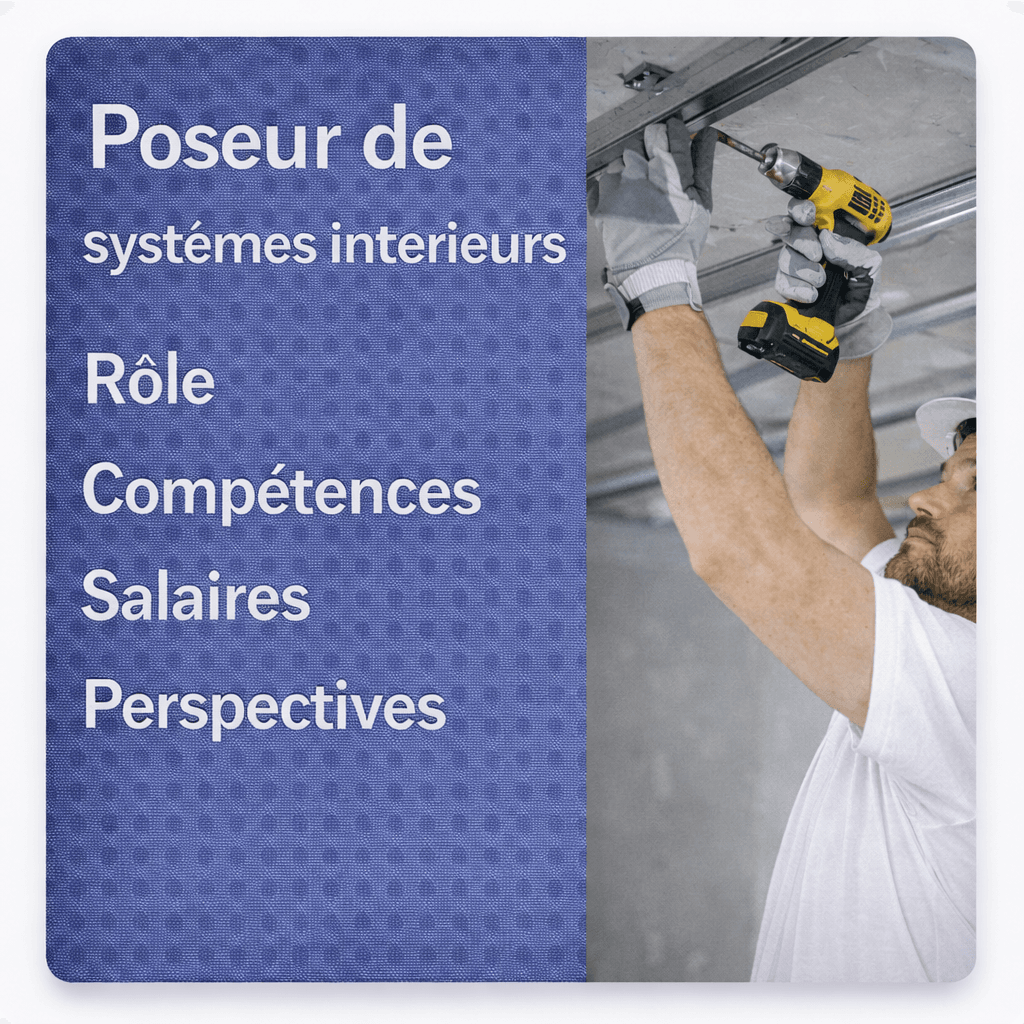
Interior Systems Installer: Training, Salary, Tasks
ConstruMD
Nov 5, 2026
All Posts
SHARE THIS POST
Published : November 5, 2026
The job of a resilient flooring installer involves installing carpet, vinyl, linoleum, and other flexible surfaces throughout Quebec. We work in residential, commercial, and institutional settings, both in new constructions and renovations.
In this guide, you will find the main tasks of the job (see the official profile on quebec.ca), the training path, salaries (CCQ), and key skills. If you are looking for a job, also check the Resilient Flooring Installer job offers on ConstruMD.

The resilient flooring installer prepares and installs flexible floors in residential, commercial, or institutional buildings. The most common materials include carpet, vinyl (sheet or tile), linoleum, as well as some sports flooring.
On a daily basis, you prepare surfaces, install flooring, and then perform clean and durable finishes. The work is often done in coordination with other trades (carpenters, painters, project managers, etc.). The job sites frequently change: schools, hospitals, businesses, housing.
A typical day often looks like this:
Assess the condition of the floor (wood, concrete, plywood)
Clean, level, and repair surfaces
Install a membrane or underlay if required
Measure and cut materials precisely
Apply the adhesive suitable for the product and substrate
Install without bubbles, creases, or waves
Install baseboards, thresholds, mouldings, transitions, and other finishes
You read plans, specifications, and technical sheets. You inspect surfaces and, if necessary, remove the old flooring. Depending on the context (e.g., institutional environment), some installations require more technical finishes, such as welded seams.
| Material | Format | Method |
|---|---|---|
| Vinyl and linoleum | Rolls | Adhesive bonding |
| Carpet | Rolls or tiles | Adhesive or fastening depending on the system |
| Flexible tiles and slabs | Individual tiles | Adhesive and joints/finishing |
| Linoleum | Rolls or tiles | Specialized bonding |
| Synthetic turf | Rolls | Fastening and joining |
| Sports flooring | Rolls or tiles | Specialized installation |
You use specific tools (notched trowel, knife, pressure roller, cutting and finishing tools) and must apply safe working methods at all times.
The most direct path is vocational training in resilient flooring installation (often offered as a DEP). You learn surface preparation, plan reading, cutting, installation, bonding methods, and finishing.
To know the job requirements and recognized tasks, the simplest reference remains the official page on quebec.ca.
Vocational training generally lasts about 9 months full-time (the number of hours may vary depending on the centre). To access job sites, the General Health and Safety on Construction Sites training (ASP Construction) is required.
To work on sites governed by the CCQ, you must hold a competency certificate (apprentice, then journeyman). The path depends on your background (recognized training or experience). To understand the access steps and workforce pool rules, the article CCQ Workforce Pool: How to Access a Trade can help you.

Examples of institutions and useful portals:
AdmissionFP (find a centre near you)
Construction salaries vary by sector. Here are the hourly rates (CCQ) for the resilient flooring installer trade, according to the current scales.
| CCQ Sector | Apprentice 1 | Apprentice 2 | Apprentice 3 | Journeyman |
|---|---|---|---|---|
| Industrial, Commercial, and Institutional (ICI) | $28.04/h | $32.71/h | $39.72/h | $46.73/h |
| Light Residential | $23.72/h | $27.68/h | $33.61/h | $39.54/h |
| Heavy Residential | $25.28/h | $29.50/h | $35.82/h | $42.14/h |
Want to see all the CCQ rates from the 2025–2028 agreement (official dates + amounts) for this trade?
Check our complete reference: CCQ Rate Chart 2025–2026
For an overview (explanations and benchmarks by trade), you can consult our guide on construction salaries in Quebec.
Outside CCQ, salaries can vary depending on the region, type of contract, and employer. A useful reference for market data is the Job Bank report: salaries in Quebec for the trade.
The job is physical: working on your knees, handling rolls and boxes, frequent travel from one site to another. Hours are often during the day, but some projects (occupied environments, tight deadlines) may require evening or night work.

Attention to detail and precision (alignment, joints, finishes)
Clear communication with the team and the client
Autonomy and discipline on site
Time management (deadlines and coordination)
Surface preparation (repair, leveling, defect control)
Accurate measurements and cuts (angles, stairs, obstacles)
Selection and application of adhesives according to the covering and substrate
Compliance with technical data sheets and manufacturer instructions
What attracts many people:
Varied projects (residential, commercial, institutional)
Concrete and quickly visible results
Technical trade where quality is immediately apparent
Challenges to consider:
Prolonged work on knees or crouched
Handling sometimes heavy materials
Requirement for constant precision (costly errors to correct)

If you want to progress quickly, focus on two points: surface preparation and precision in cuts. This is what distinguishes a "decent" job from a truly clean installation. Invest early in good knee pads and reliable cutting tools, and develop your versatility (sheet vinyl, tiles, carpet, linoleum, technical joints).
In Quebec, "linoleum" often refers to rolled vinyl. Vinyl also comes in tiles or planks. Installation methods, adhesives, and finishes may vary depending on the format.
If you wish to bid and carry out work as a contractor, an RBQ license may be required depending on the nature of the work and your business model. To start a career on a CCQ site, the essential thing is to have the corresponding competency certificate (apprentice/journeyman).
Manufacturers require specific conditions (humidity, temperature, preparation). On a site, the best practice is to rely on the specifications and manufacturer requirements before installation.
Yes. Some niches require more specialized skills (institutional environments, technical joints, sports flooring, special surfaces). Specializing often increases your value in the market.
If you are looking for a good installer for your floors:
Check their certifications and experience with the chosen material
Ask for photos of recent projects
Compare several bids
Confirm liability insurance and execution timelines
To discover other related trades and better compare specialties, visit the construction trades and occupations in Quebec page.
You might like
ConstruMD
Nov 5, 2026

ConstruMD
Nov 5, 2026

ConstruMD
Nov 5, 2026