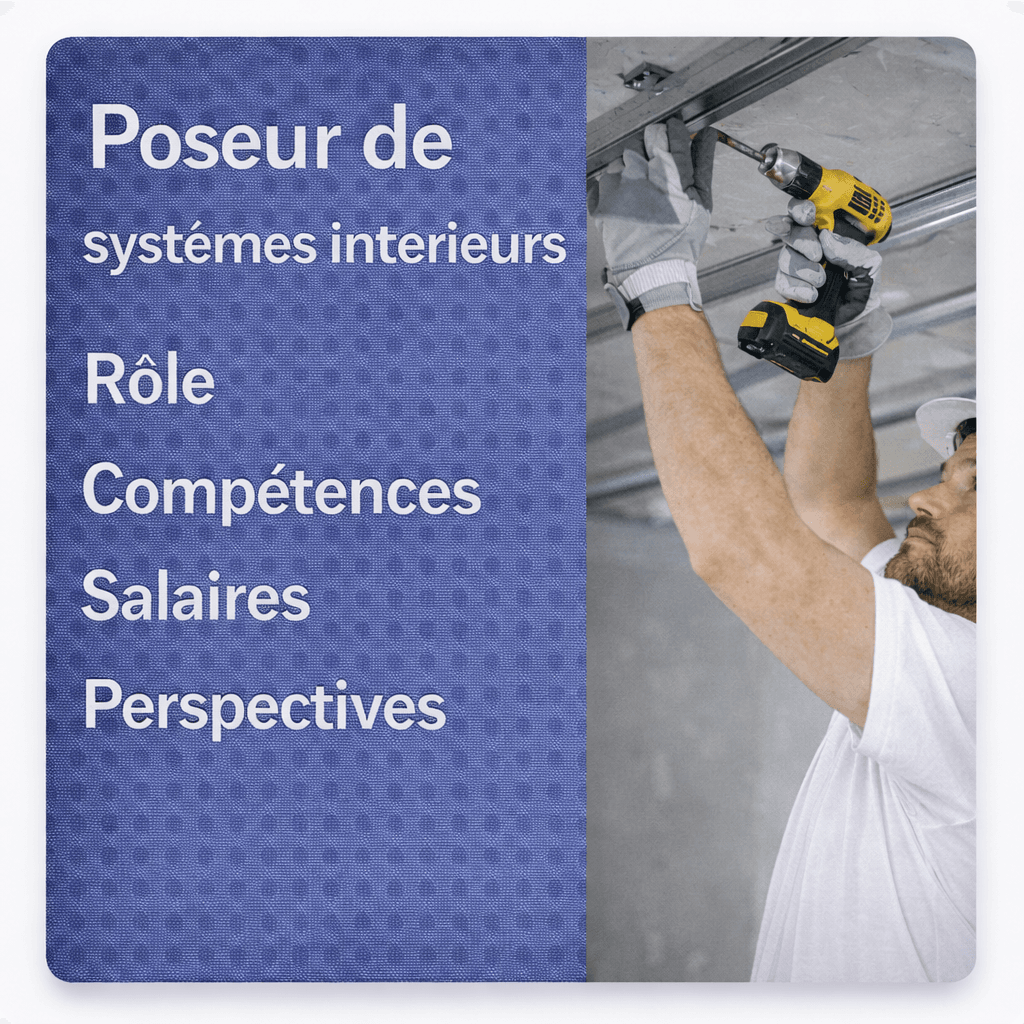
Interior Systems Installer: Training, Salary, Tasks
ConstruMD
Nov 5, 2026
All Posts
SHARE THIS POST
Published : November 5, 2026
The profession of a glazier (glazier installer-mechanic) in curtain wall installation and commercial fenestration involves installing glass facades on commercial and institutional buildings in Quebec. These professionals construct the exterior envelope of office towers, shopping centres, and public buildings.

This manual work is done in teams, often on large construction sites. It requires handling large sections of glass and aluminum with precision to ensure perfect alignment and sealing.
Want to see the open positions now? Check out the glazier installer-mechanic jobs in Quebec.
The day often starts with a safety meeting, followed by reviewing plans and shop drawings to validate the installation sequence. Materials (frames, mullions, insulating glass, hardware) arrive on site, and coordination with other trades (carpenters, sheet metal workers, crane operators, etc.) is necessary.
Curtain wall systems are installed using two main approaches:
Unitized systems: pre-assembled panels delivered by the manufacturer.
Stick-built systems: fully assembled on site.
Working at heights is common (scaffolding, aerial lifts). Risk management is constant: harnesses, lifelines, lifting procedures, secured work areas.

Read architectural plans and shop drawings
Understand technical sheets of curtain wall systems
Verify commercial fenestration specifications
Prepare frames and mullions according to tolerances
Assemble anchoring systems
Position elements with precision
Install commercial/institutional windows and doors
Install insulating, tempered, or laminated glass
Set up skylights and canopies
Mount transoms and spandrels
Apply caulking (often silicone)
Install air and vapour barrier membranes
Place glazing shims and compression seals
Verify air and water tightness
Handle suction cups and vacuum lifters
Use aerial lifts and telescopic handlers
Employ alignment lasers (level, plumb, square)
Use drills, riveters, and glass cutters
Check plumb, levels, and alignments
Correct discrepancies before closing areas
Perform required validations (e.g., water tests)
To enter the profession, one typically goes through training in glass product installation and fabrication, offered notably here: CFP Samuel-De Champlain – Glass Product Installation and Fabrication.
Once training is completed, you can proceed to obtain your competency certificate (apprentice) by following the steps explained here: how to obtain your CCQ competency card.
The ASP Construction training is also required to work on construction sites. Several useful details are summarized in: essential training to start in construction.
Vocational training generally takes 12 to 18 months depending on the centre and schedule.
Then, you must complete approximately 6,000 hours of apprenticeship on site to become a journeyman (according to applicable rules), maintain an apprenticeship logbook, and pass the required evaluations.
To understand access rules and the functioning of the labour pool: CCQ labour pool and trade access.

In commercial glazing, rates vary by sector. Here are the hourly rates (wage rates) in ICI (institutional/commercial and industrial), applicable from April 27, 2025:
Journeyman: $47.29/h
Apprentice – Period 1: $28.37/h
Apprentice – Period 2: $33.10/h
Apprentice – Period 3: $40.20/h
Want to see all the CCQ rates from the 2025–2028 agreement (official dates + amounts) for this trade?
Check out our complete reference: CCQ Rate Chart 2025–2026.
Precision (measurements, tolerances, finishing, sealing)
Communication and coordination with the team and other trades
Organization (deliveries, sequences, preparation)
Rigour in health and safety (working at heights, glass handling)
Reading plans and shop drawings
Laser alignment, level, plumb, square
System assembly (mullions, transoms, anchors)
Glass installation (tempered, laminated, insulating) with specialized tools
Sealing: membranes, tapes, joints, and sealants (according to the system)
A curtain wall is a lightweight aluminum and glass system attached to the building structure without bearing structural load. A commercial window is a unit installed in a designated opening. Curtain walls generally require more alignment, coordination, and sealing work.
In summary: recognized training, ASP Construction, then steps to obtain the competency certificate (apprentice) and accumulate apprenticeship hours. For a step-by-step detail: CCQ competency card.
Yes. Even if some facade work may slow down depending on conditions, there are also mandates for interior installation (glass partitions, commercial doors) and in service/maintenance.
You might like
ConstruMD
Nov 5, 2026

ConstruMD
Nov 5, 2026

ConstruMD
Nov 5, 2026