
Interior Systems Installer: Training, Salary, Tasks
ConstruMD
Nov 5, 2026
All Posts
SHARE THIS POST
Published : November 5, 2026
The job of a labourer is often the most direct entry point for working on construction sites in Quebec.
It is a concrete, physical, and essential role: without labourers, production slows down, logistics become disorganized, and safety takes a hit.
Whether you're the "hands-on" type, enjoy moving around, working in a team, and learning quickly, the labourer is involved in several operations: preparation, handling, cleaning, support to trade teams, and sometimes more specialized tasks depending on the site.
To see what's currently available, check out the labourer job offers on ConstruMD while you read.

The construction labourer works everywhere: residential, ICI (institutional, commercial, industrial), civil, and sometimes more isolated sites. Depending on the team, they can be a general labourer (general tasks) or assigned to a more specific category (e.g., roofing, masonry, decontamination, pipeline).
For an official description (typical tasks, conditions, etc.), the Government of Quebec's page on construction helpers and labourers provides a good overview.
A typical day often looks like this:
Arrive early, conduct a safety tour, prepare the work area.
Move materials (tools, pallets, panels, bags, pipes, etc.).
Install protections (tarps, barriers, signage) and keep access areas clean.
Help trade teams stay productive: "have the stock ready," "keep the place clean," "keep up the pace."
The job requires keeping up with the tempo, anticipating, and staying alert: traffic, carts, cranes, saws, dust, products, weather... it's always moving.

Handling and supplying teams.
Preparing surfaces/areas (cleaning, clearing, protection).
Assisting in material installation (without performing trade-specific work).
Dismantling, sorting, waste management, site cleanliness.
Strict adherence to OHS instructions and wearing PPE.
Simple and effective communication with the foreman and workers.
| Safety | Operations | Administration |
|---|---|---|
| Wear required PPE and follow instructions | Supply the team, prepare materials | Report issues (breakages, stock shortages, risk areas) |
| Keep circulation areas safe | Clean and maintain a functional site | Follow the foreman's directives |
| React quickly to dangerous situations | Install protections, barriers, signage | Report incidents according to procedure |
Being a labourer doesn't always require extensive training, but it almost always requires being site-ready: safety, attitude, and the ability to follow a team without slowing down production.
Depending on your entry path, you will often go through:
The general training Health and Safety on Construction Sites (30 h) via ASP Construction.
On-the-job training: handling, procedures, site organization.
Specific training depending on the environment: height, confined spaces, signage, etc. (depends on the type of site and employer).
To understand the basic rules on sites and prevention mechanisms, the CNESST details specific measures for construction sites that are often part of daily life.
| Step | Objective | Duration |
|---|---|---|
| Health and safety training (site) | Site access and good OHS practices | 30 h |
| Company integration | Rhythm, procedures, work methods | Variable |
| Additional training | Depending on assignment (e.g., height) | Variable |
Registration and info on the 30 h course: ASP Construction
Certificate and industry access: CCQ – competency certificates and CCQ – occupation competency certificate
Site OHS measures: CNESST – construction site measures
On the ConstruMD side, if you're starting out, the article essential training to start in construction in Quebec helps organize the steps.
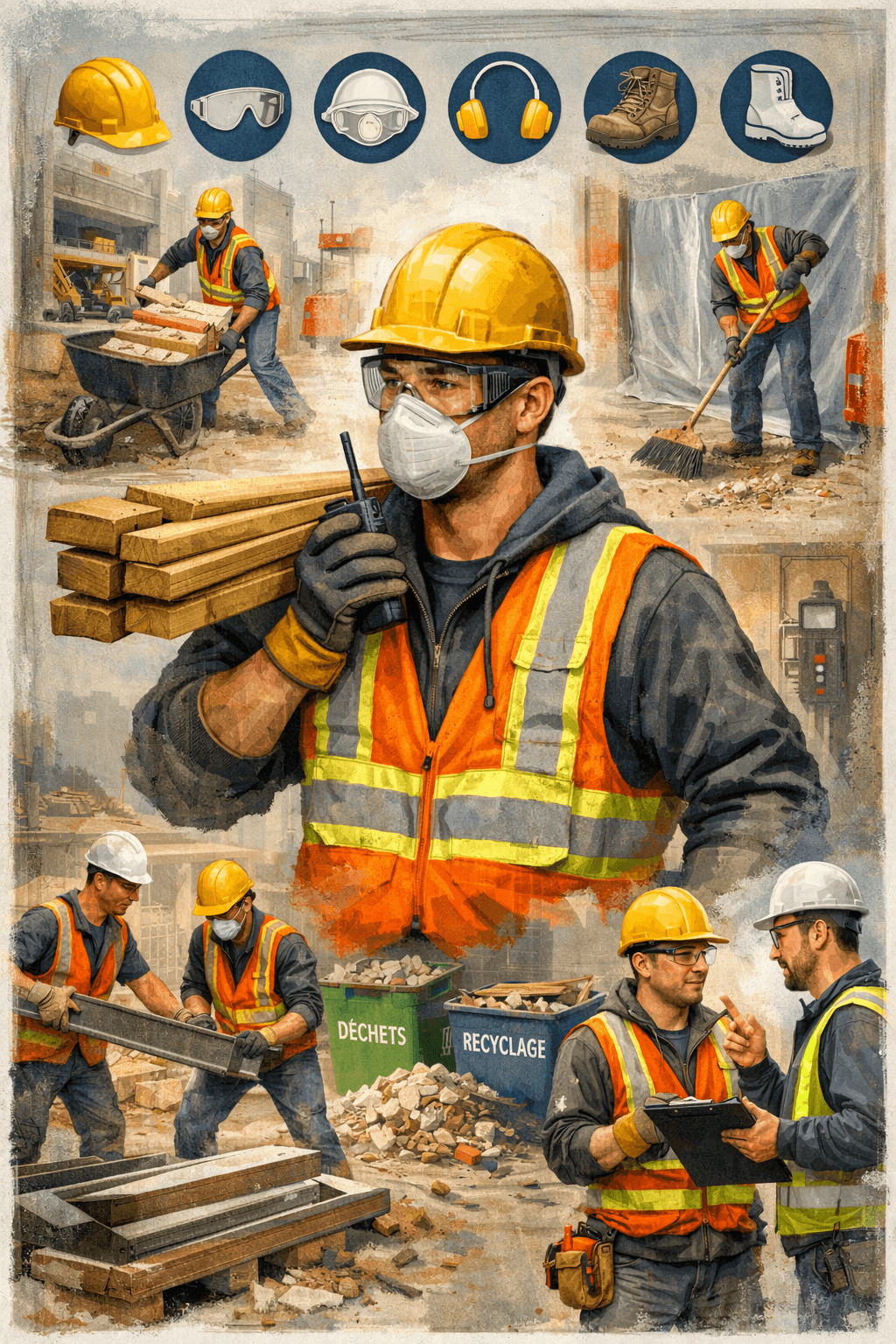
Compensation varies according to the sector and labourer category (general labourer vs specific assignments). Here are some hourly rates (ICI sector) for common categories:
| Category | Hourly Rate |
|---|---|
| Labourer (general) | $38.28/h |
| Labourer (roofing work) | $38.54/h |
| Labourer (pipeline) | $38.89/h |
| Labourer (masonry) | $39.91/h |
| Decontamination labourer | $43.07/h |
| Specialized labourer | $38.89/h |
Want to see all the CCQ rates from the 2025–2028 agreement (official dates + amounts) for this job?
Check out our complete reference: CCQ Rate Chart 2025–2026
The labourer job remains very present in the industry: there are 16,028 active employees (2024) and an average annual need of 2,162 for the period 2025–2029, with prospects rated as Good.
In practice, those who find jobs most easily are often:
reliable labourers (punctual, safe, efficient),
able to follow a team without constant supervision,
open to learning more specialized tasks.
To understand how entry (occupation, pool, procedures) works, the article CCQ workforce pool: how to access a construction trade can enlighten you.
Endurance and consistency.
Safety vigilance: attention to active zones, loads, tools.
Team spirit: help without hindering, anticipate needs.
Worksite attitude: listen, execute properly, ask the right questions.
Safe handling, securing, organizing materials.
Basic use of tools (depending on the team) and good PPE management.
Simple site reading: access, drop zones, circulation, cleanliness.
Basic notions according to specialty (e.g., masonry, roofing, decontamination) when required.
Advantages
Relatively quick entry into the market if you are worksite-ready.
Concrete job: you see progress every day.
Possibility to evolve towards more specialized tasks or a trade.
Disadvantages
Physically demanding and exposed to the weather.
Sometimes intense pace, tight deadlines.
Tasks can be repetitive if you remain strictly a labourer.
Arrive prepared: complete PPE, lunch, water, and a "solution" attitude.
The biggest "plus" of a good labourer: being useful without being told 15 times.
Clearly ask where to drop materials, how the team likes to organize, and follow the flow.
If you aim for better assignments, be willing to learn (masonry, roofing, logistics, etc.).
If mobility interests you, some remote assignments can open more opportunities: find a fly-in/fly-out construction job.
Yes. The most important thing is to be worksite-ready (safety, attitude, ability to follow a team) and to have the required training to access worksites.
On many sites, yes. The 30-hour course from ASP Construction is the most commonly required foundation for working on a site.
Often, it refers to the occupation competency certificate. The CCQ explains the conditions and process on its occupation competency certificate page.
The daily labourer mainly performs general tasks (logistics, cleaning, assistance). The specialized labourer is assigned to more technical contexts (e.g., masonry, decontamination, pipeline, roofing), with more precise methods and constraints.
Yes. Even within the same sector, rates vary according to the category (daily, masonry, decontamination, etc.).
Falls, crush injuries, machinery circulation, handling, dust/products (depending on the site). The rules and prevention mechanisms are summarized on the CNESST page of construction site measures.
Being punctual, listening, staying visible, keeping the area safe, asking where to drop stock, and keeping the team supplied without hindering. A strong first impression lasts a long time.
Yes, depending on the periods and projects. If you are mobile, it can broaden your options (different logistics, possible rotations depending on employer/project).
You might like
ConstruMD
Nov 5, 2026

ConstruMD
Nov 5, 2026

ConstruMD
Nov 5, 2026