
MÉDIC Construction 2027: changes in reimbursements
ConstruMD
Nov 18, 2026
All Posts
SHARE THIS POST
Published : November 5, 2026
In the construction industry in Quebec, the choice of a union association often comes up in job site discussions. The question seems simple: which union is most beneficial for a journeyman or an apprentice? The answer, however, requires more than just a name thrown out at random.
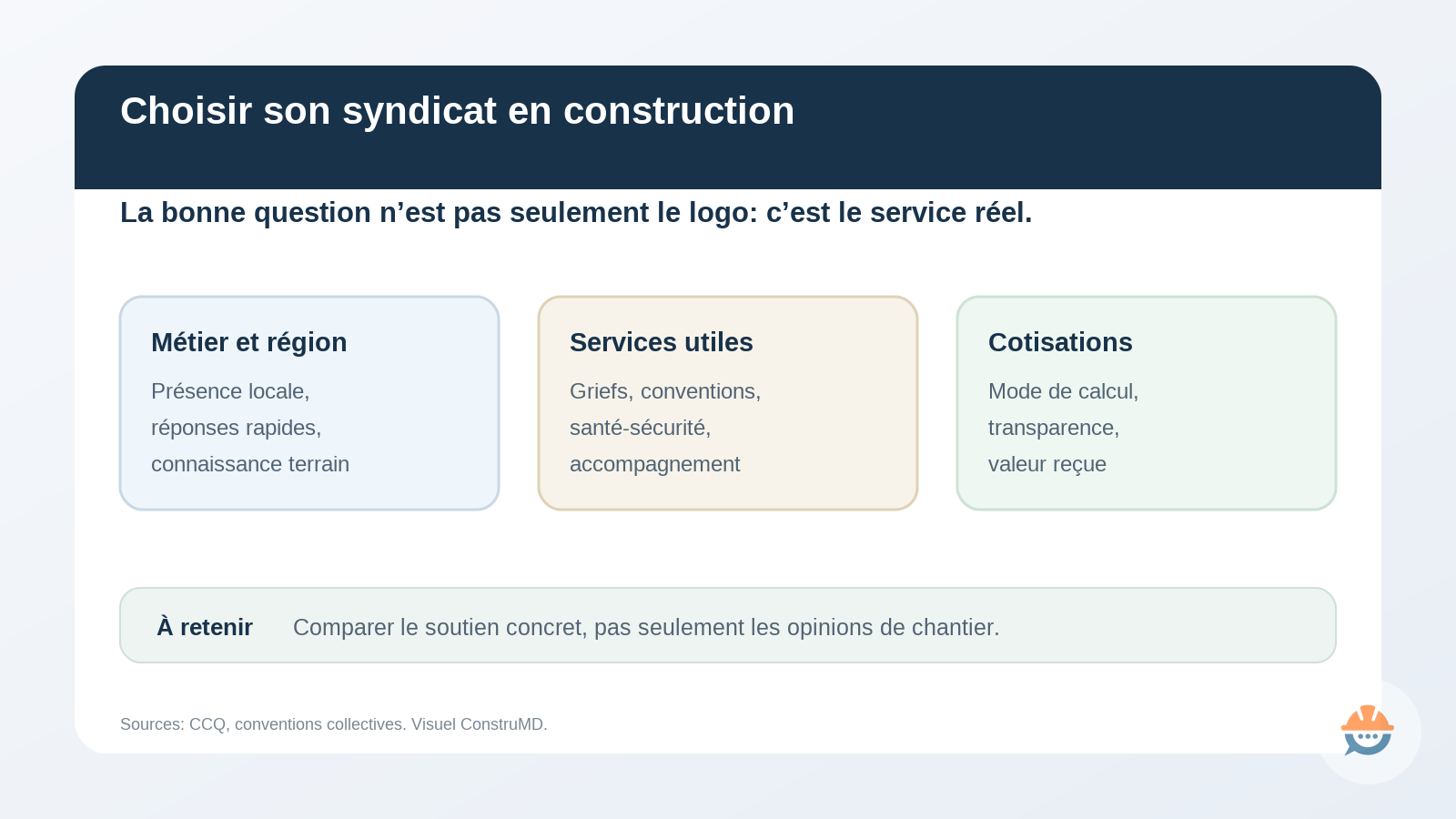
The Quebec construction system is unique. It is governed by Law R-20, operates with sectoral collective agreements, and recognizes five union associations. The best choice for a worker depends on their trade, region, the support received, dues, services offered, and how the association defends its members in everyday reality.
This article explains the basic functioning, what the union can actually do, what should not be confused, and the practical criteria to consider before choosing or wanting to change an association.
The CCQ explains that the labour relations system of the construction industry recognizes union pluralism. In simple terms, the system does not operate with a single union organization for everyone. Several associations are recognized, and each worker must choose the one they wish to join.
This choice is not merely administrative. The union association defends the economic, social, and educational interests of its members. It also plays a role in the application of collective agreements, in certain appeals, in representation, and in the union life of the industry.
Choosing a union does not change the trade listed on the competency card, does not replace CCQ rules, and does not automatically transform the conditions provided in the agreement. It rather influences representation, support, and the link between the worker and the organization that speaks on their behalf.
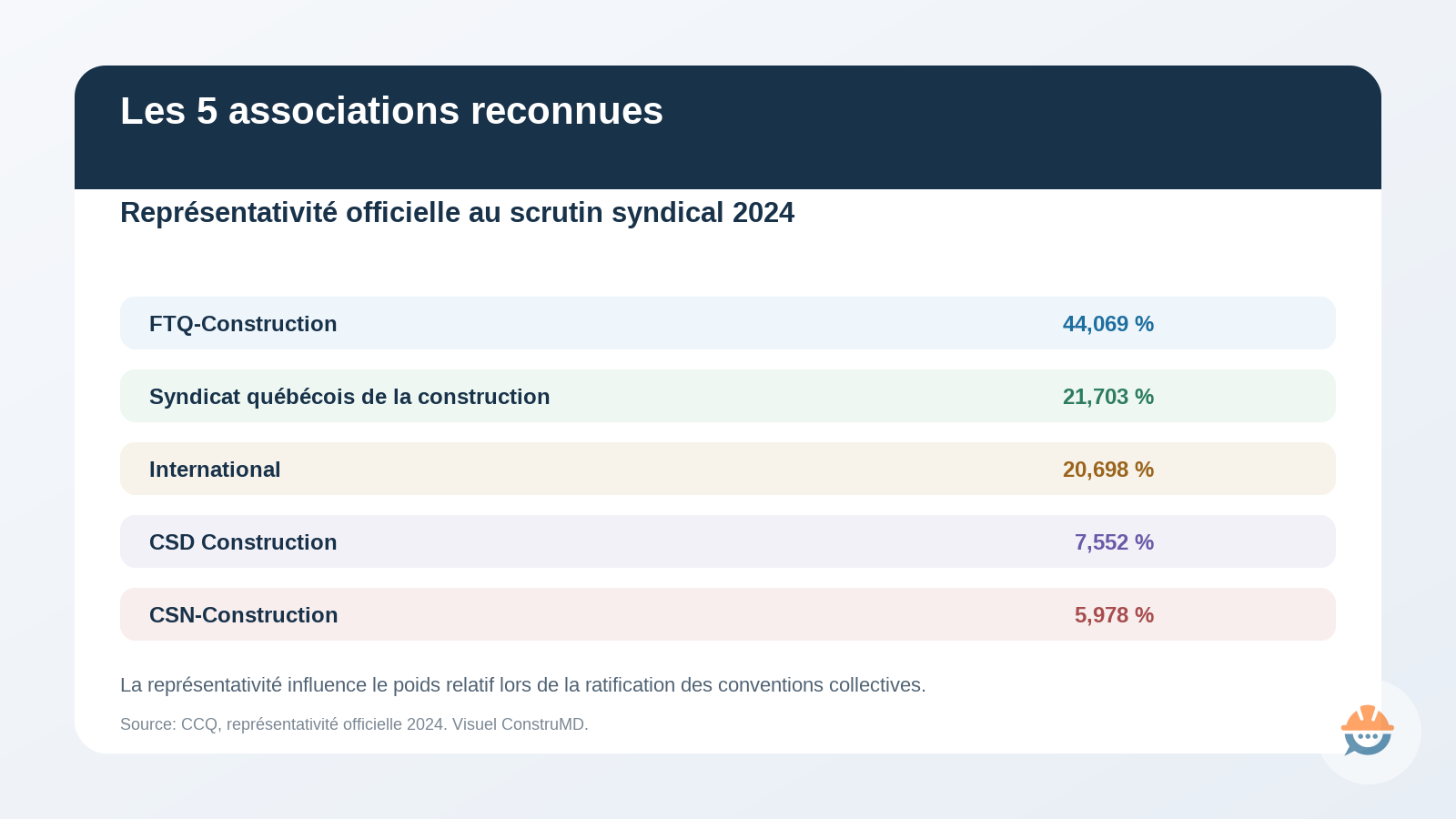
Law R-20 recognizes five representative associations in the construction industry in Quebec. According to the official representativeness published by the CCQ following the 2024 union vote, they are FTQ-Construction, the Quebec Construction Union, the Provincial Council of Quebec Construction Trades, often called International, CSD Construction, and CSN-Construction.
Representativeness is not a quality ranking. It indicates the relative weight of each association in the system, especially when it comes time to ratify collective agreements at the end of negotiations following the union vote.
In 2024, the CCQ indicates the following representativeness: FTQ-Construction 44.069%, SQC 21.703%, International 20.698%, CSD Construction 7.552%, and CSN-Construction 5.978%. These figures help to understand the weight of each association in the industry, but they do not alone tell which union will best meet a given worker's needs.
In the industry subject to Law R-20, union membership is part of the union security rules provided in the collective agreements. The CCQ specifies that, upon entering the industry, the worker is required to choose the union association they wish to join.
The collective agreements also stipulate that the employee must join a union or an affiliate of the chosen representative association. In hiring rules, the CCQ reminds that every employee must join a union association to work on construction sites and that a union declaration form must be completed upon hiring.
For the worker, this means it is not an optional subscription comparable to a club. It is an official component of the construction work system in Quebec.
The choice is made upon entering the industry. After that, the possibility of changing associations mainly exists during the union vote. Therefore, one should not think that they can change unions at any time just because they are dissatisfied or because a colleague recommends another association.
This is one of the reasons why it is better to compare seriously before choosing. A good choice rarely relies on a single anecdote. It must take into account the trade, region, sector, availability of representatives, and the ability to get answers when a concrete situation arises.
A union can help understand and enforce collective agreements. This can involve wages, schedules, travel, allowances, layoffs, grievances, working conditions, and certain employment-related disputes.
It can also support a worker who does not understand a situation regarding their pay, recall rights, a disciplinary measure, a contract clause, or a disagreement with the employer. The exact role depends on the context, the case, and the applicable rules.
In some cases, the union association can also be an important relay in health and safety. The CNESST also publishes the contact details of representative associations in the context of health and safety representatives on certain major sites.
The union does not replace the CCQ. The CCQ administers several aspects of the system, including the application of Law R-20, qualification, certain social benefits, monthly reports, compliance, and various services for workers and employers.
The union also does not replace the trade listed on the competency card. If a worker has questions about trades, occupations, or career paths, they must distinguish between the union choice and the professional choice. Our guide on construction trades and occupations in Quebec can help understand this difference.
Finally, the union does not automatically resolve every job site frustration. It can explain, support, represent, and intervene according to the rules, but it cannot always achieve the desired result if the agreement, evidence, or legal framework do not support it.
A journeyman carpenter, a pipefitter, an operator, an electrician, a labourer, or a tinsmith will not all face the same issues. Before choosing, one must see if the association is well-versed in the trade, the sector realities, and the common problems in this type of work.
The strength of a union is often measured by its proximity. A worker might wonder if it is easy to talk to someone, if the representatives know the local job sites, and if responses come quickly when a situation is urgent.
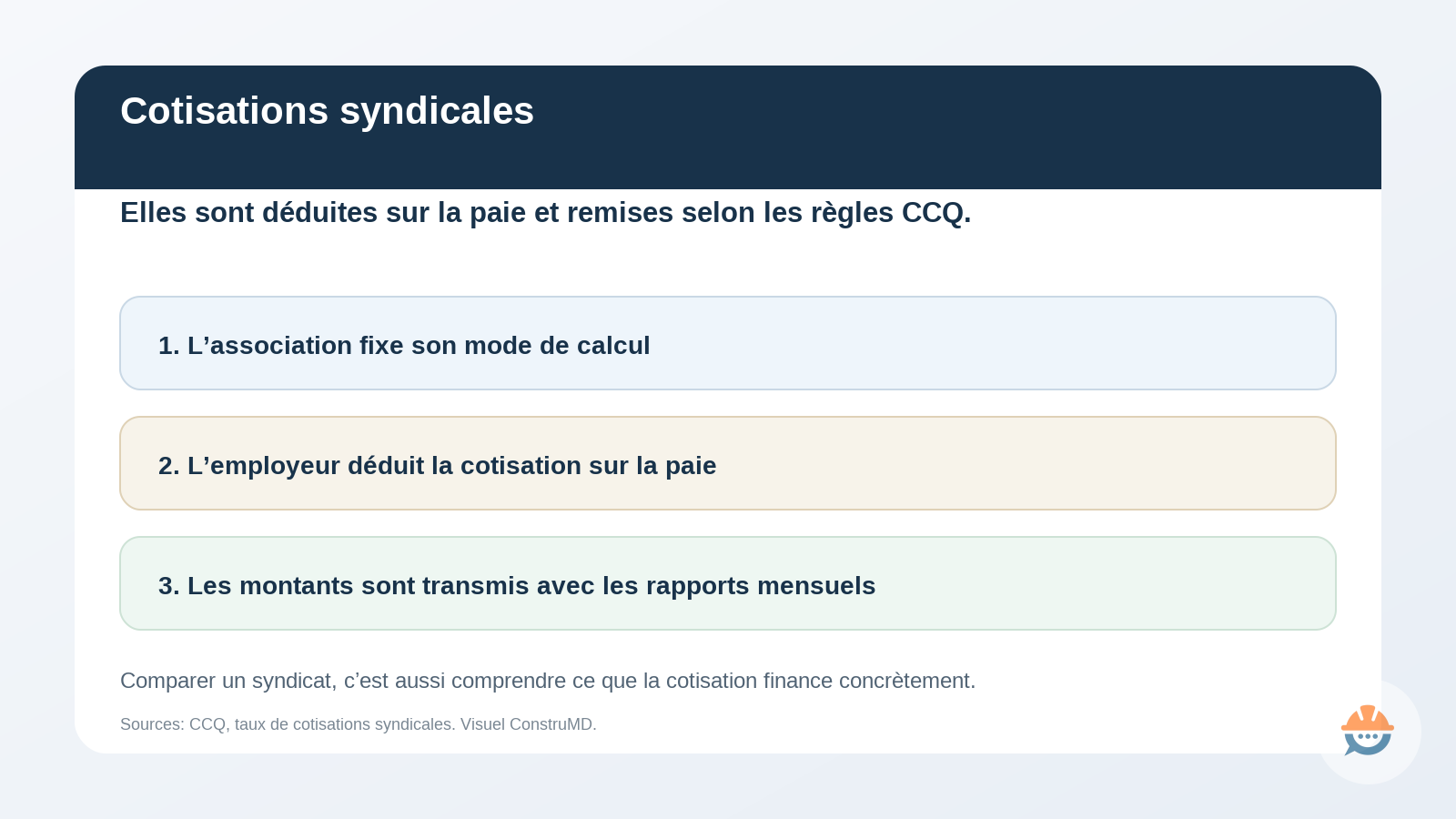
Union dues vary depending on the association, the union or the union, the trade, and the calculation method transmitted to the CCQ. The CCQ page on current union dues rates allows you to consult the calculation methods in effect.
The employer deducts the union dues from the employee's pay and transmits it with their monthly reports. If a worker wants to understand why certain amounts disappear from their gross pay, the union choice is only part of the explanation. Our article on CCQ pay and payroll deductions helps place the dues in the context of the entire pay slip.
A good criterion is the ability to obtain a precise and verifiable answer. A worker should be able to ask: which clause applies? What document needs to be provided? What deadline must be met? Is it a grievance, a CCQ question, a CNESST question, or an internal employer question?
It is also necessary to compare what the association actually offers: support in case of a problem, explanation of agreements, presence on job sites, support for apprentices, union training, information on rights, and the ability to direct to the right resources.
Myth 1: the largest union is automatically the best. Representativeness gives weight in the system, but it does not guarantee the best service for your trade, your region, or your situation.
Myth 2: the cheapest union is always the best choice. Dues matter, but you also need to look at the support offered, the availability of representatives, and the quality of responses.
Myth 3: changing unions solves all problems. Changing associations can sometimes better align a worker with their needs, but it does not change the qualification rules, collective agreements, employer obligations, or legal limits.
Myth 4: the union alone decides working conditions. Collective agreements result from a negotiation and ratification process within the industry system. The representativeness of associations influences their weight, but the system remains governed by Law R-20.
Before choosing or wanting to change associations, a worker should ask what problems they want to avoid or solve. Is it a pay issue? Layoff? Mobility? Compliance with the agreement? Health and safety? Trade? Region? The right choice often depends on the nature of the need.
It is also important to talk to more than one source. Job site opinions are useful for getting a feel for the ground, but they can be very polarized. A worker benefits from consulting official sites, calling associations, asking for examples of services, checking dues, and seeing who clearly answers their questions.
The construction industry is experiencing a period of high pressure: labour shortages, mobility, more complex job sites, salary expectations, difficult recruitment, and tight collective bargaining. In this context, workers want to know who truly represents them and what they get in return for their dues.
For employers, this topic also matters. Understanding the role of associations helps better manage labour relations, union declarations, payroll deductions, and communications with workers. In a market where recruitment in construction remains a major issue, clarity avoids many unnecessary frustrations.
The best union is not the same for everyone. The right choice is the one that provides the worker with the most useful support in their trade, region, and job site realities, with understood dues and clearly explained services.
Official representativeness, dues, local presence, trade knowledge, quality of responses, and support in case of problems are the most concrete criteria to compare.
For a worker, the winning reflex is simple: don't choose based solely on rumours. Check official sources, talk to associations, understand the contributions, and ask specific questions before deciding.
You might like
ConstruMD
Nov 18, 2026

ConstruMD
Nov 15, 2026

ConstruMD
Nov 11, 2026