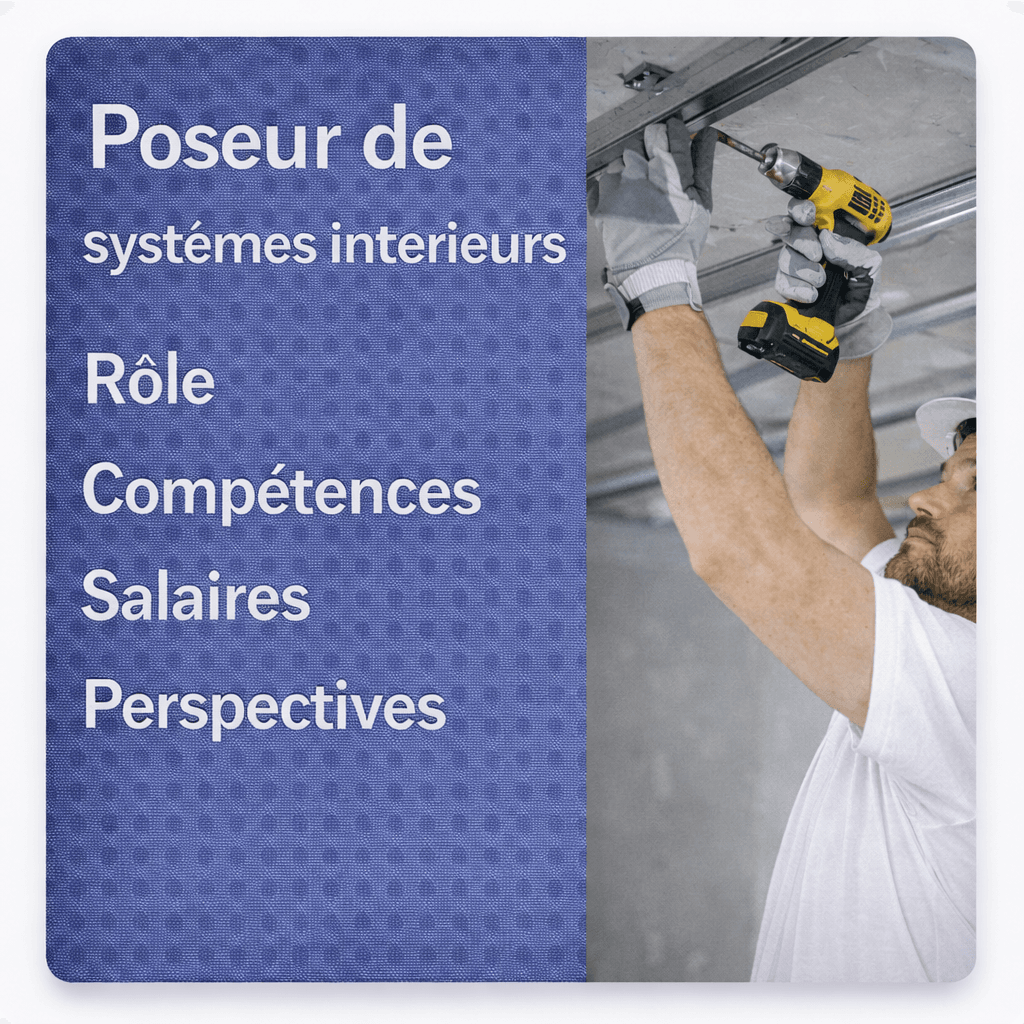
Interior Systems Installer: Training, Salary, Tasks
ConstruMD
Nov 5, 2026
All Posts
SHARE THIS POST
Published : November 5, 2026
The job of an assembler-fitter is tangible: you manufacture, assemble, and fit steel components that hold up buildings, walkways, stairs, guardrails, mezzanines, and a good part of the "skeleton" seen on construction sites.
In Quebec, it’s a job that requires a cool head, precision, and true safety discipline, especially when working at heights and rigging becomes critical. If you like when "things move forward," are comfortable with tools, plans, and teamwork, you're in the right lane.
To see available positions and regions hiring, check out the listings for assembler-fitter. If you're still exploring, the page on construction trades and occupations in Quebec helps compare similar roles, and you can also take a look at construction salaries in Quebec to understand the differences between sectors and levels.

A typical day alternates between preparation, assembly, and control: reading plans, taking measurements, installing parts (beams, columns, bracing, architectural elements), adjusting, bolting, sometimes welding depending on tasks, then final verification (plumb, alignment, level, tightening, stability).
Depending on the site, you may be:
On a steel structure of a commercial or industrial building
On more "civil" works (walkways, specific components)
On architectural elements (stairs, guardrails, canopies)
In a workshop or preparing parts before installation

Read and interpret plans and shop drawings
Prepare and handle steel parts and prefabricated components
Install, align, and assemble structural and architectural elements
Perform bolting and assembly adjustments
Participate in rigging and lifting maneuvers with the team
Verify assembly compliance (measurements, alignment, tightening, stability)
Apply safe work methods at heights and around lifts
| Aspect | Task Examples |
|---|---|
| Safety | Harnesses and anchor points, exclusion zones, lifting signals, visual inspection of slings and accessories |
| Operations | Plan reading, marking, assembly, alignment, bolting, adjustments, final control |
| Administration | Site notes, corrective follow-up, coordination with foreman and other trades |
The most direct path is through vocational training focused on structural and architectural assembly, which specifically prepares for the work of an assembler-fitter on sites: Structural and Architectural Assembly.

Then, access and progression in the trade are achieved through competency certificates and industry apprenticeship: competency certificates, with typical steps for apprentices: apprentice competency certificate.
| Stage | What to Expect |
|---|---|
| Basic Training | Learn plan reading, assembly methods, assembly, safe handling of parts |
| Entry into the Industry | Procedures and access conditions depending on the path, then integration on sites |
| On-the-Job Training | Progression through apprenticeship periods, mentoring, gaining autonomy |
| Qualification | When requirements are met, transition to journeyman status according to applicable rules |
Job details and typical tasks (CCQ youth): Assembler-Fitter
CCQ job sheet (PDF): Assembler-Fitter / Assembler-Fitter
Fall prevention and field practices (ASP Construction): Fall Prevention

| Level | ICI ($/h) | Residential ($/h) |
|---|---|---|
| Journeyman | 48.87 | 45.36 |
| Apprentice period 1 | 29.32 | 27.22 |
| Apprentice period 2 | 34.21 | 31.75 |
| Apprentice period 3 | 41.54 | 38.56 |
Want to see all the CCQ rates from the 2025–2028 agreement (official dates + amounts) for this trade?
Check out our complete reference: CCQ Rate Chart 2025–2026
If you're comparing offers, pay attention to the sector (ICI vs residential), the type of site (structural, architectural, industrial), and the actual responsibilities on the ground (rigging, height, team leadership). On some projects, employers also offer hour stability: if that's important to you, see how to find a 150-hour guarantee in construction and what to check before committing.
The prospects are strong for the trade, especially because demand remains steady and workforce replacement is a significant factor. In other words, teams that can assemble cleanly, safely, and efficiently are in demand.
Cool-headedness and safety discipline
Attention to detail (alignment, level, tightening, compliance)
Good communication (signals, coordination, teamwork)
Ability to keep pace without skipping steps
Consistency: "do the same, but well, all day long"
Reading plans, shop drawings, markers, and measurements
Structural and architectural assembly (placement, adjustment, bolting)
Rigging knowledge and coordination with lifts
Safe use of tools and construction site equipment
On-site quality control (plumb, alignment, practical tolerances)
Advantages
Visible result: you see the structure actually rise
Strong teamwork: coordination, mutual support, rhythm
Technical trade with rapid progression when you are reliable
Disadvantages
Physically demanding, often at heights and exposed to weather conditions
Zero tolerance for improvisation: a mistake can be costly (or cause injury)
Production pressure on some sites: quality must be maintained
Never sacrifice safety to "save two minutes": in assembly, it always costs more later.
Develop an inspection routine: harness, anchorage, tools, rigging accessories, and "work zone."
Be the person who communicates clearly: a good signal and a good call prevent many problems.
Take the time to understand the plans: if you understand the intent, you assemble faster and cleaner.
If you want to take on more responsibility: become solid on alignment, bolting, and coordination with the crane.
It's very close, but the trade also covers the assembly of architectural elements (stairs, railings, canopies) in addition to structural.
Yes. A large part of the work is done at heights, often with movement on the structure. Safety and good practices are non-negotiable.
Generally, tasks that require more autonomy, precision, coordination with lifts, and on-site responsibilities are better valued. The sector and type of site also matter.
Often yes, but it depends on projects and regions. Reliable and safe teams find new placements more easily when a site ends.
It exists depending on the companies, but the core of the trade in construction remains assembly and erection on site. Many do a mix depending on the season and contracts.
Being punctual, listening, following instructions, quickly learning the safety routine, and being consistent in quality (measurements, alignment, tightening).
Not necessarily everywhere, but understanding the basics of metalwork and assembly realities helps a lot. Tasks vary depending on the sites and the company's organization.
The sector (ICI or residential), the type of projects, the stability of hours, expectations in height/rigging, the on-site team, and how safety is managed daily.
You might like
ConstruMD
Nov 5, 2026

ConstruMD
Nov 5, 2026

ConstruMD
Nov 5, 2026