
Harness and Aerial Platform: The Rule in Quebec
ConstruMD
Nov 5, 2026
All Posts
SHARE THIS POST
Published : November 5, 2026
Since September 8, 2026, the second phase of the Regulation on Payments and Rapid Dispute Resolution in Construction Work has been in effect in Quebec. For many general contractors, subcontractors, and suppliers involved in public contracts, this change is significant: more contracts are now subject to a mandatory payment schedule and a rapid dispute resolution mechanism.
The topic may seem administrative, but it directly affects companies' cash flow, the ability to pay teams, the relationship between clients, contractors, and subcontractors, and the management of changes during construction. In an industry where payment delays can create a domino effect, understanding the timelines becomes an operational issue.
Here is a simple explanation of what changes, what existed before, the contracts affected, key dates, and the reflexes to adopt.
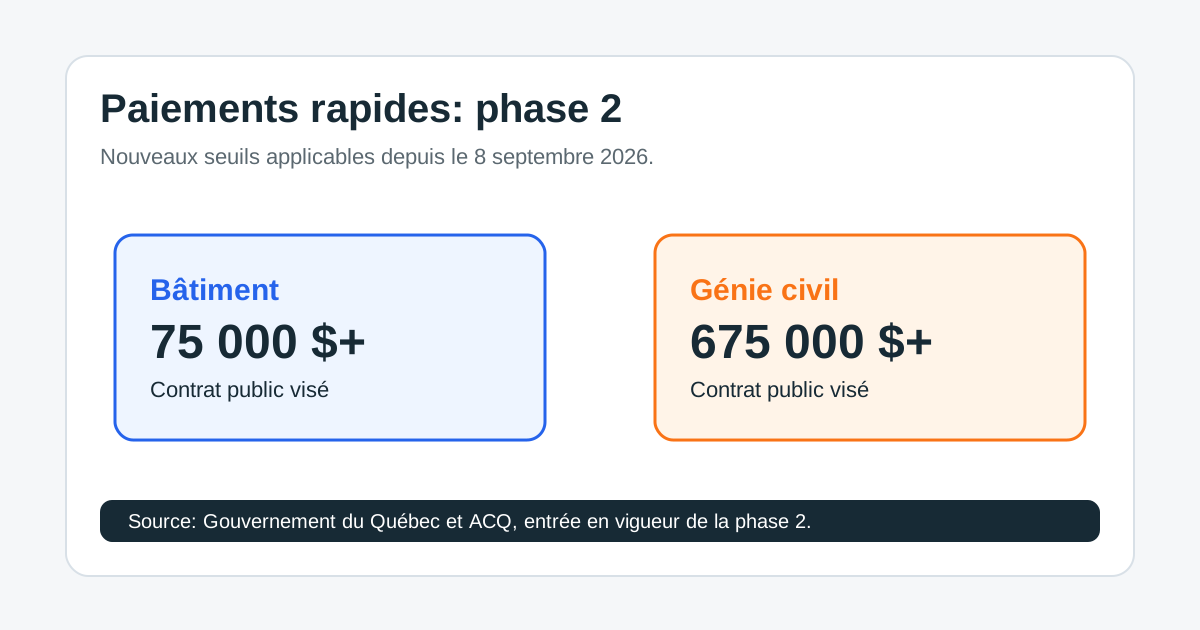
Phase 2 expands the number of public construction contracts subject to the regime. According to the reminder published by the Quebec Construction Association, since September 8, 2026, the regime notably targets contracts concerning a work related to a building involving an expenditure equal to or greater than $75,000, as well as civil engineering contracts, other than those related to a building, involving an expenditure equal to or greater than $675,000.
The difference is significant because the thresholds were much higher during the first phase. Since September 8, 2025, phase 1 notably targeted public building contracts of $750,000 and more and civil engineering contracts of $2,500,000 and more. By lowering the thresholds, phase 2 brings many more projects into the regime.
The Government of Quebec presents this regulation as a framework for rapid payments and rapid dispute resolution for construction work contracts. The official text is available on Légis Québec.
Construction often operates with a contractual chain: public body, general contractor, subcontractors, other subcontractors, and suppliers. If payment is blocked at the top of the chain, the effect can quickly trickle down. A subcontractor may wait, then delay their own payments, then create pressure on payroll, materials, or the ability to take on other contracts.
The regulation aims to make payment more predictable. It governs the submission of payment requests, payment deadlines, payment refusals, certain withholdings or deductions, and recourse to an accredited third-party decision-maker when an eligible dispute arises during the execution of the work.
The simplification is straightforward: the goal is not to guarantee that every claimed amount will be paid without discussion. The goal is rather to prevent payments or disputes from remaining blocked for too long without a framework, without detailed reasoning, and without a fast resolution path.
Before the regulation, Quebec conducted a pilot project aimed at facilitating payment in the construction industry for public contracts and related public subcontracts. This pilot project began on August 2, 2018, and ended on August 1, 2021. It primarily tested a mandatory payment schedule and a dispute resolution process with an expert intervener.
The current regulation adopts this logic but within a broader regulatory framework. Since 2025, it has been applied progressively by phases according to the value and nature of the contracts. Phase 2 is therefore a transition step between the large contracts initially targeted and the more general application planned for the third phase.
The third phase is scheduled for September 8, 2027. From that date, according to the ACQ reminder, the regime should apply to all construction work contracts covered by the regulation.
Phase 2 primarily affects construction work contracts on behalf of public bodies that reach the new thresholds. It therefore concerns general contractors contracting with these bodies, but also subcontractors directly or indirectly linked to these public contracts.
This point is important. A subcontractor may not sign directly with the public body but still be in the contractual chain of a targeted public contract. They must therefore understand their own payment request deadlines, the applicable payment deadlines they are awaiting, and the rules surrounding a refusal or withholding.
Companies that mainly work in the private sector should not too quickly conclude that the regime applies to all their contracts. The regulation targets public contracts covered by the applicable framework. When a contract is mixed, complex, or linked to a subcontracting chain, the specific contractual situation must be validated.
The regulation governs the date on which a payment request must be submitted. According to the official text on Légis Québec, the contractor party to a targeted public contract submits their payment request on the 1st day of the month. The subcontractor directly or indirectly linked to a targeted public contract must submit their request no later than the 25th day of the month.
These dates change the administrative discipline on construction sites. A contractor or subcontractor who still treats their payment requests as a simple invoice sent when the file is ready risks missing an important deadline.
In practice, the request must be prepared before the due date. Quantities, changes, supporting documents, work orders, photos, approvals, breakdowns, and evidence must be organized early enough to avoid submitting an incomplete or disputable file.
The ACQ reminder summarizes the basic deadlines. The public body must make the payment no later than the last day of the month in which it received the payment request. The general contractor must pay no later than the 5th day of the second month following the month in which it received the request. The subcontractor must pay no later than the 10th day of the second month following the month in which it received the request.
The logic is to move the payment down the chain with more predictable dates. However, this requires good internal management. If the company receives a payment request, lets it sit, and then discovers too late that it wants to refuse part of it, it risks missing its own deadline or poorly documenting its refusal.
For companies already under pressure with their workforce, financial predictability becomes a stability factor. In a market where team planning is already difficult, as shown in the ConstruMD article on CCQ Outlook 2026-2030, better control of payments can help prevent cash flow problems from turning into site issues.
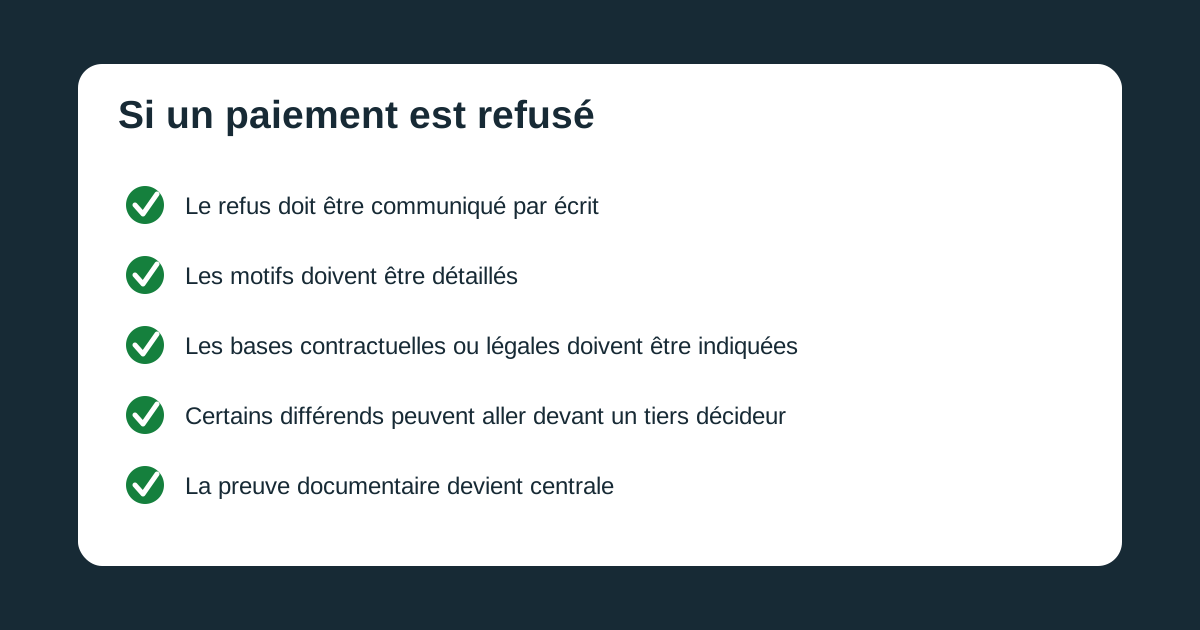
The regulation does not state that a debtor must pay everything requested without the possibility of discussion. Instead, it frames how to refuse, retain, or deduct an amount. The regulatory text specifically provides that the reasons supporting the refusal must be detailed enough to allow for their assessment, and that the contractual or legal provisions used must be indicated when applicable.
In practice, a vague refusal like "non-compliant," "to be verified," or "disputed amount" may not suffice if the case goes further. It is necessary to explain what is refused, why, on what basis, and for what amount.
This requirement also changes how work is documented. Photos, reports, site notices, directives, change orders, measured quantities, emails, and minutes become essential pieces. A payment dispute is rarely won with a general impression. It is defended with clear evidence.
An important point of the regulation concerns work resulting from a change in the scope or conditions of contract execution. The regulation provides that a public body cannot refuse to pay the claimed amount for this work solely because the value of the change had not yet been agreed upon or determined at the time of the payment request.
If the public body disagrees with the estimated value of the change, it can refuse to pay the portion that exceeds the amount it estimates and breaks down according to the applicable framework. The nuance is important: disagreement over the value of a change should not automatically block the entire request.
For contractors, this reinforces the importance of properly breaking down changes. A request that distinguishes basic work, changed work, quantities, evidence, and estimated amounts will be more solid than a global claim that is difficult to analyze.
The regulation provides for a quick and confidential dispute resolution mechanism by an accredited third-party decision maker. The Government of Quebec explains that this mechanism allows contractors, subcontractors, and public bodies to obtain quick decisions when disputes arise during the execution of work.
This mechanism should not be confused with a full trial. Its objective is to obtain a quick decision to prevent the dispute from blocking the progress of the site or the payment chain. Therefore, the parties must be ready to present a clear, structured, and documented case.
For a company, the best preparation begins before the conflict. A clear contract, complete payment requests, organized evidence, documented changes, and written communication reduce the risk of facing a third-party decision maker with an incomplete file.
Affected companies should review their administrative schedule. The 1st and 25th should not be treated as last-minute reminders. They must be integrated into project management, accounting, work approval, and coordination with subcontractors.
Invoice and payment request templates should also be reviewed. Even if some government-proposed forms are not mandatory, they can serve as a reference to structure the information. A payment request should allow the debtor to quickly understand what is being claimed, for which work, during which period, and with what supporting documents.
Finally, site managers should know what to document during the month. Accounting cannot recreate on its own the evidence of a change, delay, directive, or executed work. The quality of the file depends on what has been captured on the ground.
Subcontractors should first verify if their contracts are linked to a targeted public contract. They should then confirm the submission dates, document requirements, refusal mechanisms, and applicable payment deadlines in their contractual chain.
They should also pay particular attention to scope changes. Extras, urgent work, verbal directives, and site adjustments are often at the heart of disputes. A subcontractor who poorly documents their changes may lose time, even in a system designed to speed up payments.
The reflex to adopt is simple: request in writing, confirm in writing, document with photos or reports, break down the amounts, and submit on time. This is not just good administrative practice. With the regulation, it becomes commercial protection.
Fast payments are not just a matter for the office. Project managers, superintendents, and foremen can directly influence the quality of a payment request. They know what has been done, what has changed, what is disputed, and what remains to be corrected.
If site information arrives too late to administration, the company risks submitting an incomplete request or poorly responding to a refusal. Conversely, if the field documents key steps during the month, the payment file becomes more robust.
This discipline aligns with the general management of a construction company. To recruit and retain good workers, an organization must also keep its commitments and reduce unnecessary tensions. The ConstruMD article on how to recruit skilled labour reminds us that an employer's operational credibility is as important as their rhetoric.
Since September 8, 2026, phase 2 of the Quebec rapid payment regime significantly expands the targeted public construction contracts. The thresholds drop to $75,000 for certain building contracts and $675,000 for certain civil engineering contracts.
The regulation imposes a more structured logic: fixed-date payment requests, payment deadlines in the contractual chain, written and justified refusals, regulation of holdbacks and deductions, and the possibility of rapid resolution of certain disputes by a third-party decision-maker.
For contractors and subcontractors, the message is clear: payments must be managed as part of the project. Dates, evidence, changes, and communications must be rigorously tracked. This regulation does not replace contracts or legal advice, but it changes the expected discipline around payments in the targeted public contracts.
You might like
ConstruMD
Nov 5, 2026
ConstruMD
Nov 5, 2026
ConstruMD
Nov 5, 2026