CCQ Retirement: When Can You Transfer Your Fund to a LIRA?
ConstruMD
Nov 5, 2026
All Posts
SHARE THIS POST
Published : November 5, 2026
The short answer is clear: a worker who remains employed, takes the scheduled construction holidays, and receives the accumulated vacation pay is not entitled to regular employment insurance benefits for this period.
A worker can receive employment insurance during the construction holidays only if they have experienced a genuine layoff or job termination without being at fault, meet all eligibility conditions, and are genuinely available to accept another job.
In other words, the normal closure of sites for holidays does not automatically create a right to unemployment benefits. What determines the right is the worker's actual employment situation.
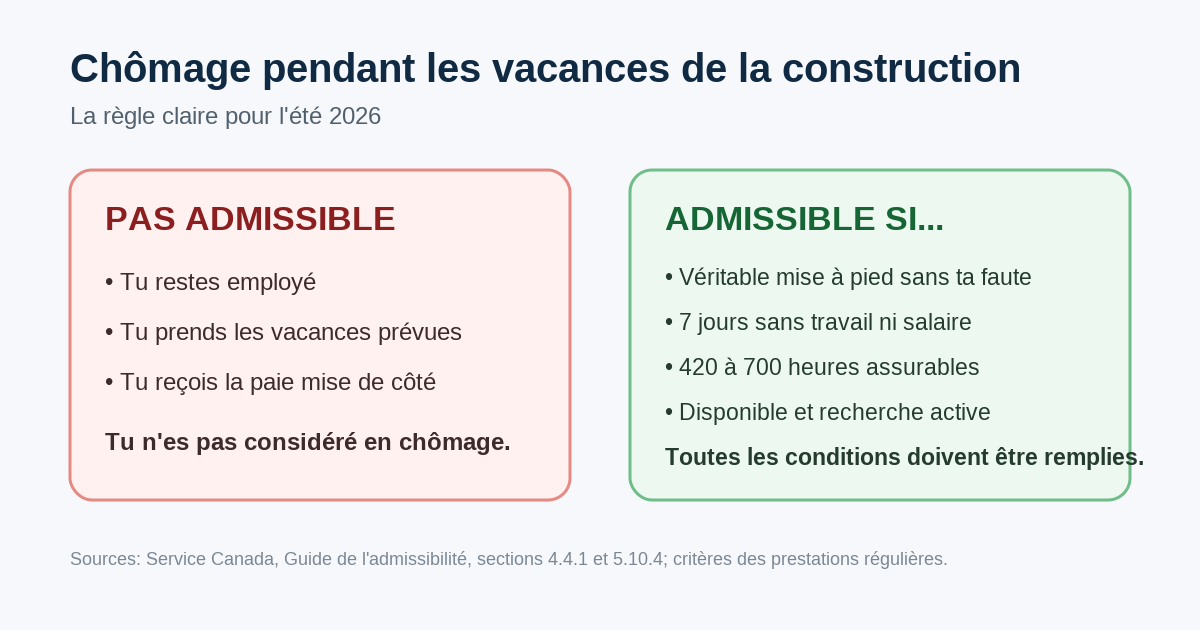
The Service Canada Eligibility Determination Guide specifies that a person is not considered unemployed during their company's annual closure when three conditions are met:
First condition: the worker takes a vacation period in accordance with the agreement with their employer.
Second condition: they remain employed by that employer during the leave.
Third condition: they have received the vacation pay set aside for this period, regardless of the exact payment date.
When these three conditions are present, the answer is no: the period is not recognized as an unemployment period for employment insurance purposes.
This rule was clarified in the Guide in 2026 following a decision by the Federal Court of Appeal. It directly applies to the usual functioning of construction holidays in Quebec.
If the employment continues, the site closes for mandatory holidays, and the worker must resume their position after the closure, it is not a genuine job loss. The worker is on vacation, not unemployed.
Not working for two weeks is not enough. Employment insurance does not pay simply because the site is closed.
The CCQ administers the allowances paid by employers for mandatory annual leave, statutory holidays, and sick leave. These amounts represent 13% of the earned salary: 6% for annual vacations, 5.5% for statutory holidays, and 1.5% for sick leave.
For summer 2026, the CCQ paid the allowances on June 19, 2026. The mandatory summer holidays run from July 19, 2026, at 12:01 a.m. to August 1, 2026, at midnight.
Receiving this payment does not entitle one to employment insurance. When the worker remains employed and takes the scheduled holidays, they are not considered unemployed during this period.
A person who requests voluntary leave or decides not to work when a job remains available does not meet the condition of having lost their job without being at fault.
They are therefore not eligible for regular benefits to fund their leave.
To receive regular benefits, one must be able to work, available to do so, and actively seeking employment. A worker who goes on a trip and cannot quickly accept a job does not meet this requirement for the days concerned.
A person who is outside Canada is generally ineligible for regular benefits, except in certain specific situations provided by the rules. Personal vacations abroad do not constitute a job search.
Even after a genuine layoff, the right is not automatic. One must have accumulated between 420 and 700 hours of insurable employment during the reference period. The exact number depends on the unemployment rate in the region where the worker resides.
Without the required number of hours, no regular benefits claim can be established.
The eligible worker is one whose employment has genuinely ended for a reason beyond their control, such as a lack of work, end of a project, or a real layoff, and not simply the annual closure for holidays.
They must then meet all other employment insurance conditions.
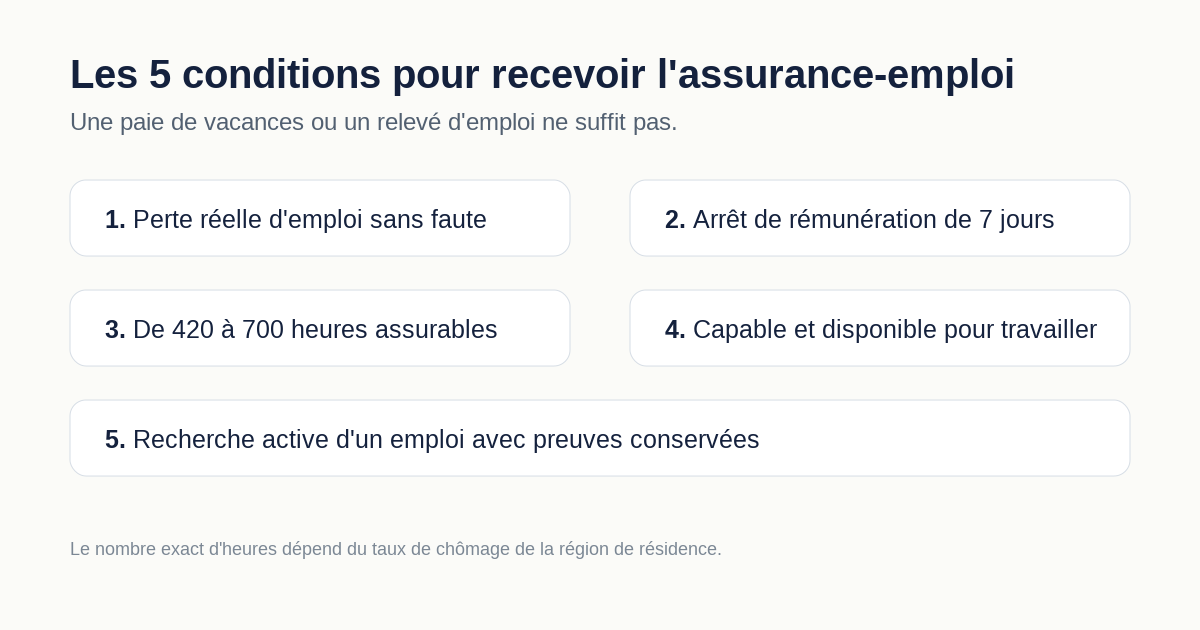
The layoff must be real. The worker no longer has work due to a lack of work, end of a project, reduction in activity, or another situation they did not cause.
An employer cannot transform simple scheduled holidays into a layoff solely by issuing a record of employment. Service Canada examines the facts: does the employment continue, is a return planned, and does the period correspond to the agreed holidays?
The worker must have experienced an interruption of earnings: at least seven consecutive days without work and without pay from that employment.
The record of employment should normally be issued when such an interruption occurs. This document is important, but it does not alone guarantee eligibility.
The number of required hours is calculated based on the unemployment rate in the area of residence. The official page on eligibility for regular benefits allows you to check the applicable threshold with the postal code.
The reference period generally corresponds to the 52 weeks preceding the application or the period since the start of a previous application, whichever is shorter.
The worker must be able to accept a job. It is not enough to be technically unemployed. One must be ready to work and not impose conditions that reasonably prevent hiring.
Simply waiting to return to the former employer without looking elsewhere can fail this condition.
The worker must conduct a genuine job search and keep evidence: companies contacted, dates, positions targeted, applications sent, and follow-ups made.
Construction job offers with a guarantee of 150 hours can be part of this search when they match the trade, apprenticeship level, and region of the worker.
No. The CCQ vacation cheque does not automatically prevent a person who is genuinely laid off from receiving employment insurance.
The Service Canada Guide specifies that amounts held in trust and paid during general vacations, particularly in the construction industry in Quebec, do not constitute remuneration at the time of payment due to their fiduciary nature.
The distinction is important. For a worker who remains employed and takes the planned vacation, the refusal comes from the fact that they are not considered unemployed. For a worker whose employment has truly ended, the vacation pay held by the CCQ does not automatically destroy their eligibility.
However, amounts received must still be declared when Service Canada requests it. It is Service Canada that applies the correct allocation rule.
Marc finishes his week on July 17. His employer closes during the construction holidays and confirms his return on August 3. Marc receives his CCQ vacation pay.
Result: Marc is not entitled to regular benefits for the two weeks of vacation. His employment continues, and he takes the planned vacation period.
Julie finishes a project on July 10. Her employer has no more work for her and does not promise any return date. A record of employment is issued for lack of work. Julie has the required number of hours, remains available, and sends applications.
Result: Julie may be eligible for benefits, including during the construction holiday period. Her situation is a real layoff, not just an annual leave.
Alex receives a record of employment, but his employer asks him to return immediately after the vacation. The closure corresponds to the annual vacation, and Alex has received the set-aside pay.
Result: the record of employment is not enough. Alex is not considered unemployed if the employment remains in effect and the period is the planned vacation.
The application for regular benefits must be made as soon as work stops. It is not necessary to wait for the record of employment.
Waiting more than four weeks after the last day of work can result in losing weeks of benefits.
The worker must check in My Service Canada Account that the record of employment has been submitted and that the reason matches the actual situation. In a layoff due to lack of work, the reason used is normally lack of work.
If the record is not produced, the worker must contact their employer, then Service Canada if the problem persists.
The search must start immediately and continue during the claimed weeks. Keeping a clear list of efforts helps demonstrate availability.
The declarations are used to confirm hours worked, earnings, availability, job searches, and other amounts received. An omission can result in a delay, overpayment, or repayment.
For a new application starting between March 30, 2025, and October 10, 2026, the one-week waiting period is waived.
An eligible worker who opens an application during the summer of 2026 does not automatically lose a first week due to the waiting period. However, this measure does not help a person who is not eligible from the start.
In 2026, the base rate generally corresponds to 55% of the average insurable weekly earnings, up to a maximum of $729 per week. Regular benefits can be paid for 14 to 45 weeks depending on the hours accumulated and the regional unemployment rate.
The exact amount is determined by Service Canada after analyzing the application and records of employment.
You return to the same employer after the vacation, your employment continues, and you receive your CCQ vacation pay: you are not entitled to unemployment for this period.
You have truly lost your job before the vacation, through no fault of your own, you have enough hours, you are available, and you are actively seeking work: you can receive employment insurance.
The Record of Employment and the vacation pay cheque do not decide alone. It is the actual end of employment and the fulfillment of all eligibility conditions that decide.
You might like
ConstruMD
Nov 5, 2026

ConstruMD
Nov 5, 2026

ConstruMD
Nov 5, 2026